
Moles vs. Birthmarks: What's Normal and What Warrants a Check

Medically reviewed by Oghenefejiro Okifo | MD, Harvard Medical School | Henry Ford Hospital - Detroit, MI on April 24th, 2026.
Published on April 17th, 2026. Updated on July 23rd, 2026.
Key takeaways
Most adults have 10 to 40 moles, most of which are benign and stable throughout life.
Birthmarks fall into two categories: pigmented (café-au-lait spots, Mongolian spots) and vascular (hemangiomas, port-wine stains).
The ABCDE checklist (Asymmetry, Border, Color, Diameter, Evolving) is the standard tool for self-evaluating a mole.
Additional warning signs include bleeding without injury, persistent itching, crusting, the "ugly duckling" sign, and any new mole appearing after age 40.
Sun protection, monthly self-exams, and annual dermatology screenings (for high-risk individuals) are the core of prevention and early detection.
When a skin spot starts to change or doesn't look like anything else on your body, Doctronic.ai can help you assess your symptoms and decide whether to see a specialist.
What Are Moles?
Most people have spots on their skin they've never thought much about. A cluster of brown dots on the shoulder, a faint blue-gray patch on the lower back, and a bright red bump that appeared in infancy. These marks are common, and the vast majority are completely harmless. But knowing what each one is, and when its appearance should prompt a conversation with a doctor, is genuinely useful information.
Moles are skin growths that form when melanocytes, the pigment-producing cells in your skin, cluster together rather than spread out evenly. They appear after birth, usually beginning to show up in childhood and continuing to develop through about age 35. Most adults have somewhere between 10 and 40 moles, the majority of which appear on skin that gets regular sun exposure: the face, neck, arms, and upper back.
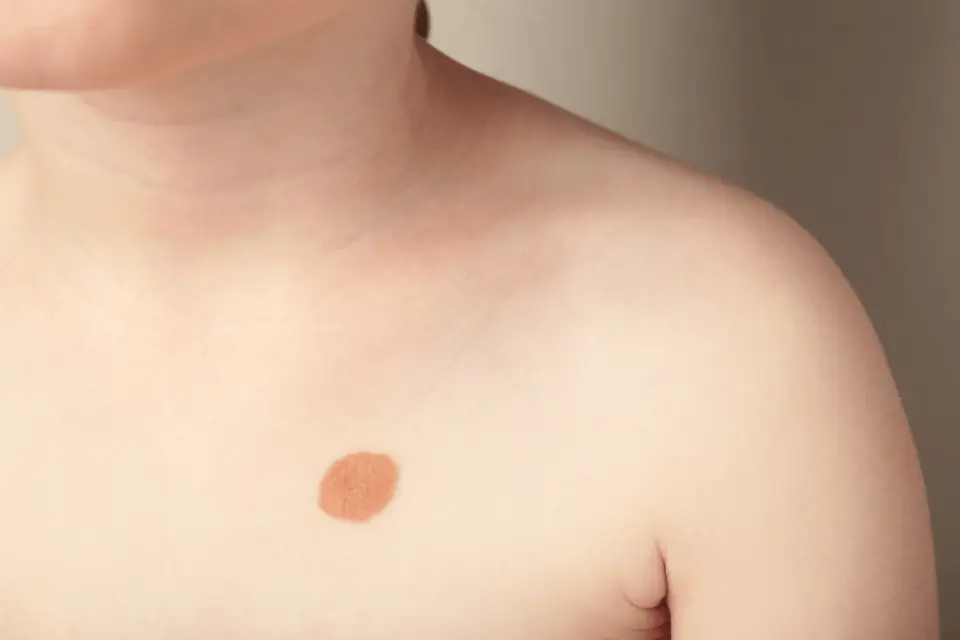
In their typical form, moles are round or oval, evenly colored (tan, brown, or nearly black), and no larger than a pencil eraser. They can be flat or slightly raised. Most stay the same throughout a person's life, though they may gradually lighten or become less prominent with age.
A small percentage of the population, roughly 2 to 8% of Americans, has what are called atypical or dysplastic moles. These are larger than average, have irregular borders, and may display more than one color within the same spot. Having atypical moles doesn't mean cancer is present, but it does mean those moles warrant ongoing monitoring.
What Are Birthmarks?
Birthmarks are marks present on the skin at birth or appearing within the first few weeks of life. They fall into two main categories based on their cause.
Pigmented Birthmarks
Pigmented birthmarks result from an overgrowth of pigment cells in a localized area.
Café-au-lait spots are flat, light brown patches that can appear anywhere on the body. The name comes from French and roughly translates to "coffee with milk," which describes their color accurately. They're common and usually harmless on their own, though a large number of them (typically more than six) can sometimes be associated with a genetic condition called neurofibromatosis.
Mongolian spots, now more often called congenital dermal melanocytosis in clinical settings, appear as blue-gray patches, most commonly on the lower back or buttocks. They're more prevalent in people with darker skin tones, are present from birth, and in most cases fade entirely by adolescence.
Vascular Birthmarks
Vascular birthmarks are caused by abnormal blood vessels near the skin's surface.
Hemangiomas are raised, bright red marks sometimes called "strawberry hemangiomas" because of their appearance. They're not typically present at birth but usually appear within the first few weeks of life and grow rapidly before slowing down. Most hemangiomas shrink on their own and are gone by ages 7 to 10 without any treatment.
Port-wine stains are flat birthmarks that range in color from pale pink to deep red or even purple. Unlike hemangiomas, they are permanent and tend to darken and thicken over time. They appear most often on the face and neck, and some individuals choose to treat them with laser therapy for cosmetic reasons or because of associated health concerns.
ABCDE: The Mole Evaluation Checklist
Dermatologists use the ABCDE checklist as a practical framework for evaluating whether a mole shows signs that should be looked at more closely.
Asymmetry: One half of the mole doesn't match the other.
Border: The edges are ragged, notched, or blurred rather than smooth and defined.
Color: There are multiple shades within the mole (brown, black, red, white, or blue).
Diameter: The spot is larger than 6 millimeters, roughly the size of a pencil eraser.
Evolving: The mole is changing in size, shape, color, or texture, or a new symptom like bleeding or itching has appeared.
No single criterion is a definitive alarm, but any one of them is reason to book a dermatology appointment rather than wait.
See a doctor online today
A licensed doctor can review your symptoms online, talk through next steps, and send a prescription to your pharmacy if appropriate.
- $39 video visit
- Insurance accepted
- 4.8 on Trustpilot
Warning Signs That Go Beyond the Checklist
The ABCDE framework focuses on visual characteristics, but there are other warning signs worth knowing.
A mole that bleeds without any injury, itches persistently, crusts over, or develops a scab should be evaluated. These are signs that something may be happening beneath the surface.
The "ugly duckling" sign is a useful self-examination concept: most moles on a person tend to look similar to each other. A mole that looks noticeably different from all your others, the "ugly duckling" in the group, stands out for a reason and deserves attention even if it doesn't meet the classic ABCDE criteria.
Any new mole appearing after age 40 is worth showing to a dermatologist. While new moles can form throughout life, they become less common as people age, and a spot that appears later in life should be examined.
Melanoma is the most serious form of skin cancer. The American Cancer Society projects approximately 100,640 new melanoma cases in 2026, around 68,000 of which are expected to be invasive. Early detection remains one of the most important factors in treatment outcomes.
What to Do About Birthmarks
Most birthmarks require no treatment at all. They're benign, and for the majority of people, the only decision is whether to leave them alone or pursue cosmetic treatment if they're in a visible location or affect confidence.
Port-wine stains and large congenital melanocytic nevi, a type of pigmented birthmark, may be monitored over time because of a slightly increased risk of changes. A pediatrician or dermatologist can advise on whether any follow-up is appropriate.
If a birthmark changes in color, texture, or size, or if it develops raised areas, irregular edges, or new symptoms, those changes should be brought to a doctor's attention.
Prevention and Monitoring Routines
Sun protection reduces the risk of mole development and lowers the overall risk of skin cancer. Daily use of SPF 30 or higher sunscreen, protective clothing such as wide-brim hats and long sleeves during peak hours, and avoiding tanning beds all reduce cumulative UV exposure.
Monthly self-exams using a full-length mirror and a hand mirror to check hard-to-see areas help build familiarity with what your skin normally looks like. That baseline is what makes it easier to notice something new or changing.
Annual skin screenings with a dermatologist are recommended for people at higher risk: those with a family history of melanoma, a personal history of atypical moles, fair skin that burns easily, or significant past sun exposure. For lower-risk individuals, speaking with a primary care provider about the right screening interval is a reasonable starting point.
Frequently Asked Questions
No. Moles form after birth when melanocytes cluster together, while birthmarks are present at or shortly after birth and result from either an overgrowth of pigment cells or abnormal blood vessels. They have different causes and different patterns of development.
Most moles never become cancerous. However, melanoma can arise within an existing mole or as a new spot on normal-appearing skin. Atypical moles carry a slightly higher risk, which is why they're monitored. Using the ABCDE checklist and reporting changes to a dermatologist is the most reliable way to catch problems early.
Most hemangiomas begin to shrink by around age 1 and continue fading through childhood. The majority are fully gone or significantly reduced by ages 7 to 10. Some may leave behind minor changes in skin texture or color, and in some cases, a doctor may recommend earlier treatment if the hemangioma is near the eye, mouth, or airways.
Sunscreen reduces the cumulative UV exposure that contributes to new mole formation and to melanoma risk. It doesn't guarantee that no new moles will ever appear, but consistent use from childhood onward meaningfully lowers the overall burden of UV damage to the skin.
The term refers to a mole that looks distinctly different from the other moles on your body. Most moles on any one person share a similar general appearance. One that stands out from the rest, in size, color, shape, or feel, is worth having examined even if it doesn't fit the classic ABCDE warning criteria.
New moles can appear through about age 35 and occasionally beyond, but the rate slows with age. A new mole appearing after age 40 should be checked by a dermatologist, since new spots later in life are less common and warrant evaluation to rule out a concerning change.
The Bottom Line
Moles and birthmarks are a normal part of human skin, and the vast majority will never cause any health problems. The difference between something harmless and something that needs attention usually comes down to change: a spot that looks different from how it looked before, or a new mark that doesn't look like anything else on your body, is the one worth bringing to a doctor.
Related articles
Compare your treatment options
Chat Now