
Diseases and Conditions
How to Get Rid of Skin Tags Safely: Home vs. Professional Methods
April 9, 2026
8 min read

Medically reviewed by Alan Lucks | MD, Alan Lucks MDPC Private Practice - New York on May 24th, 2026.
Published on April 17th, 2026. Updated on July 23rd, 2026.
Skin tags are harmless growths made of collagen and blood vessels. They do not need to be removed unless they cause irritation or are cosmetically bothersome.
At-home removal methods range from low-risk (small freezing kits available over the counter) to high-risk (cutting, tying off, or burning). None are appropriate for tags near the eyes, on the genitals, or anywhere the diagnosis is uncertain.
Medical removal by a dermatologist or physician is fast, low-risk, and ensures the lesion is accurately identified before it is destroyed.
Never remove a growth at home if you are not certain it is a skin tag. Moles, warts, and skin cancers can resemble skin tags. To understand how to visually distinguish skin tags from moles and other growths, the guide about moles vs. birthmarks covers the key differences between benign skin lesions.
Doctronic.ai connects you with a licensed physician who can evaluate a skin growth online and advise on safe removal options.
Skin tags (medical term: acrochordons) are soft, flesh-colored growths that hang off the skin on a thin stalk. They are made of collagen fibers and blood vessels surrounded by normal skin. They are entirely benign.
Skin tags appear most often in areas where skin rubs against skin or clothing: the neck, armpits, groin, under the breasts, and on the upper back and chest. They range in size from a few millimeters to about the size of a grape, though most are small.
They are common in adults and become more frequent with age. Obesity and insulin resistance are associated with their development, as is pregnancy. Genetics also plays a role. Skin tags are not contagious and are not caused by any infection.
Most people have skin tags removed because they snag on clothing or jewelry and bleed, or for cosmetic reasons. There is no medical urgency to remove them.
In-office removal of a skin tag is quick and simple: it takes a few minutes, is performed under local anesthesia, and costs between $100 and $500 depending on the provider and the number of tags removed. Insurance rarely covers cosmetic removal.
Because skin tags are benign and the procedures seem simple, many people opt for at-home methods to avoid the cost and inconvenience of a clinic visit. This is understandable, but it carries real risks, particularly when the lesion has not been professionally diagnosed.
Products such as Compound W Freeze Off and similar kits use dimethyl ether and propane to apply a brief burst of cold to small skin tags. The mechanism mimics cryotherapy, where liquid nitrogen kills tissue by freezing it.
These products can work for small skin tags when used as directed. The tag typically darkens, forms a small blister, and falls off within one to two weeks.
Risks include skin irritation or blistering around the treated area, incomplete treatment (leaving a residual base that may need a second application), and accidental application to surrounding normal skin.
These kits are only appropriate for small, clearly identified skin tags on low-risk areas of the body (neck, trunk, arms, or legs). They should not be used near the eyes, on the genitals, or on any lesion that looks different from a typical skin tag.
Some sources recommend wrapping a thin thread or piece of dental floss tightly around the base of a skin tag to cut off its blood supply. The tag is supposed to turn dark and fall off within a few days.
This method does work on paper, but the risks outweigh the convenience for most tags. Applying a thread tightly enough to cut off circulation can be difficult and painful. Infection at the ligation site is a meaningful risk. If the thread slips or loosens, the tag may swell and become more irritated without falling off.
This approach is higher risk than OTC freezing kits and is not recommended.
Cutting a skin tag at its base is the most direct removal method, but it carries the highest risk of the at-home options. Skin tags have a blood supply. Cutting without anesthesia is painful. Bleeding can be significant, especially for larger tags. The wound is open and at risk for infection. And if the lesion is not actually a skin tag, you have now disrupted a potentially important lesion without any pathology.
Medical professionals do remove skin tags by snipping with scissors (called snip excision), but the procedure is performed with proper sterile technique, local anesthesia, and hemostatic tools to control bleeding. These conditions cannot be replicated at home.
Cutting a skin tag at home is not recommended.
Despite widespread online claims, there is no clinical evidence that apple cider vinegar, tea tree oil, or similar products safely or reliably remove skin tags. Repeated application of acidic substances to the skin can cause chemical burns and permanent scarring. These methods should be avoided.
In-office removal options are faster and safer than any at-home method:
Cryotherapy applies liquid nitrogen (which is colder and more precisely controlled than OTC freezing kits) directly to the tag. Most tags fall off within one to two weeks.
Snip excision uses sterile scissors to cut the tag at its base after local anesthesia is administered. Bleeding is controlled with a cotton tip applicator or cautery. Healing takes about a week.
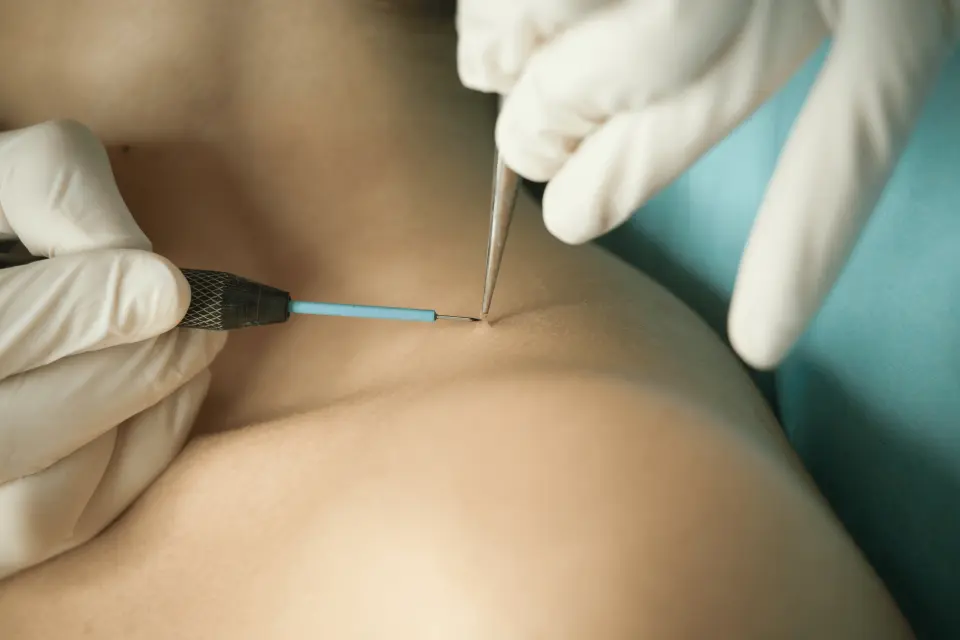
Electrocautery uses a low electrical current to destroy the tag tissue. It is fast and leaves minimal scarring.
Laser removal is less commonly used for skin tags, but it is an option at some dermatology practices.
All of these are performed in under 15 minutes. Local anesthesia means the procedure itself is painless. The main trade-off relative to at-home methods is cost and a clinic visit.
See a physician before attempting any removal if:
The growth looks different from a typical skin tag. Moles can have a stalked appearance. Warts can look flesh-colored and soft. Certain types of basal cell carcinoma can appear as small flesh-colored nodules. Removing an undiagnosed lesion at home destroys the tissue and eliminates the option of performing a biopsy.
The tag is near the eye (on the eyelid) or in the genital area. These locations require professional care due to the sensitivity of the surrounding tissue.
The growth has changed recently, is bleeding without provocation, or has an irregular surface, multiple colors, or an unusual border.
You have a bleeding disorder or take blood thinners. Even minor procedures can cause significant bleeding in these situations.
A skin tag that is fully removed at the base does not grow back. New skin tags can develop in the same general area over time, but they are new growths rather than regrowth of the removed tag.
Occasionally a very small skin tag twists on its stalk, cuts off its own blood supply, and falls off. This is not common and not predictable. Most skin tags are permanent unless treated.
A small amount of bleeding when a skin tag is snagged on clothing or jewelry is normal. A skin tag that bleeds repeatedly without provocation, or bleeds heavily, should be evaluated by a physician to confirm the diagnosis.
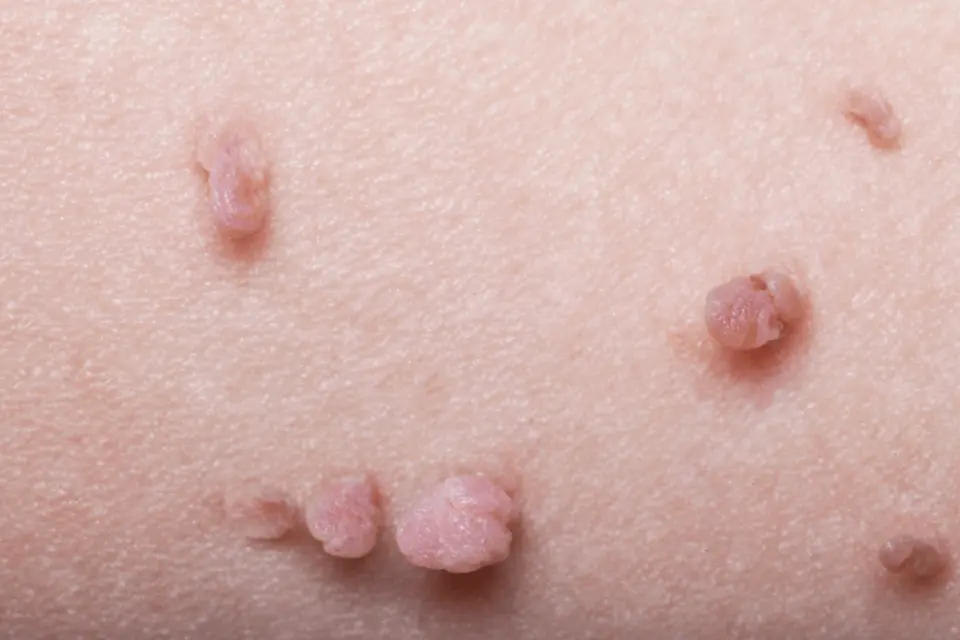
Skin tags hang off the skin on a thin stalk and are usually flesh-colored or slightly darker. They are soft and move when touched. Moles sit flat against or slightly raised from the skin and are firmly attached. Most moles are uniformly pigmented (brown, tan, or black). If you are uncertain, have a physician look at it before attempting any removal.
At-home removal can be uncomfortable to painful, particularly cutting or tying methods. In-office removal with local anesthesia is painless during the procedure. You may feel a brief sting from the anesthetic injection, and the area may be mildly sore for a day or two afterward.
Skin tags are more common in people with insulin resistance and type 2 diabetes, and multiple skin tags may occasionally prompt a doctor to screen for blood sugar problems. However, having skin tags does not mean you have diabetes. Many people with skin tags have completely normal blood sugar.
Skin tags are harmless, and removal is optional. OTC freezing kits are the safest at-home method for small, clearly identified tags. Cutting, tying, or acidic remedies pose a greater risk than the problem itself. For any growth that is changing, bleeding, or near a sensitive area, see a physician first.
Doctronic.ai lets you connect with a licensed physician online to evaluate a growth and discuss removal options.
Get skin care advice
Chat Now
Join 50,000+ readers using Doctronic to understand symptoms, medications,
and next steps.
Add your phone number below to get health updates and exclusive VIP offers.
By providing your phone number, you agree to receive SMS updates from Company. Message and data rates may apply. Reply “STOP” to opt-out anytime. Read our Privacy Policy and Terms of Service for more details.
Save your consults. Talk with licensed doctors and manage your health history.