
What Does Melanoma Actually Look Like? Dermatologists Explain

Medically reviewed by Alan Lucks | MD, Alan Lucks MDPC Private Practice - New York on May 23rd, 2026.
Published on April 17th, 2026. Updated on July 24th, 2026.
Key takeaways
Melanoma affects approximately 100,640 people in the U.S. annually, making early detection critical for survival
The ABCDE method helps identify suspicious moles: Asymmetry, Border irregularity, Color variation, Diameter over 6mm, and Evolution over time
Melanoma can appear in unexpected places, including under fingernails, on palms, soles, and even as colorless lesions
The "ugly duckling" sign helps spot moles that look different from others on the body
Regular skin checks and professional exams save lives by catching melanoma early
Doctronic.ai offers free AI doctor visits to help assess skin concerns before seeing a specialist
Understanding Melanoma and Why Early Detection Matters
A small dark spot appears on the skin. Most people ignore it, assuming it's just another freckle or mole. But that spot could be melanoma, the deadliest form of skin cancer. Dermatologists see this scenario constantly, and they want everyone to understand exactly what melanoma looks like because early recognition dramatically improves survival rates.
Melanoma develops in the cells that give skin its color. Unlike other skin cancers, it can spread quickly to other parts of the body if not caught early. The good news: when detected before it spreads, the five-year survival rate exceeds 99%. This is why knowing what melanoma actually looks like matters so much.
Regular daily use of an SPF 30 or higher sunscreen reduces the risk of developing melanoma. Prevention works, but so does vigilance. Understanding the visual signs of melanoma helps people catch suspicious spots before they become dangerous.
The ABCDEs of Identifying Suspicious Moles
Dermatologists developed the ABCDE system to help people remember what to look for during self-examinations. This simple framework has saved countless lives by giving non-experts a reliable way to spot potential problems.
Asymmetry and Irregular Borders
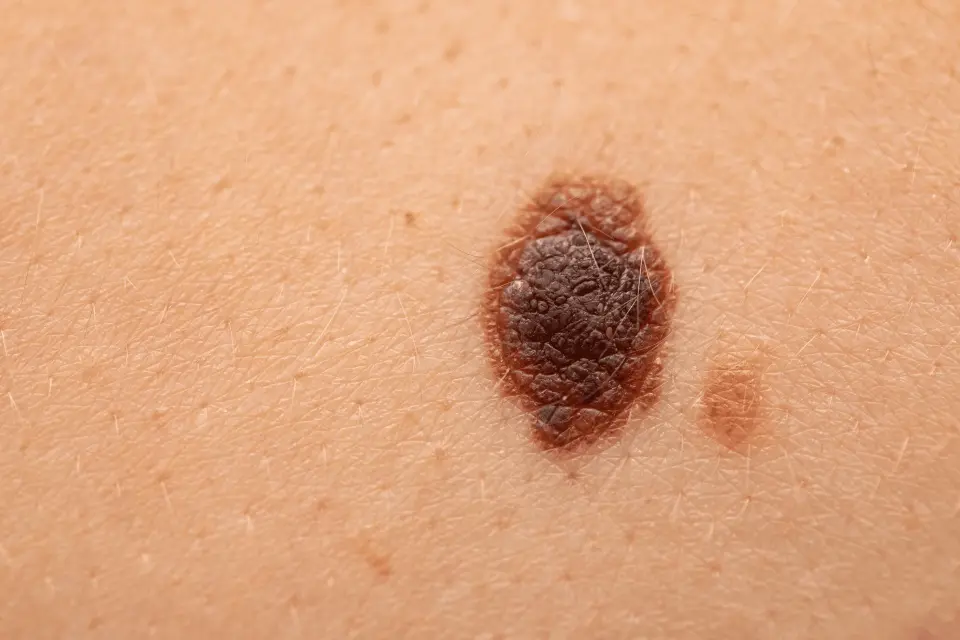
Normal moles are typically round or oval with smooth edges. When examining a mole, imagine drawing a line through its center. If the two halves do not match, that asymmetry warrants attention.
Border irregularity is equally telling. Healthy moles have clean, well-defined edges. Melanoma frequently displays ragged, notched, or blurred borders that seem to fade into surrounding skin. These irregular edges occur because cancer cells grow unevenly.
Color Variations and Increasing Diameter
A single mole containing multiple colors raises concern. Normal moles are usually one uniform shade of brown. Melanoma often shows a mixture of brown, black, red, white, or blue within the same lesion. Some spots may have areas that appear lighter than others.
Size matters too. While melanoma can be smaller, most are larger than 6mm in diameter, roughly the size of a pencil eraser. Any mole that grows larger than this threshold deserves professional evaluation.
Evolution: Tracking Changes Over Time
Of the five criteria, evolution is considered the most important factor when identifying potential melanoma. Any mole that changes in size, shape, color, or elevation should be examined by a dermatologist.
New symptoms like itching, bleeding, or crusting also indicate evolution. Taking monthly photos of suspicious moles helps track subtle changes that might otherwise go unnoticed. Doctronic.ai can help assess whether changes in a mole warrant an in-person dermatology visit.
Visual Variations: What Different Types of Melanoma Look Like
Melanoma does not have one single appearance. Different types present differently, which is why understanding the variations helps with early detection.
Superficial Spreading Melanoma
This is the most common type, accounting for about 70% of cases. It typically appears as a flat or slightly raised discolored patch with irregular borders. The colors often include shades of tan, brown, black, red, blue, or white.
Superficial spreading melanoma grows outward across the skin surface before penetrating deeper layers. It commonly develops on the trunk in men and on the legs in women. This type often evolves from an existing mole.
Nodular Melanoma: The Fast-Growing Bump
Unlike other types, nodular melanoma grows vertically into the skin from the start. It appears as a raised bump that is usually black but can also be blue, gray, white, brown, tan, red, or skin-colored.
This aggressive form accounts for about 15% of melanomas. Because it grows quickly downward, nodular melanoma is particularly dangerous. Any new bump that grows rapidly and bleeds easily requires immediate medical attention.
Amelanotic Melanoma: The Danger of Pink or Colorless Lesions
Perhaps the most deceptive type, amelanotic melanoma contains little or no pigment. It may appear pink, red, white, or skin-colored. Because people associate melanoma with dark spots, this type often goes undetected until later stages.
Amelanotic melanoma can look like a pimple, scar, or minor skin irritation. Any persistent pink or red spot that does not heal within a few weeks should be evaluated.
Talk to a doctor about melanoma
Connect with a licensed doctor online to talk through your symptoms, understand your treatment options, and find out which medications may be available through telehealth.
- $39 video visit
- Insurance accepted
- 4.8 on Trustpilot
Hidden Melanoma: Checking Less Obvious Areas
Melanoma does not only appear in sun-exposed areas. It can develop in places most people never think to check.
Acral Lentiginous Melanoma on Palms and Soles
This type appears on the palms, soles, and under nails. It is the most common melanoma type in people with darker skin tones. A guide to acral lentiginous melanoma explains that it often looks like a dark spot or streak that may be mistaken for a bruise.
On palms and soles, it appears as a dark, irregularly colored patch. The skin in these areas is thicker, so the melanoma may look different than it would elsewhere on the body.
Subungual Melanoma Under Fingernails and Toenails
Melanoma under the nail typically appears as a dark streak running the length of the nail. It most commonly affects the thumb or big toe. The streak may widen over time and cause the nail to crack or bleed.
Not all dark nail streaks are melanoma, but any new streak that appears without injury should be examined. For a detailed breakdown of when to worry, see our guide to black lines on fingernails and melanoma risk. Subungual melanoma can also cause the nail to separate from the nail bed.
The 'Ugly Duckling' Sign and Other Dermatologist Tips
Beyond the ABCDEs, dermatologists use the "ugly duckling" concept. Most moles on a person's body look similar to each other. The ugly duckling is the mole that stands out as different from the rest.
This outlier mole might be larger, darker, lighter, or have a different shape than its neighbors. Even if it does not meet all ABCDE criteria, its uniqueness makes it suspicious. During self-examinations, look for the mole that does not fit in.
Monthly skin checks should cover the entire body. Use mirrors to examine the back, scalp, and other hard-to-see areas. Do not forget between toes, on the soles of feet, and in the genital area. Melanoma can develop anywhere.
When to See a Specialist for a Professional Skin Exam
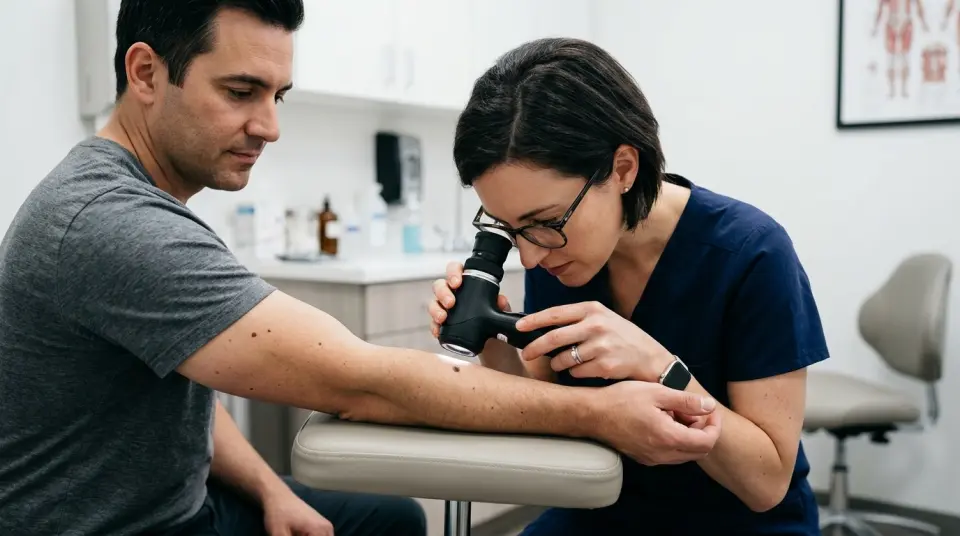
Annual professional skin exams are recommended for everyone, especially those with risk factors like fair skin, history of sunburns, or family history of melanoma. Approximately 100,640 cases of melanoma will be diagnosed in the U.S. in 2026, making professional screening essential.
Between annual exams, see a dermatologist immediately if any mole changes, bleeds, itches, or looks different from others. Do not wait for the next scheduled appointment. Early detection saves lives.
For initial concerns or questions about suspicious spots, Doctronic.ai provides free AI doctor consultations that can help determine whether a dermatology visit is needed.
Frequently Asked Questions
Melanoma can appear both ways. About 70% of melanomas develop on normal skin as new spots, while 30% arise from existing moles. Any new dark spot or changes to an existing mole should be monitored.
Dermatologists recommend monthly full-body skin checks. Consistency matters more than frequency. Pick a day each month and examine all skin surfaces, including areas that do not get sun exposure.
People with fair skin, light eyes, and red or blonde hair have a higher risk. Those with many moles or a family history of melanoma should be especially vigilant. Melanoma can affect anyone regardless of skin tone.
While rare, melanoma can occur in children and teenagers. Parents should monitor their children's moles and report any changes to a pediatrician or dermatologist.
The Bottom Line
Knowing what melanoma looks like saves lives. Regular self-checks using the ABCDE criteria and ugly duckling method help catch suspicious spots early. For quick guidance on skin concerns, visit Doctronic.ai for free AI-powered consultations before scheduling a dermatology appointment.
Related articles
Explore treatment options
Chat Now