
Symptoms and Diagnosis
Deer Tick vs. Dog Tick: How to Tell Them Apart (With Photos)
March 30, 2026
7 min read

Medically reviewed by Alan Lucks | MD, Alan Lucks MDPC Private Practice - New York on May 24th, 2026.
Published on April 17th, 2026. Updated on July 23rd, 2026.
Ticks have eight legs as adults, a single oval body without segments, and range from poppy seed size (nymphs) to apple seed size (adults)
The four most common tick species in the U.S. are the deer tick, American dog tick, lone star tick, and brown dog tick, each with distinct markings
Engorged ticks can expand up to 10 times their original size and change from flat brown to grayish-blue or olive
Ticks are often confused with bed bugs, small spiders, and beetles, but their fused body and eight legs make them identifiable
Tick-borne disease cases in the U.S. more than doubled between 2004 and 2022, making proper identification essential
For guidance on symptoms after a tick bite, visit Doctronic.ai
Questions about tick identification?
Free. Anonymous. Built by doctors.
This article covers general information. Ask Doctronic about your symptoms, medications, side effects, or treatment options.
Finding a small creature attached to skin can cause immediate concern. Knowing what a tick looks like helps people act quickly and appropriately. Ticks are tiny arachnids that feed on blood from humans, pets, and wildlife. They carry diseases like Lyme disease, Rocky Mountain spotted fever, and alpha-gal syndrome. Early identification matters because prompt removal reduces the risk of disease transmission. This guide breaks down tick identification by species, explains how their appearance changes after feeding, and clarifies how to distinguish ticks from similar-looking bugs. For anyone uncertain about a bite or potential tick exposure, Doctronic.ai offers free AI doctor visits that can help assess symptoms and recommend next steps.
Ticks belong to the arachnid family, making them relatives of spiders and mites. Unlike insects, which have three body segments, ticks have a single, fused, oval body. Adult ticks have eight legs, while larvae have six. Their mouthparts, called the capitulum, project forward from the body and include barbed structures that anchor them during feeding. The body appears flat and teardrop-shaped before feeding. Most unfed ticks are brown, reddish-brown, or black, with species-specific markings on their backs.
Tick nymphs are roughly the size of a poppy seed, measuring 1 to 2 millimeters. Their tiny size makes them difficult to spot and particularly dangerous, as they often go unnoticed while feeding. Adult ticks range from sesame seed to apple seed size, approximately 3 to 5 millimeters before feeding. Female ticks are generally larger than males. The nymphal stage transmits many tick-borne illnesses because these immature ticks feed for longer periods without detection.
Hard ticks have a visible shield-like plate called a scutum on their backs. This plate covers the entire back of males but only partially covers females. Soft ticks lack this hard plate and have a leathery, wrinkled appearance. Hard ticks are the primary concern for humans and pets because they include species such as deer ticks and dog ticks. Soft ticks typically live in animal burrows and rarely bite people.
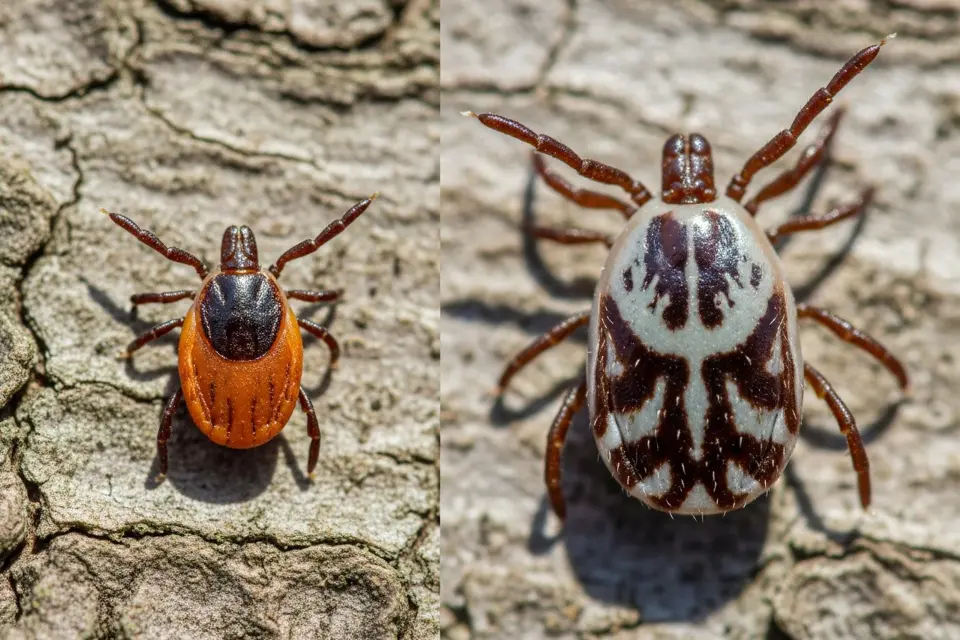
The deer tick, also called the black-legged tick, is the primary carrier of Lyme disease in the eastern United States. Adults have dark brown to black legs and an orange-red body, with a dark brown scutum. Females display a distinctive two-toned appearance, with a reddish-orange body contrasting with the darker shield. Males appear entirely dark brown. Adults measure about 3 millimeters unfed. These ticks prefer wooded areas with dense leaf litter and tall grasses. For a side-by-side comparison with similar species, see our deer tick vs. dog tick identification guide.
American dog ticks are larger than deer ticks, measuring 5 millimeters or more as adults. They have brown bodies with white or cream-colored mottled patterns on their backs. Males show extensive white marbling across the entire back, while females display a smaller white marking concentrated near the head. These ticks transmit Rocky Mountain spotted fever and tularemia. They thrive in grassy fields, along trails, and near areas where dogs frequently walk.
The lone star tick gets its name from the single white dot on the center of the female's back. Males lack this distinctive spot but show scattered white streaks along their edges. Both sexes are reddish-brown with round bodies. Bites from the Lone Star tick can trigger alpha-gal syndrome, a condition causing allergic reactions to red meat. These aggressive ticks actively pursue hosts and are common throughout the southeastern United States, with their range expanding northward into the Midwestern and northeastern United States.
The brown dog tick is uniformly reddish-brown without distinctive markings. This species is unique because it can complete its entire life cycle indoors, making it a year-round concern. Adults measure about 3 millimeters unfed. Unlike other ticks that prefer wildlife, brown dog ticks almost exclusively feed on dogs. They can infest homes, kennels, and veterinary facilities. These ticks transmit canine ehrlichiosis and, in certain regions, potentially Rocky Mountain spotted fever.
Ticks feed slowly, remaining attached for several days as they consume blood. During this process, their bodies expand dramatically. An engorged tick can grow up to 10 times its original size. The feeding creates a balloon-like appearance that often makes identification difficult. People frequently mistake engorged ticks for skin growths, moles, or completely different insects. The feeding duration varies by species, with some ticks requiring 2 to 7 days to fully engorge.
As ticks fill with blood, their color changes significantly. Flat brown ticks become grayish-blue, olive, or silvery as their bodies stretch. The original markings become less visible or disappear entirely as the body expands. The once-flat tick transforms into a round, grape-like shape. Legs may appear smaller relative to the swollen body. Recognizing these changes helps people identify ticks at various feeding stages.
Small spiders have two distinct body segments (cephalothorax and abdomen) visible as a "waist," while ticks have a single fused body. Beetles have hard wing covers, antennae, and six legs. Ticks lack antennae entirely. Weevils and small beetles sometimes resemble ticks, but have segmented bodies and visible head structures. Clover mites are tiny red arachnids that people mistake for tick nymphs, but they do not bite humans or pets.
Bed bugs and ticks both feed on blood, but look quite different upon close inspection. Bed bugs have flat, oval bodies with six legs, visible antennae, and segmented abdomens. Ticks have eight legs and no antennae. Bed bugs are reddish-brown and approximately apple-seed-sized. They do not attach and feed for days, as ticks do. Bed bugs leave multiple bites in clusters or lines, while ticks produce a single bite site where they remain attached.
Ticks seek warm, moist areas with thin skin. On humans, check the scalp, behind the ears, armpits, groin, behind the knees, and around the waist. Children should be checked thoroughly after outdoor play. On pets, examine the ears, between the toes, under the collar, around the base of the tail, and in skin folds. Running fingers through a pet's fur helps detect attached ticks that a visual inspection might miss. Invasive and expanding tick species continue to spread due to climate shifts, making regular checks increasingly important.
Use fine-tipped tweezers to grasp the tick as close to the skin as possible. Pull upward with steady, even pressure without twisting. Clean the bite area with rubbing alcohol or soap and water. Save the tick in a sealed container with a damp paper towel if testing is desired. Note the date and body location of the bite. Doctronic.ai can help evaluate symptoms that develop after tick bites and provide guidance on when professional testing or treatment is warranted.
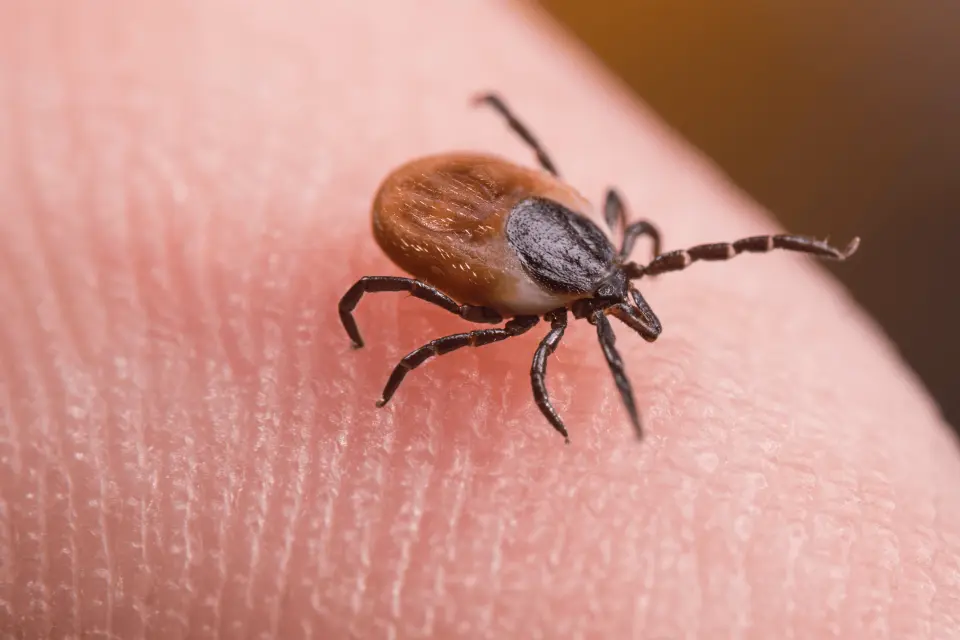
Most tick-borne diseases require 24 to 48 hours of attachment for transmission. Lyme disease typically requires at least 36 hours of feeding. Prompt daily tick checks and removal significantly reduce the risk of infection.
Ticks cannot jump or fly. They wait on grass, leaves, or low vegetation with their front legs extended, latching onto hosts who brush past them. This behavior is called questing.
Tick activity peaks during warm months from April through September. Some species remain active year-round in mild climates. Brown dog ticks can be active indoors regardless of the season.
Not all tick bites require antibiotic treatment. Medical evaluation is recommended if a rash develops, the tick was attached for over 24 to 36 hours, or flu-like symptoms appear within weeks of the bite.
Identifying ticks by species and feeding stage helps people respond appropriately to bites and reduce disease risk. For questions about tick bites, symptoms, or next steps, visit Doctronic.ai for free AI consultations and affordable telehealth visits with licensed doctors available 24/7.
Get allergy care advice
Chat Now