
Skin Health
UV Rays Today: Understanding Daily UV Reports and Your Skin Risk
April 17, 2026
7 min read

Medically reviewed by Alan Lucks | MD, Alan Lucks MDPC Private Practice - New York on May 23rd, 2026.
Published on April 15th, 2026. Updated on July 23rd, 2026.
UV radiation follows predictable daily patterns, with peak danger occurring between 10 AM and 4 PM when the sun climbs highest in the sky
The UV Index scale ranges from 1 to 11+, giving a daily forecast of radiation intensity that determines what level of protection a given day requires
Solar noon, when UV intensity peaks, does not align with clock noon and shifts based on geographic location, time zone, and season
UVA rays remain present throughout all daylight hours and penetrate clouds and glass, meaning protection matters even outside peak windows
The shadow rule offers a simple real-time check: if your shadow is shorter than you, UV levels are high enough to cause damage
Doctronic.ai provides free AI consultations and affordable telehealth visits to address sunburn concerns and other UV-related skin issues
Not all hours of sunlight carry equal risk. The angle of the sun relative to Earth's surface determines how much atmosphere UV rays must travel through before reaching the skin. Early morning and late afternoon sun travel a longer path through the atmosphere, with more atmospheric particles absorbing and scattering radiation. Midday sun travels nearly straight down through a much thinner atmospheric column, arriving with significantly less filtering and far more intensity.
Understanding this hourly variation allows people to make genuinely informed choices about spending time outdoors. Knowing exactly when radiation peaks and when it drops to manageable levels makes practical protection possible without requiring a complete indoor retreat during the summer months.
The UV Index translates the sun's radiation output into a simple daily forecast scale from 1 to 11+. UV index scale categories range from Low (1 to 2), where minimal protection is needed, through Moderate (3 to 5) and High (6 to 7), where broad-spectrum sunscreen and shade become important, up to Very High (8 to 10) and Extreme (11+), where intensive protection is required for any outdoor time. Weather services calculate and broadcast the UV Index daily, making it the most accessible real-time guide for sun-safety decisions.
Solar noon is the moment when the sun reaches its highest point in the sky for a given location, not when clocks read 12:00 PM. Time zones group large geographic areas under one clock standard, meaning a person on the eastern edge of a time zone experiences solar noon nearly an hour earlier than someone on the western edge. Daylight saving time adds another offset. In practice, solar noon typically falls between 12:30 PM and 2:00 PM across the continental United States, pushing the actual UV peak later than most people assume.
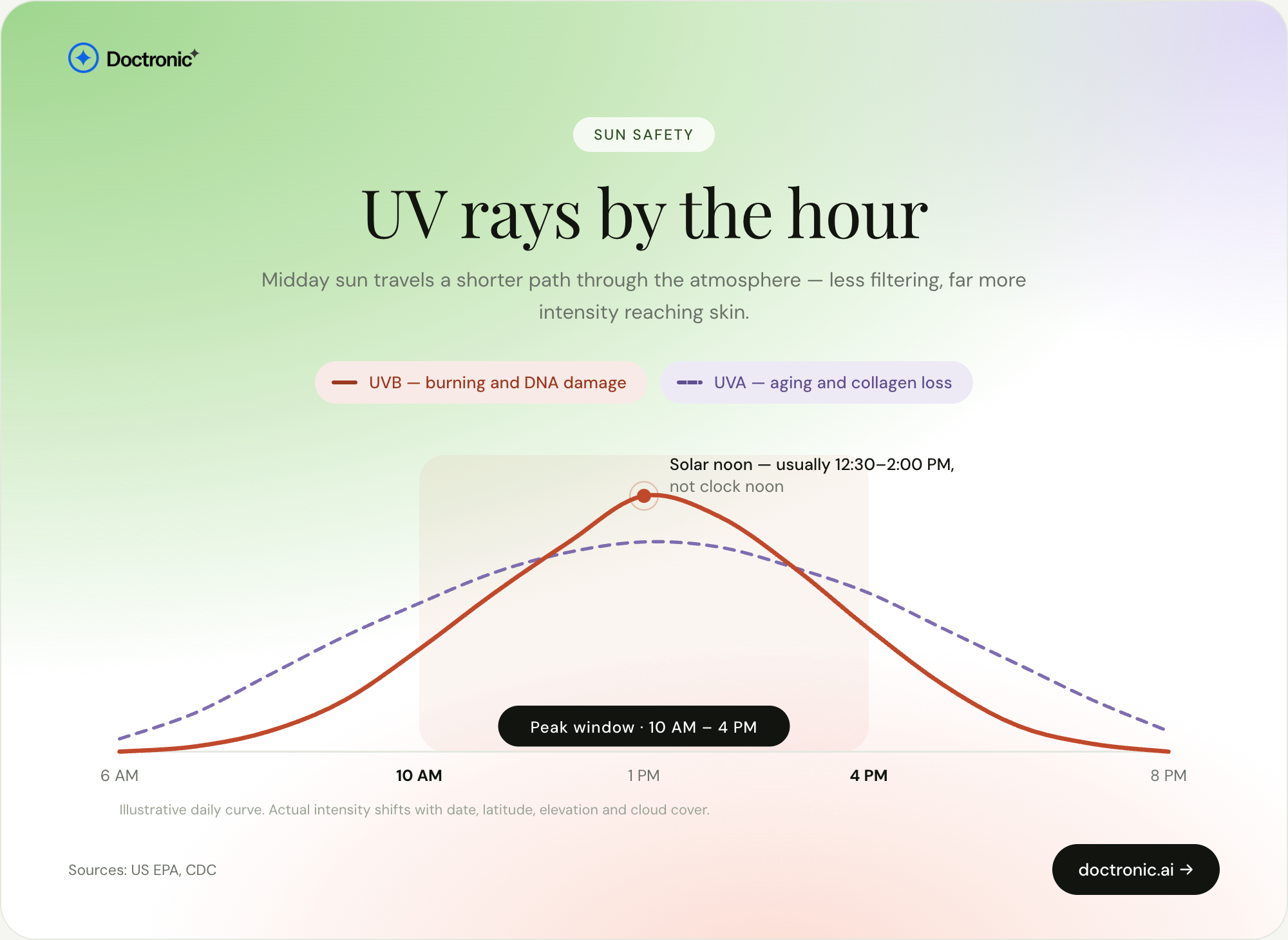
Both UVA and UVB radiation increase as the sun climbs above the horizon. UVB intensity, which drives sunburn and direct DNA damage, rises steeply from roughly 10 AM onward. UVA intensity also rises during this window, though more gradually. UV rays are strongest between 10 AM and 4 PM. Skin cancer prevention strategies center on protecting skin during these peak hours to reduce long-term cancer risk. People who schedule outdoor activity before 10 AM or after 4 PM absorb meaningfully less cumulative radiation than those who spend peak hours in direct sunlight.
The 30- to 60-minute bracket around solar noon represents the highest UV intensity of any given day. At midday, UV radiation can be intense enough to cause sunburn in fair-skinned individuals in under 15 minutes without protection. This window also carries the highest UVB dose of the day, which translates directly to elevated skin cancer risk with repeated unprotected exposure. People engaging in midday outdoor activities, particularly at the beach, on ski slopes, or at high elevations, face compounded UV exposure from direct sunlight and reflections off surrounding surfaces.
When shadows fall shorter than the person casting them, UV levels are high enough to require immediate protection. This visual shorthand requires no device: short shadows indicate the sun is nearly overhead, meaning less atmospheric filtering and higher UV intensity reaching skin. Conversely, when shadows stretch longer than a person's height, the sun sits low enough that UV travels through a significantly thicker layer of atmosphere, and intensity drops. Checking shadow length provides instant feedback on current UV conditions.
Get sunburn treatment online today
A licensed doctor can review your symptoms and send a prescription to your pharmacy, often the same day.
Related medications we prescribe
Learn moreTemperature and UV intensity are not correlated. A cool morning at 8 AM carries real UV radiation, particularly during summer months at lower latitudes. People gardening, walking, or commuting outdoors during early morning or late afternoon often skip sunscreen because the air does not feel threatening. This habit leads to cumulative exposure over months and years. UVB at these hours is lower than midday but not absent, and the UVA component remains significant throughout all daylight hours.
UVA follows a flatter daily curve than UVB. While UVB spikes dramatically at midday and drops at the solar edges of the day, UVA radiation persists at meaningful levels from sunrise to sunset. A person spending two hours outdoors at 7 AM absorbs a real UVA dose even though UVB is minimal at that hour. This matters because UVA drives photoaging, collagen breakdown, and the development of wrinkles and age spots regardless of whether a person ever burns. Even low UV Index values carry UV index tanning risks that accumulate invisibly over time.
Elevation amplifies UV intensity at every hour of the day. For every 1,000 feet gained in altitude, UV radiation increases by approximately 4 to 6 percent. A hiker at 10,000 feet receives 40 to 60 percent more UV radiation than someone at sea level for the same time of day. Proximity to the equator shortens the atmospheric path that UV rays travel, raising baseline intensity across all hours of the day. People planning outdoor activities at altitude or in equatorial regions should treat their UV Index forecast as an underestimate of actual skin exposure.
Reflective surfaces extend UV exposure beyond direct sunlight. Snow reflects up to 80 percent of UV rays, effectively doubling the dose for skiers during midday peak hours. Water reflects about 25 percent, and sand reflects a similar amount. Reflected UV strikes skin from below and at angles that sunscreen applied only to horizontal surfaces may not cover. Reapplying sunscreen to the underside of the chin, neck, and ears matters particularly in high-reflection environments, regardless of the time of day.
Clouds filter approximately 20 percent of UV radiation on average, leaving up to 80 percent reaching the ground on overcast days. A cloudy midday still carries nearly as much UV danger as a clear midday. Broken cloud cover can focus UV radiation through gaps, briefly producing higher surface levels than clear conditions. People working outdoors on overcast summer days without sun protection receive a damaging dose comparable to a sunny day.
Sunscreen degrades with time, sweat, water exposure, and physical activity. The two-hour reapplication rule applies during outdoor activity regardless of the UV Index or cloud cover. A single morning application before an eight-hour outdoor event provides no meaningful protection by mid-afternoon. For activities involving water or heavy sweating, reapplication should occur immediately after exiting the water or after heavy perspiration rather than waiting for the two-hour mark.
UPF-rated clothing provides consistent UV protection without the degradation that affects sunscreen. A UPF 50 garment blocks 98 percent of UV radiation and maintains that protection throughout the day with no reapplication required. Wide-brimmed hats protect the face, scalp, and back of the neck, areas that sunscreen application often misses. Seeking shade during peak UV hours, particularly between 11 AM and 3 PM, reduces exposure more than any topical product alone. Combining shade, UPF clothing, and broad-spectrum SPF 30 or higher sunscreen provides the most complete hourly protection available.
Before 10 AM and after 4 PM, UV risk is lowest during most of the year. Even within these windows, UVA radiation persists throughout all daylight hours, so daily sunscreen use remains important for prolonged outdoor time.
Yes. Clouds block approximately 20 percent of UV radiation on average, leaving most exposure unchanged. Sunburns on cloudy days are common precisely because people skip protection when skies look overcast.
Every two hours during outdoor activity, and immediately after swimming or heavy sweating. A single morning application does not provide all-day protection. Carry sunscreen with you when spending extended time outdoors.
Standard window glass blocks most UVB rays but allows UVA to pass through. People near windows or driving for extended periods accumulate UVA exposure that causes photoaging over time. UV-blocking window film or daily broad-spectrum sunscreen provides protection indoors.
At higher elevations, the atmosphere is thinner, meaning UV rays travel through less air and fewer particles that would otherwise absorb or scatter radiation. This effect compounds midday peak exposure, making sunscreen reapplication even more important at elevation.
UV intensity follows a predictable daily arc, peaking between 10 AM and 4 PM and varying further with altitude, reflection, and cloud cover. For any skin concern related to sun exposure or sunburn, Doctronic.ai offers free AI consultations and affordable telehealth visits with licensed doctors available 24/7.
Get skin care advice
Chat Now