Symptoms and Diagnosis
Black Lines on Fingernails: When a Nail Streak Could Signal Melanoma
March 30, 2026
8 min read

Medically reviewed by Alan Lucks | MD, Alan Lucks MDPC Private Practice - New York on May 23rd, 2026.
Published on April 15th, 2026. Updated on July 31st, 2026.
Subungual melanoma is a rare but serious skin cancer that appears as a dark streak under fingernails or toenails, accounting for less than 3 percent of all melanoma cases
This cancer disproportionately affects people with darker skin tones, representing a significant portion of melanoma diagnoses in individuals of African, Asian, and Hispanic descent
The ABCDEF rule helps identify warning signs: Age, Band characteristics, Color changes, Digit affected, Extension to cuticle, and Family history
Early detection dramatically improves outcomes, with survival rates reaching approximately 80 to 90 percent when caught early
Dark streaks under nails can also result from harmless causes like bruising or benign melanonychia, making professional evaluation essential
Doctronic.ai offers telehealth visits to help assess concerning nail changes and determine whether in-person evaluation is needed
Telehealth may not be appropriate for every medication or condition. Doctronic can help you understand your options and determine the appropriate next step.
A dark line appearing under a fingernail or toenail often gets dismissed as a bruise or minor injury. Most people wait weeks or months before seeking medical attention, assuming the discoloration will fade on its own. This delay can prove dangerous when the streak represents subungual melanoma, a form of skin cancer that develops in the nail matrix.
Unlike melanomas that develop on sun-exposed skin, this type occurs in areas rarely exposed to ultraviolet light. The thumb and big toe are most commonly affected. Because the nail plate covers the growing tumor, early changes often go unnoticed until the cancer has progressed. Understanding what distinguishes a harmless nail discoloration from a potentially life-threatening condition empowers people to seek timely evaluation.
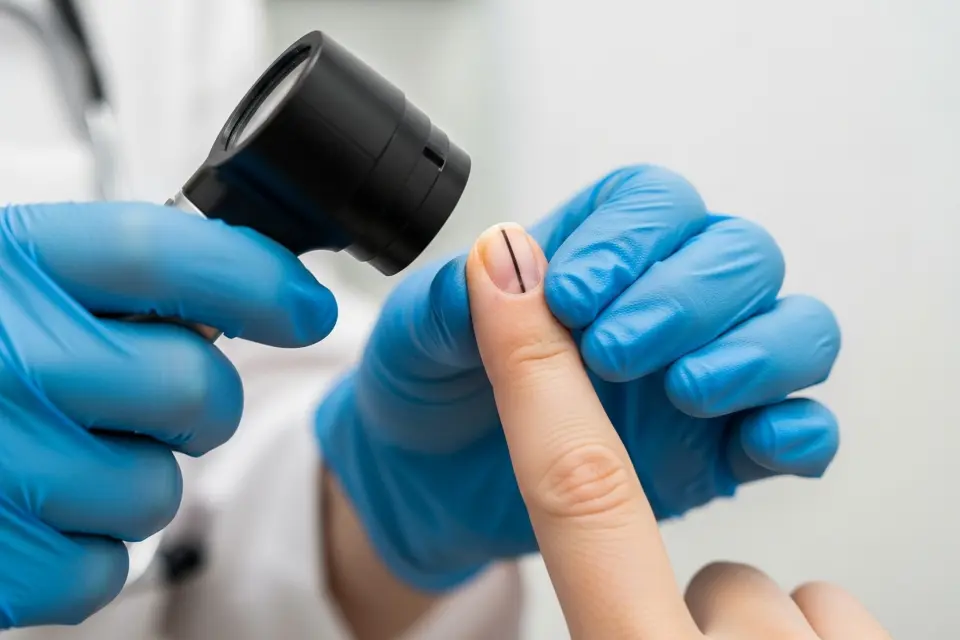
Subungual melanoma originates in the nail matrix, the tissue beneath the base of the nail responsible for producing the nail plate. As cancer cells multiply, they create pigmented streaks that grow outward with the nail. The cancer typically presents as a brown or black longitudinal band extending from the cuticle toward the nail tip. Unlike a bruise that grows out with the nail, melanoma-related pigmentation remains persistent and may widen over time.
Subungual melanoma exhibits striking demographic patterns that differ from those of cutaneous melanoma. While fair-skinned individuals face higher overall melanoma risk, subungual melanoma disproportionately affects people with darker skin tones. Asian and Hispanic populations also experience higher rates of this specific melanoma subtype. Most cases occur in adults between ages 50 and 70, with men and women affected at similar rates.
Repeated nail trauma has been proposed as a potential trigger, though direct causation remains unproven. People who frequently injure their nails through work or sports may have an elevated risk. Genetic factors appear to play a role, particularly in individuals with family histories of melanoma or certain inherited conditions affecting pigmentation.
The ABCDEF mnemonic provides a practical framework for evaluating suspicious nail changes. "A" stands for age, with peak incidence occurring between the fifth and seventh decades of life. "D" represents the digit most commonly affected, the thumb on the hands and the big toe on the feet. Single-digit involvement raises more concern than multiple nails showing similar changes.
"B" refers to the band itself, specifically its width and borders. Bands wider than 3 millimeters with irregular or blurred edges warrant closer examination. "C" addresses color: variegation within the band, including shades of brown, black, blue, or areas lacking pigment, suggests malignancy. Rapid color changes over weeks to months also raise red flags. "F" encompasses family history of melanoma and personal history of dysplastic nevi.
"E" represents extension of pigmentation into the proximal or lateral nail folds, known as the Hutchinson sign. This finding strongly suggests melanoma and requires immediate dermatologic evaluation. Pigment spreading beyond the nail plate indicates the tumor has grown beyond the nail matrix. People noticing dark streaks in their toenails should pay particular attention to whether pigmentation extends into the surrounding skin.
Subungual hematoma results from blood accumulating beneath the nail after trauma. The discoloration typically has a rounded shape and migrates toward the nail tip as the nail grows. Most hematomas resolve within three to six months. Unlike melanoma, the pigmentation does not originate from the nail matrix and lacks the longitudinal band pattern. Dermoscopy can help distinguish between the two conditions.
Fungal nail infections cause thickening, discoloration, and debris accumulation. The color changes tend toward yellow, white, or greenish hues rather than the brown-black pigmentation of melanoma. Fungal infections typically affect multiple nails and progress slowly over the years. Laboratory testing can confirm the presence of fungi and rule out melanoma.
Longitudinal melanonychia refers to any dark streak running along the nail and is common in individuals with darker skin tones, often representing benign activation of nail matrix melanocytes. Multiple nails may be affected. Benign bands typically remain stable in width and color over time, while melanoma-related bands show progressive changes. Recognizing the difference between benign nail streaks and potential melanoma helps people make informed decisions about seeking evaluation.
Dermoscopy allows magnified visualization of nail plate pigmentation patterns, helping clinicians identify features suggestive of melanoma, including irregular band coloration and disrupted parallel lines. This non-invasive examination helps determine which patients require biopsy and which can be safely monitored.
Definitive diagnosis requires tissue sampling from the nail matrix through punch, shave, or excisional techniques. The procedure involves partial or complete nail removal to access the matrix. Pathologic examination determines whether melanoma cells are present and measures tumor thickness, the most important prognostic factor.
Treatment depends on tumor thickness and staging. Thin melanomas may be treated with wide local excision, preserving the digit, while more advanced cases require amputation at various levels. Sentinel lymph node biopsy helps determine whether cancer has spread to regional lymph nodes. Reconstructive options following amputation include skin grafts and local flaps, with functional outcomes varying based on which digit and how much length is removed.
Early detection remains crucial, with nail melanoma warning signs worth learning to recognize. Survival rates reach approximately 80 to 90 percent when the cancer is caught early, but advanced-stage disease carries a significantly worse prognosis.
Monthly self-examination of all twenty nails takes only minutes and can detect changes early. Photographing suspicious streaks creates a baseline for comparison. Any new longitudinal band in adults, particularly on a single digit, deserves professional evaluation. People with risk factors should establish care with a dermatologist for regular skin and nail examinations.

Pediatric cases are extremely rare. Dark nail streaks in children almost always represent benign melanonychia. Biopsy is generally avoided unless features strongly suggest malignancy.
No evidence links nail polish or artificial nails to this cancer. The condition develops in the nail matrix, not from external exposures to the nail surface.
Growth rates vary considerably. Some tumors remain localized for years while others progress rapidly. Any band showing changes over weeks to months requires urgent evaluation.
While not directly inherited, a family history of melanoma increases risk. Genetic counseling may benefit individuals with multiple affected family members.
Dark streaks under nails deserve attention, not dismissal. Early evaluation of suspicious nail changes can mean the difference between simple treatment and advanced disease requiring amputation. For accessible guidance on nail symptoms, Doctronic.ai offers telehealth visits to help determine whether in-person dermatology care is needed.
Explore treatment options
Chat Now
Join 50,000+ readers using Doctronic to understand symptoms, medications,
and next steps.
Add your phone number below to get health updates and exclusive VIP offers.
By providing your phone number, you agree to receive SMS updates from Company. Message and data rates may apply. Reply “STOP” to opt-out anytime. Read our Privacy Policy and Terms of Service for more details.
Save your consults. Talk with licensed doctors and manage your health history.