Bone & Joint Health
What Is a Dangerously High Calcium Level and What Does It Mean?
July 21, 2026
6 min read

Medically reviewed by Lauren Okafor | MD, The Frank H Netter MD School of Medicine, Loyola University Medical Center on April 23rd, 2026.
Published on April 17th, 2026. Updated on July 23rd, 2026.
Grade 1 ankle sprains heal in 1 to 3 weeks, Grade 2 sprains typically require 4 to 8 weeks, and Grade 3 injuries may need 4 to 6 months for full recovery
The first 72 hours are critical for managing acute inflammation through the P.E.A.C.E. and L.O.V.E. protocol, which has replaced the older R.I.C.E. approach
Proprioception training is essential for rebuilding the neural pathways that prevent future sprains
Returning to sports too early significantly increases the risk of chronic ankle instability
Nearly half of the people who sprain an ankle develop ongoing problems when rehabilitation is incomplete
Doctronic.ai offers 24/7 telehealth consultations to monitor recovery progress and answer questions at every stage
A twisted ankle during a basketball game or a misstep on uneven pavement can sideline anyone for weeks. Understanding sprained ankle recovery time week by week helps set realistic expectations and prevents the frustration that leads many people to rush back too soon. Basketball accounts for approximately 25% of ankle sprains, making it one of the most common sports injuries treated in clinics and emergency rooms alike.
The ankle contains three main ligaments on the outer side, and damage to these structures determines how long it takes to heal. Most people underestimate the importance of proper rehabilitation, which explains why up to 70% of ankle sprains can lead to persistent symptoms or reinjury. Doctronic.ai provides AI-powered assessments that can help identify injury severity and guide treatment decisions from day one.
Not all ankle sprains are equal. The grade of injury directly determines the recovery timeline and treatment approach needed.
Grade 1 sprains involve minor stretching of the ligament fibers without significant tearing. The ankle remains stable, and most people can walk with mild discomfort. Swelling is minimal, and bruising may not appear at all. Recovery typically takes 1 to 3 weeks with proper care.
Grade 2 sprains cause partial tearing of one or more ligaments. Walking becomes difficult, and the ankle feels loose during movement. Significant swelling and bruising develop within hours. These injuries require 4 to 8 weeks of dedicated rehabilitation.
Grade 3 sprains involve complete ligament tears, causing severe instability where the ankle gives way during standing. Pain is intense initially but may decrease as nerve involvement occurs. These injuries often require immobilization and sometimes surgical intervention. Full recovery takes 4 to 6 months.
Ankle ligament tears follow a three-phase rehabilitation program covering protection, rehabilitation exercises, and return to activity, with recovery timelines varying by severity.
The initial response to injury determines how quickly healing progresses. Acting appropriately in the first three days makes a measurable difference in outcomes.
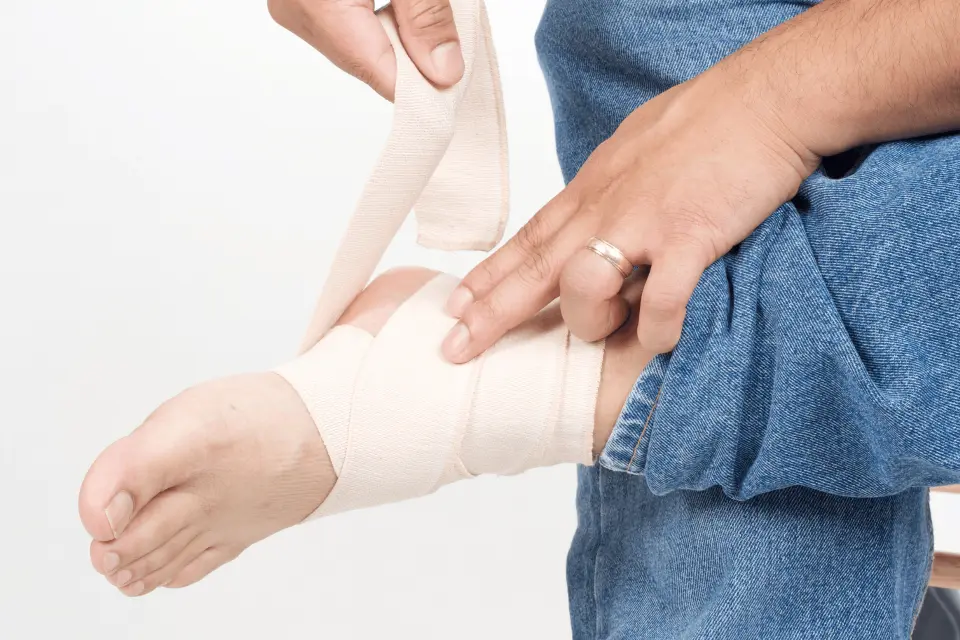
Modern sports medicine guidelines now favor the P.E.A.C.E. and L.O.V.E. approach. Protection means limiting activities that cause pain while allowing early pain-free movement. Elevation above heart level reduces swelling by improving fluid drainage. Avoiding anti-inflammatory medications in the early phase allows the natural healing process to proceed. Compression with an elastic bandage limits swelling. Education keeps patients actively involved in recovery. Load refers to progressively reintroducing movement. Optimism supports mental well-being. Vascularization through pain-free cardiovascular activity promotes circulation. Exercise restores strength and mobility once pain allows.
Seek imaging if the ankle cannot bear weight after 24 hours, if bone tenderness exists at specific points, or if swelling continues increasing after 48 hours. MRI or ultrasound may also be indicated for persistent pain or suspected complete ligament tears. Doctronic.ai's telehealth services can help determine whether imaging is necessary without an emergency room visit.
Once acute inflammation subsides, gentle movement prevents stiffness and promotes healing blood flow to damaged tissues.
Trace the alphabet with the big toe while seated. This exercise moves the ankle through its full range without weight-bearing stress. Perform ankle circles in both directions, completing 10 to 15 rotations each way. Towel stretches for the calf muscle prevent tightness that limits ankle mobility.
Progress from non-weight-bearing to partial weight-bearing as pain allows. Use crutches until walking without a limp becomes possible. Pain during weight-bearing indicates the tissue needs more time. Forcing progression too quickly delays healing and risks reinjury.
Get ankle pain treatment online today
A licensed doctor can review your symptoms and send a prescription to your pharmacy, often the same day.
Related medications we prescribe
Learn moreThe ligaments have begun healing, but the muscles and balance systems need targeted work to restore full function.
Loop a resistance band around the forefoot and perform dorsiflexion, plantarflexion, inversion, and eversion exercises. Complete 3 sets of 15 repetitions for each direction. Increase band resistance as strength improves. These exercises rebuild the muscles that protect the ankle during activity.
Single-leg standing on a flat surface progresses to standing on a pillow or balance board. Closing the eyes challenges the proprioceptive system further. Proprioception training is often the most neglected aspect of ankle rehabilitation, yet it is among the most important for preventing future sprains.
Ankle injuries and disorders involving ligament damage may take weeks to many months to heal completely, with rehabilitation exercises and strengthening guidance playing a central role in full recovery.
Athletes and active individuals face the challenge of returning to high-impact activities safely.
Start with double-leg hops before progressing to single-leg variations. Ladder drills improve coordination and confidence in lateral movements. Sport-specific movements should be introduced gradually, starting at 30 to 50% of normal intensity. Pain or instability during any drill means stepping back in the progression.
Lace-up braces provide consistent support and are easier to apply independently. Bracing is recommended for the first 3 to 6 months of return to activity. Athletic tape offers customizable support but requires proper technique. Taping works well for athletes who find braces restrictive during competition.
For additional guidance on ankle-specific strengthening routines that support this phase, see this overview of ankle strengthening exercises on the Doctronic blog.
Nearly half of people who sprain an ankle develop ongoing problems. Preventing this outcome requires attention to healing quality, not just timeline.
Persistent swelling beyond 6 weeks indicates ongoing inflammation. Feelings of the ankle giving way during daily activities suggest ligament laxity. Pain with stairs or uneven surfaces means rehabilitation is incomplete. These symptoms warrant professional evaluation to prevent long-term dysfunction.
Continue balance exercises three times weekly even after full recovery. Calf raises and ankle strengthening should become permanent parts of fitness routines. Warm up thoroughly before sports and activities. Wearing supportive footwear reduces strain on healing ligaments.
Surgery is rarely needed for ankle sprains. Grade 3 sprains that remain unstable after 4 to 6 months of rehabilitation may require surgical repair. Athletes with repeated sprains on the same ankle sometimes benefit from ligament reconstruction. Most people recover fully with conservative treatment.
Walking depends on sprain severity and pain levels. Grade 1 sprains often allow walking with mild discomfort. Grade 2 and 3 sprains require crutches initially. Walking through significant pain delays healing and risks further damage.
Persistent pain may indicate incomplete healing, scar tissue formation, or damage to structures beyond the ligaments. Cartilage injuries and tendon problems can accompany sprains. Evaluation by a healthcare provider can identify the cause and adjust the treatment plan.
Running typically resumes 6 to 8 weeks after Grade 1 and 2 sprains when walking is pain-free and strength has returned. Start with walking intervals mixed with jogging on flat surfaces. Progress to full running only when the ankle feels stable during quick direction changes.
P.E.A.C.E. and L.O.V.E. is the updated evidence-based protocol. The main shift: it limits ice application and early anti-inflammatory use, which current research suggests may slow tissue repair. The newer approach emphasizes education, gradual loading, and optimism rather than passive rest.
Ankle sprain recovery follows a predictable pattern when proper rehabilitation protocols are followed, with most injuries healing within 8 weeks. Rushing the process leads to chronic instability that can affect mobility for years. For personalized guidance throughout recovery, visit Doctronic.ai for AI-powered medical assessments and convenient telehealth consultations available 24/7.
Get pain relief advice
Chat Now