Bone & Joint Health
What Is a Dangerously High Calcium Level and What Does It Mean?
July 21, 2026
6 min read

Medically reviewed by Oghenefejiro Okifo | MD, Harvard Medical School | Henry Ford Hospital - Detroit, MI on April 19th, 2026.
Published on April 17th, 2026. Updated on July 23rd, 2026.
Plantar fasciitis is the most common running injury affecting the heel, caused by repetitive stress on the thick band of connective tissue running along the bottom of the foot.
Returning to running before the plantar fascia has adequately healed is the single most common reason this injury drags on for months instead of weeks.
A structured return-to-run protocol using heart rate zones and cross-training can maintain aerobic fitness while the fascia heals.
Footwear, training load, and running surface are three controllable variables that directly affect both recovery speed and relapse risk.
Most runners recover within three to six months with consistent care, but heel pain that persists or worsens warrants a clinical evaluation.
For guidance on next steps without waiting weeks for an appointment, Doctronic.ai puts licensed clinicians on call 24/7 to assess your symptoms and advise on your recovery plan.
Questions about plantar fasciitis?
Free. Anonymous. Built by doctors.
This article covers general information. Ask Doctronic about your symptoms, medications, side effects, or treatment options.
The plantar fascia absorbs force equal to roughly three times your body weight with each running stride. Over miles and months, repetitive stress without adequate recovery creates micro-tears at the fascia's attachment to the heel bone. Inflammation develops at that insertion point, producing the sharp, stabbing pain that most runners first notice in their first steps of the morning or in the initial miles of a run.
Runners are particularly susceptible because running multiplies the mechanical load compared to walking, and many push through early warning signs rather than scale back. High weekly mileage, rapid mileage increases, hard surfaces, worn shoes, and tight calf muscles all elevate risk. So do flat arches and high-arched feet, both of which create mechanical strain on the fascia.
Understanding plantar fascia anatomy and the mechanics of this injury is useful before committing to a recovery approach.
The standard advice to "rest until it stops hurting" fails most runners. Complete rest causes fitness loss, creates frustration, and still does not address the biomechanical causes of the injury. A smarter approach uses active relative rest: replacing high-impact running with lower-impact training while treating the underlying inflammation and mechanical triggers.
During the acute phase, the goal is reducing inflammation while keeping fitness from eroding.
Replace running with swimming, pool running, or cycling. These activities maintain cardiovascular fitness and muscular endurance without loading the plantar fascia. Pool running in particular mimics the biomechanics of running closely enough to preserve running-specific conditioning.
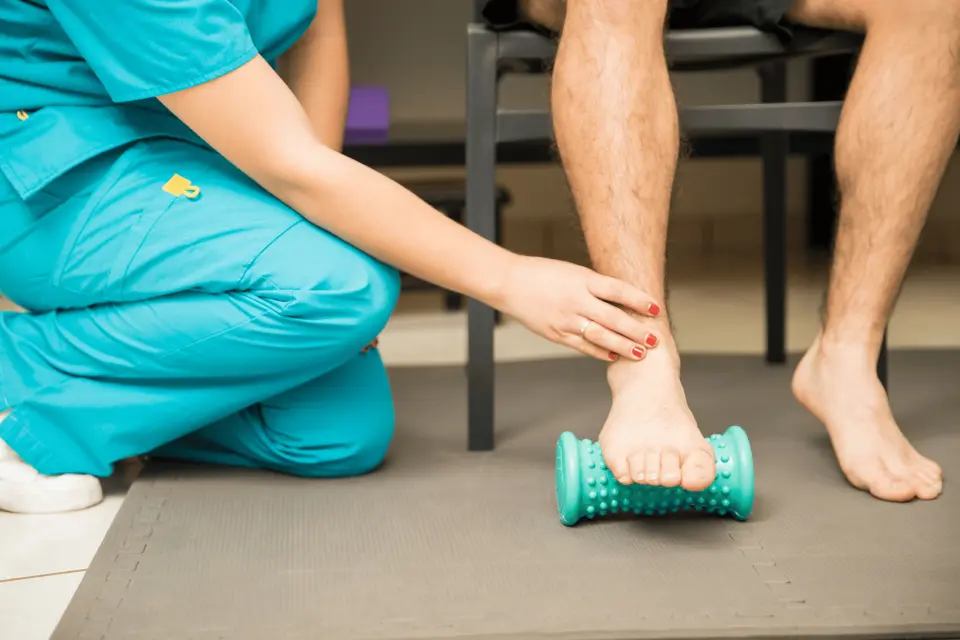
During this phase, apply ice to the heel for 15 to 20 minutes after any activity. A frozen water bottle rolled under the arch works well because it combines ice with a mild myofascial release effect. Do this twice daily.
Begin the following two stretches immediately:
Plantar fascia stretch: Sit on the edge of a chair or bed. Cross the affected foot over your knee. Grip your toes and pull them toward your shin, holding 20 to 30 seconds. Repeat 10 times. Do this before your first step each morning and again before any workout.
Calf and Achilles stretch: Stand facing a wall, hands on the wall, affected leg straight behind you with the heel flat on the floor. Hold 30 seconds, then repeat with the knee slightly bent to target the soleus separately. Perform three sets per leg, twice daily.
Once acute morning pain drops below a 3 on a 10-point scale, begin progressive eccentric loading. The most evidence-supported exercise for plantar fasciitis is the single-leg heel drop:
Stand with the ball of your foot on the edge of a stair or step. Raise on both feet, then lower slowly on only the affected foot, taking 3 full seconds to lower the heel below step level. Do three sets of 15 repetitions, twice daily. This is initially uncomfortable but should not produce sharp pain.
Continue cross-training. Begin adding short, easy-paced walk intervals to assess pain response. If walking a mile produces no more than a 2 out of 10 pain level and symptoms do not worsen the following morning, you are approaching return-to-run readiness.
A walk-run protocol is the safest way back. Start with 1 minute of running followed by 2 minutes of walking for 20 minutes, three times per week. Increase run intervals by no more than 10 percent per week. At each session, monitor pain during the run (should not exceed 2 out of 10) and morning pain the following day (should return to baseline within 24 hours).
If either of those thresholds is exceeded, scale back one step and allow an additional week before progressing again. Impatience at this phase is the primary driver of relapse.
Get plantar fasciitis treatment online today
A licensed doctor can review your symptoms and send a prescription to your pharmacy, often the same day.
Related medications we prescribe
Running in worn or biomechanically mismatched shoes is one of the most common reasons plantar fasciitis recurs or fails to fully resolve.
Replace running shoes every 300 to 500 miles. The midsole loses shock absorption and arch support well before the outsole visibly wears through. If your shoes are more than 18 months old and you run regularly, they are almost certainly contributing to your symptoms.
For runners with flat arches, motion-control or stability shoes provide structural support that reduces fascial strain. For high-arched runners, cushioned neutral shoes absorb impact more effectively. A specialty running store that performs gait analysis can help match you to the right category if you are unsure.
A temporary heel lift (6 to 12 millimeters) inside the shoe takes tension off the Achilles and plantar fascia attachment and often provides noticeable pain relief in the early recovery weeks. Runners dealing with concurrent Achilles tightness can find targeted guidance in Achilles tendon pain, which covers the overlap between these two common overuse injuries. It is not a long-term fix but is a useful short-term bridge.
Surface matters. Asphalt and concrete are significantly harder than packed trails or rubberized tracks. If you return to running on pavement, the impact forces are substantially higher than on softer surfaces. Use softer surfaces during the return-to-run phase when possible.
Cadence adjustment reduces loading per stride. Increasing your running cadence by 5 to 10 percent shortens ground contact time and reduces peak force on the plantar fascia. A metronome app or music set to a target BPM makes this practical during training.
Avoid hill running and speed work until you have maintained pain-free running on flat surfaces for at least four weeks. Both increase fascial load significantly and are common triggers for setbacks.
For most runners, consistent home management resolves plantar fasciitis within three to six months. Certain situations warrant earlier professional involvement:
Pain does not improve after 8 weeks of consistent stretching, load management, and footwear changes
Morning pain is severe enough to affect how you walk
Pain extends up the Achilles or into the midfoot, which may indicate a different diagnosis
You have had plantar fasciitis before and it recurs faster than expected
A sports medicine physician or physical therapist can confirm the diagnosis, rule out stress fractures or nerve entrapment syndromes, and provide targeted interventions such as ultrasound-guided cortisone injections, custom orthotics, or shockwave therapy. Plantar fasciitis diagnosis and treatment options include cortisone injections, custom orthotics, and shockwave therapy for cases that do not resolve with conservative care.
Running through active plantar fasciitis typically prolongs the injury rather than allowing it to resolve. Low-level activity that does not worsen pain or morning symptoms the following day is generally acceptable, but it is important to stay within those pain thresholds rather than pushing through significant discomfort.
Early aggressive stretching (especially before morning steps), consistent eccentric heel exercises, and replacing running with pool running or cycling for the acute phase consistently produce the fastest recoveries. Footwear correction and addressing calf tightness are equally important.
A useful benchmark is less than 2 out of 10 pain during daily walking, no significant increase in morning pain compared to baseline, and the ability to complete single-leg heel raises without sharp pain. Start with a walk-run protocol even when you feel fully recovered.
Yes, and it is one of the most consistently evidence-supported interventions. The plantar fascia stretch before morning steps is particularly important because it prepares contracted, inflamed tissue for load before the first step of the day.
They are related but different. A heel spur is a bony projection that sometimes develops at the plantar fascia attachment site in response to chronic tension. Many people with plantar fasciitis do not have heel spurs, and many people with heel spurs do not have plantar fasciitis pain. The treatment approach is largely the same.
If you plateau after 8 to 12 weeks of consistent home management, professional options include corticosteroid injections, physical therapy with hands-on soft tissue work, platelet-rich plasma therapy, or extracorporeal shockwave therapy. Each has an appropriate place in the treatment ladder.
Plantar fasciitis recovery involves temporarily replacing running with low-impact alternatives, daily stretching and eccentric loading, and a gradual return to running with better footwear. Most runners return to full training; those who recover fastest treat it as a training block, not a waiting game.
If pain is not improving, Doctronic.ai connects you with licensed clinicians around the clock.
Explore treatment options
Chat Now