Bone & Joint Health
What Is a Dangerously High Calcium Level and What Does It Mean?
July 21, 2026
6 min read

Medically reviewed by Lauren Okafor | MD, The Frank H Netter MD School of Medicine, Loyola University Medical Center on April 13th, 2026.
Published on March 23rd, 2026. Updated on July 23rd, 2026.
Spring triggers Achilles tendon pain due to sudden training increases, harder surfaces, and temperature changes affecting tendon elasticity
The estimated lifetime incidence of Achilles tendinopathy reaches up to 24% in athletes, but this condition also affects non-athletes who stand or walk frequently
Distinguishing between tendonitis and tendinopathy determines the right treatment approach
Eccentric loading exercises remain the gold standard for long-term Achilles rehabilitation
Proper footwear evaluation and gradual training progression prevent most spring flare-ups from becoming chronic problems
Wondering whether your Achilles pain needs medical attention? Talk to a doctor through Doctronic.ai for a fast, affordable telehealth assessment from home
Questions about Achilles tendon pain?
Free. Anonymous. Built by doctors.
This article covers general information. Ask Doctronic about your symptoms, medications, side effects, or treatment options.
Achilles tendon pain catches many people off guard when warmer weather arrives. After months of reduced activity during winter, the sudden return to running, hiking, and outdoor sports puts enormous stress on a tendon that has quietly deloaded. Men account for up to 83% of Achilles tendon rupture injuries, but women and non-athletes also face significant risk during seasonal transitions. Understanding why spring creates the perfect conditions for Achilles problems helps prevent a minor twinge from becoming a months-long setback.
Winter often means treadmill runs, indoor cycling, or complete breaks from exercise. When spring arrives, enthusiasm leads to longer runs, hillier routes, and faster paces before the Achilles tendon has adapted. A tendon requires at least 8 to 10 weeks to strengthen in response to new demands, far longer than muscles take to build capacity. Jumping from 10-mile weeks to 25-mile weeks in March creates exactly the overload pattern that triggers tendinopathy.
Transitioning from softer indoor surfaces to concrete sidewalks and asphalt roads increases the impact forces traveling through the Achilles tendon. Trail runners switching from soft winter mud to packed spring ground face similar challenges. The tendon absorbs forces up to 8 times body weight during running, and harder surfaces amplify those loads at a time when the tendon is least prepared to handle them.
Spring's unpredictable weather means starting runs in low 50-degree temperatures before finishing in warmer conditions. Cold tendons have less elasticity and higher stiffness, making them more vulnerable to microdamage during the early minutes of exercise. The temperature swing within a single workout creates inconsistent mechanical properties in the tendon, increasing injury risk. Warming up thoroughly before outdoor activity becomes especially important during spring months.
The estimated lifetime incidence of Achilles tendinopathy reaches up to 24% in athletes, but this condition isn't limited to athletes. Early warning signs include morning stiffness that improves with movement, pain at the start of exercise that temporarily fades during activity, and a tender or thickened area along the tendon. Ignoring these signals risks progression from reversible inflammation to structural tendon changes that take much longer to resolve.
Mid-substance pain occurs 2 to 6 centimeters above the heel, where the tendon is narrowest and blood supply poorest. This location responds well to eccentric exercises and typically heals faster. Insertional pain happens right where the tendon attaches to the heel bone, often involving bone spurs or bursa inflammation. This type proves more stubborn and may require different treatment approaches, including avoiding certain stretches that aggravate the insertion point.
Complete rest rarely helps Achilles problems and often makes them worse. The tendon needs appropriate loading to stimulate healing. Reducing training volume by 30 to 50% while maintaining some activity preserves tendon capacity without causing further damage. Swimming, cycling, or elliptical training maintains fitness while reducing Achilles stress.
Walking remains acceptable for most people with mild to moderate symptoms. The key involves avoiding activities that cause pain during or after exercise. Doctronic.ai's AI doctor can help determine appropriate activity modifications based on individual symptom patterns.
Ice applied for 15 to 20 minutes after activity reduces pain and limits excessive inflammation. Compression sleeves provide support during daily activities and may improve blood flow to the area. Topical nonsteroidal anti-inflammatory gels can offer temporary pain relief but do not accelerate tendon healing. Avoid ice before exercise, as numbing the area masks pain signals that protect against further injury.
Get achilles tendinitis treatment online today
A licensed doctor can review your symptoms and send a prescription to your pharmacy, often the same day.
Related medications we prescribe
Eccentric exercises involve lengthening the muscle-tendon unit under load, the opposite of a typical calf raise. The Alfredson protocol, performing 3 sets of 15 heel drops twice daily, remains the most researched approach for mid-substance Achilles tendinopathy. Starting on flat ground and progressing to a step edge allows gradual intensity increases. Most people notice improvement within 6 to 8 weeks, though full recovery often takes 3 to 6 months.
Tight calf muscles increase the strain on the Achilles tendon with every step. Gentle static stretching held for 30 seconds, performed after exercise when muscles are warm, improves gastrocnemius and soleus flexibility. Ankle circles and alphabet exercises restore joint mobility that may have decreased during winter inactivity. Foam rolling the calf muscles reduces trigger points that contribute to tendon overload.
Isometric calf raises, holding a raised position for 30 to 45 seconds, provide immediate pain relief for many Achilles sufferers. Research shows that isometric loading reduces tendon pain for several hours after exercise, making it useful as a pre-activity warm-up strategy. Performing 5 repetitions of 45-second holds on a single leg creates enough stimulus to modulate pain without aggravating the tendon.
Running shoes lose their cushioning and support after 250 to 500 miles, and many people enter spring wearing shoes that have already exceeded their lifespan. Worn-out midsoles fail to absorb impact effectively, transferring more force to the Achilles tendon. Replacing shoes at the start of spring running season, rather than waiting for visible wear, protects against unnecessary tendon stress. A visit to a specialty running store for gait analysis can identify shoes that match individual biomechanics.
Temporary heel lifts of 6 to 12 millimeters reduce tension on the Achilles tendon during acute flare-ups. This simple intervention can make walking and daily activities more comfortable while the tendon heals. However, long-term reliance may weaken the tendon. Custom orthotics address biomechanical issues like overpronation that contribute to Achilles problems. Over-the-counter arch supports offer a less expensive starting point for mild cases.
Gradual training progression prevents most Achilles problems. The 10% rule, increasing weekly mileage or intensity by no more than 10%, gives tendons time to adapt. Alternating running days with cross-training reduces cumulative Achilles stress while maintaining cardiovascular fitness. Monitoring morning stiffness provides an early warning system: increased stiffness signals the need to back off training.
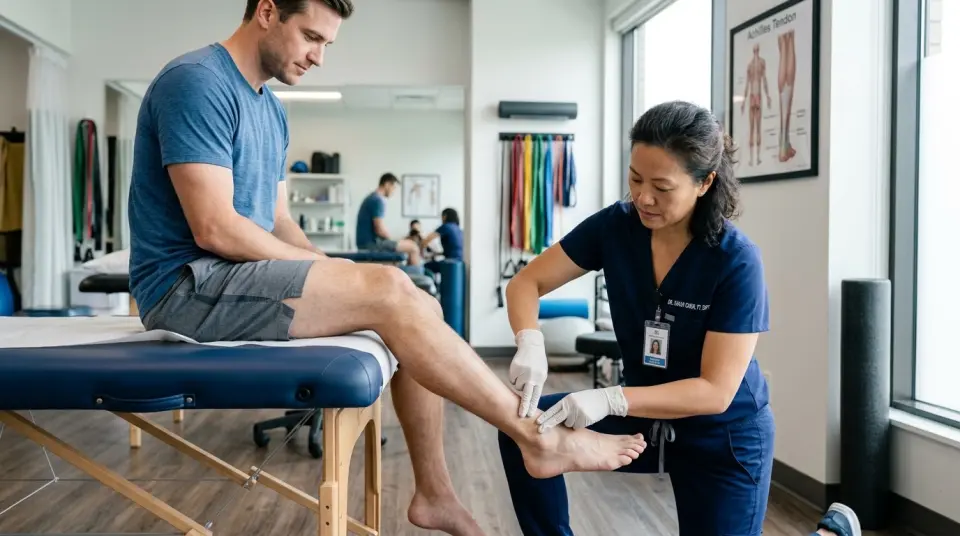
Acute tendonitis often resolves within 2 to 6 weeks with proper treatment. Chronic tendinopathy may require 3 to 6 months of consistent rehabilitation. Early intervention shortens recovery time significantly.
Running through pain that worsens during or after activity risks progression to chronic tendinopathy. If pain stays below a 3 out of 10 and does not increase during the run, cautious continuation at reduced volume may be acceptable. Any pain that limps or alters running form means stopping immediately.
Seek medical attention if pain persists beyond two weeks of home treatment, if you experience sudden sharp pain with a popping sensation, or if swelling and bruising develop around the heel. These symptoms may indicate a partial or complete tendon tear requiring immediate evaluation.
Chronic tendinopathy weakens the tendon structure over time, increasing rupture risk. However, many ruptures occur in tendons without prior symptoms. Maintaining tendon health through consistent strengthening exercises and gradual training progression reduces rupture risk regardless of injury history.
Spring Achilles tendon pain responds well to a combination of load management, eccentric exercises, and gradual return to activity. Most cases resolve within weeks to months. For personalized guidance on Achilles symptoms or any health concern, visit Doctronic.ai for free AI doctor consultations or affordable telehealth visits with licensed physicians.
Get pain relief advice
Chat Now