
Moles on Your Face: When a Cosmetic Concern Becomes a Health One

Medically reviewed by Alan Lucks | MD, Alan Lucks MDPC Private Practice - New York on May 24th, 2026.
Published on April 17th, 2026. Updated on July 23rd, 2026.
Key takeaways
Most facial moles are benign and don't require treatment.
Use the ABCDE criteria (Asymmetry, Border, Color, Diameter, Evolution) to self-screen.
Any mole that changes in size, shape, color, or starts bleeding should be evaluated promptly.
Excision with biopsy is the appropriate treatment for suspicious moles; at-home removal kits carry real risks and should be avoided.
Daily SPF 30+ sunscreen and annual dermatology exams are the most effective long-term prevention strategies.
Doctronic.ai connects you with qualified providers who can evaluate skin concerns and guide next steps.
What Is a Facial Mole?
A mole on your face is usually nothing to worry about. Most adults have between 10 and 40 moles somewhere on their body, and facial moles are among the most common benign skin growths a dermatologist sees. But "usually nothing" is not "always nothing," and knowing the difference could matter a great deal.
Certain changes in a facial mole's appearance are early warning signs of skin cancer, including melanoma, the most serious form. This guide covers what normal moles look like, which changes should prompt a call to your doctor, and your treatment options if removal becomes necessary.
Moles (medically called nevi) develop when pigment-producing cells called melanocytes cluster together rather than spreading evenly across the skin. They can appear anywhere on the face, including the cheeks, forehead, nose, chin, and around the eyes.
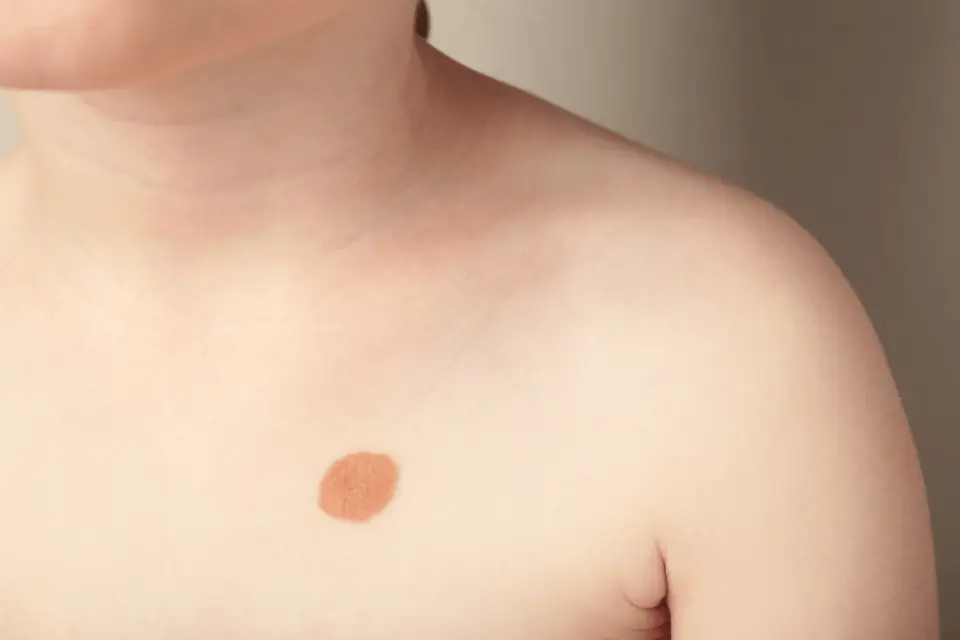
Most moles form during childhood and early adulthood. They're typically round or oval, uniformly colored (tan, brown, or dark brown), and smaller than a pencil eraser (under 6 millimeters). A mole that has been present, stable, and unchanged for years is almost always benign.
New moles that appear after age 40 deserve more attention. While most are still benign, the probability of an atypical or cancerous change is higher in moles that develop later in life.
The ABCDE Method: How to Screen a Mole on Your Face
Dermatologists use the ABCDE criteria to evaluate whether a mole warrants further examination. You can use the same framework at home.
A is for Asymmetry. Draw an imaginary line through the center of the mole. If the two halves don't match, that's asymmetry, a potential warning sign.
B is for Border. Healthy moles have smooth, well-defined borders. Irregular, ragged, notched, or blurred edges are a reason for concern.
C is for Color. A uniform tan or brown is normal. Multiple shades of brown, red, white, or black within a single mole suggest atypical cell activity.
D is for Diameter. Moles larger than 6 millimeters (roughly the diameter of a pencil eraser) are worth evaluating, though some melanomas are smaller.
E is for Evolution. This is the one many people overlook. Any change in size, shape, color, or texture over weeks or months warrants prompt evaluation, as does a mole that starts bleeding, itching, or crusting without injury.
If a mole on your face meets any one of these criteria, schedule an appointment with a board-certified dermatologist. You don't need to meet all five.
When Is a Mole Actually a Problem?
Benign moles have no health consequences. They don't spread, don't cause symptoms, and don't need to be removed unless they're being irritated by clothing, eyewear, or shaving.
The concern arises when a mole becomes dysplastic (atypical) or malignant. Dysplastic nevi have abnormal cell features under a microscope and are considered a risk factor for melanoma, not a guarantee. People with many dysplastic moles have a higher lifetime risk of developing melanoma than the general population.
Melanoma itself can arise in an existing mole or appear as a new lesion. When caught early, melanoma is highly treatable. When it progresses and spreads to lymph nodes or other organs, outcomes become significantly more serious. That's why the ABCDE screening matters, and why annual dermatology exams are a genuine investment in your long-term health.
Other skin lesions sometimes confused with moles include seborrheic keratoses (benign, waxy, "stuck-on" growths common in older adults) and basal cell carcinoma, which often appears on sun-exposed facial skin. A dermatologist can usually distinguish these on visual exam, sometimes with a handheld dermoscope.
See a doctor online today
A licensed doctor can review your symptoms online, talk through next steps, and send a prescription to your pharmacy if appropriate.
- $39 video visit
- Insurance accepted
- 4.8 on Trustpilot
Treatment Options for Facial Moles
Not all mole removal is the same. The method depends on whether the mole is benign, suspicious, or confirmed atypical.
Surgical Shaving
Surgical shaving uses a blade to slice a raised mole flush with the skin surface. It's the most common technique for benign moles that cause irritation or aesthetic concerns. No stitches are required, and healing is typically quick. Cost ranges from $150 to $350 per mole depending on provider and location. Insurance rarely covers removal for cosmetic reasons alone.
Excision with Biopsy
When a mole looks suspicious, a dermatologist will perform a full excision (cutting the mole and a margin of surrounding tissue) and send the sample to a pathology lab. This is the standard approach for anything that might be dysplastic or malignant. Results typically take one to two weeks. If atypical cells are confirmed, a second procedure may be needed to widen the margins.
Insurance usually covers excision when the mole is clinically suspicious. The documentation burden is on your provider to show medical necessity.
Laser Removal
Laser treatments can fade or remove small, flat, benign moles. The limitation: laser destroys tissue rather than preserving it for biopsy. For that reason, most dermatologists won't use laser on a mole that has any atypical features. It's primarily a cosmetic option for clearly benign lesions.
What to Avoid: At-Home Removal Kits
At-home mole removal products are sold online and in some pharmacies. They typically use acids, freezing agents, or abrasive tools to destroy or lift the mole.
Dermatologists consistently advise against them. The risks include infection, permanent scarring, and incomplete removal. More critically, removing a mole at home eliminates any chance of pathological examination. If that mole turned out to be atypical, the opportunity for early detection is gone.
Prevention: Reducing Your Risk Over Time
You can't prevent every mole from forming, but you can meaningfully reduce your risk of atypical moles and skin cancer with consistent sun protection habits.
Apply SPF 30 or higher sunscreen every morning, including cloudy days. UV radiation penetrates cloud cover and accumulates with daily exposure.
Reapply every two hours when outdoors, or after swimming or sweating.
Avoid peak UV exposure between 10am and 4pm when possible.
Wear a wide-brimmed hat and UPF-rated clothing for extended outdoor time.
Never use tanning beds.
Schedule annual dermatology exams, especially if you have many moles, a personal or family history of skin cancer, or fair skin that burns easily.
Sun protection doesn't mean avoidance. It means consistent, habitual use of the tools that are well-established to lower skin cancer risk over a lifetime.
What to Expect at a Dermatology Appointment
If you're concerned about a mole on your face, a dermatology visit is straightforward. The dermatologist will examine all visible moles, often with a dermoscope, and note any that need closer follow-up or removal. If a biopsy is warranted, it can often be done the same day.
Bring a record of when you first noticed the mole, whether it has changed, and any family history of skin cancer. The more context you can provide, the easier it is to prioritize the right next step.
For those who don't have easy access to an in-person dermatologist, teledermatology services can evaluate high-quality photos of suspicious moles and triage appropriately. Doctronic.ai can help you access a dermatology consultation quickly, so you're not left waiting and wondering.

Frequently Asked Questions
Yes, though it's uncommon. Most moles remain stable throughout life. A small percentage become dysplastic (atypical) and an even smaller percentage develop into melanoma. Regular self-screening and annual dermatology exams catch most changes early.
Any mole removal can leave a mark. Surgical shaving typically leaves a flat, faint scar. Excision leaves a linear scar. Laser removal generally produces the least visible result for small benign moles. A skilled dermatologist can advise on the best technique for minimizing scarring at a specific facial location.
Take photos. A clear, well-lit photo of your moles every six to twelve months creates a personal baseline. Comparing over time is often the clearest way to detect slow changes that might not be obvious at a glance.
Laser removal is safe for small, confirmed-benign moles. The key limitation is that lasers destroy tissue without allowing for biopsy. It should never be used on a mole that shows any of the ABCDE warning signs.
See a dermatologist promptly if a mole changes in size, shape, or color; develops irregular borders; starts bleeding, itching, or crusting; or if a new dark lesion appears after age 40. You don't need to wait for your annual exam if something concerns you.
The Bottom Line
A mole on your face is most likely harmless. But most likely isn't certainly, and the difference between a benign nevus and early melanoma is something a dermatologist, not a mirror, can reliably determine. Regular self-exams, annual skin checks, and consistent sun protection are low-effort habits with outsized long-term benefit.
Related articles
Get skin care advice
Chat Now