
Infectious Disease
Pneumonic Plague: What We Know About Symptoms, Spread, and Treatment
October 8, 2026
4 min read

Medically reviewed by Oghenefejiro Okifo | MD, Harvard Medical School | Henry Ford Hospital - Detroit, MI on April 27th, 2026.
Published on April 17th, 2026. Updated on July 23rd, 2026.
The classic Lyme disease rash (erythema migrans) forms an expanding red ring with a clear center, but only about 70-80% of infected people develop any rash at all.
The rash can appear as a solid red patch with no ring, making it easy to mistake for cellulitis, ringworm, or a spider bite.
On darker skin tones, the rash may appear bluish-purple or be difficult to see, which can delay diagnosis.
The rash typically appears 3 to 30 days after a tick bite and grows over days or weeks, sometimes reaching 12 inches or more in diameter.
Do not wait for test results before seeking treatment. Doctors often start doxycycline based on clinical presentation alone.
If you notice a suspicious rash after spending time outdoors in tick-prone areas, Doctronic.ai can connect you with a provider for same-day evaluation.
Questions about Lyme disease rash?
Free. Anonymous. Built by doctors.
This article covers general information. Ask Doctronic about your symptoms, medications, side effects, or treatment options.
Most people picture the Lyme rash as a perfect bullseye: a dark red center surrounded by a pale ring, then another red ring around the outside. That image exists for a reason. It does appear that way in many cases.
In the classic presentation, a red spot forms at the site of the tick bite within a few days to a few weeks. Over the following days, the spot expands outward while the center begins to clear. This creates the concentric ring pattern that doctors call erythema migrans. The rash is usually flat or only slightly raised, warm to the touch, and rarely itchy or painful.
The outer border tends to be more deeply red than the interior, which gives the rash its defined edge. As it grows, the total diameter can range from about 5 centimeters (the minimum size physicians use as a diagnostic threshold) to well over 12 inches.
What makes this rash distinctive is the expansion. Unlike a standard bug bite that peaks and fades, erythema migrans keeps growing over days and weeks. If you notice a circular red mark that is getting larger, that behavior alone should prompt a call to a doctor.
The textbook bullseye is actually the minority presentation. A significant portion of people with erythema migrans develop a uniform red patch without any central clearing. It can look like a red oval or circle that simply continues to expand, with no rings visible at all.
In some cases, the center of the rash becomes darker rather than lighter. Others develop a crusty or blistered center at the bite site, which can make the rash look more like a wound than an infection.
On darker skin tones, the rash may be easy to miss entirely. The typical bright red coloration may not show clearly, and the rash can instead appear as a subtle discoloration or take on a bluish-purple hue. People with brown or dark skin should watch for any expanding patch that feels warm or looks different from the surrounding skin, even if the color is not distinctly red.
This variation in appearance is one reason Lyme disease goes undiagnosed or misdiagnosed more often than it should.
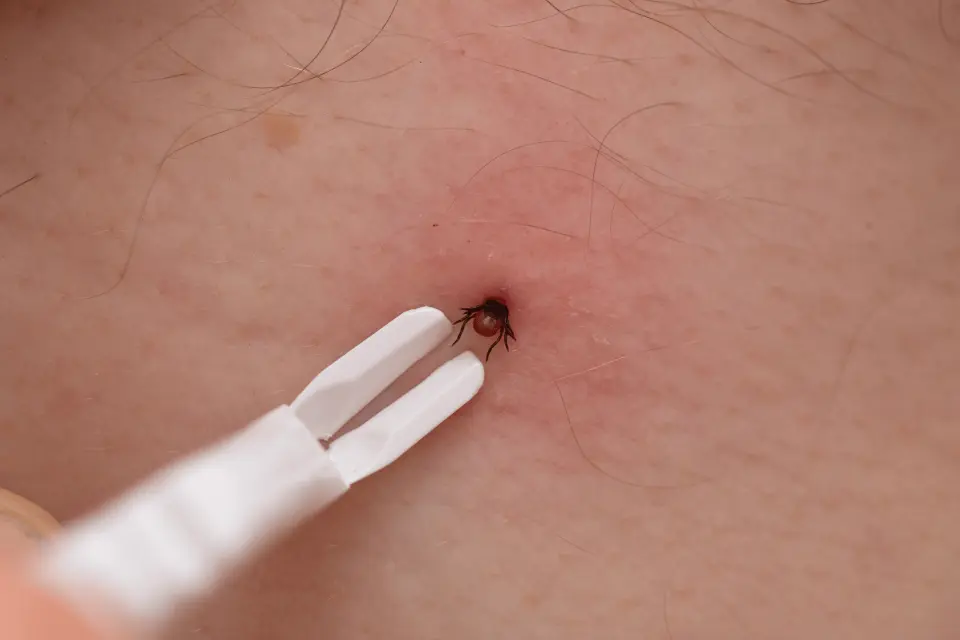
The rash always starts at the location where the tick attached. Ticks prefer warm, hidden areas, which means bites often occur in places that are easy to miss during a skin check.
Common sites include the groin, inner thighs, armpits, behind the knees, around the waist, inside the belly button, and along the scalp or hairline. The back of the neck is also a frequent location, especially in children.
Because these areas are not always in plain view, the rash can grow to a significant size before it is noticed. This is why thorough full-body tick checks after outdoor activity matter, including areas that require a mirror or help from another person to examine properly.
The rash typically appears within 3 to 30 days of the tick bite, with the average being around 7 to 14 days. Most people have no memory of being bitten, since the deer tick nymph (the stage responsible for most infections) is about the size of a poppy seed and its bite is usually painless.
Once the rash appears, it expands steadily. The rate of growth varies, but many rashes double in size within a few days. Left untreated, the rash will continue to grow and can eventually span a large portion of the torso, thigh, or upper arm.
The rash can persist for several weeks without treatment. In some cases, the infection spreads and secondary rashes appear elsewhere on the body, away from the original bite site. These secondary spots indicate early disseminated Lyme disease and require prompt treatment.
Several other conditions can mimic erythema migrans closely enough to cause confusion.
Ringworm is a fungal infection that produces a circular, ring-shaped rash with a clearer center, much like the classic Lyme pattern. The key difference is that ringworm is often scaly and itchy, while erythema migrans is usually smooth and not particularly itchy.
Cellulitis is a bacterial skin infection that causes a spreading red patch, warmth, and swelling. It typically lacks the distinct ring border and is more likely to be painful, but a solid-red erythema migrans can be difficult to distinguish without context.
Spider bites, particularly from brown recluse spiders, can create a small central wound surrounded by expanding redness. The spider bite will usually show more localized tissue damage at the center.
Nummular eczema produces coin-shaped red patches that can look similar in shape, but the patches are scaly, crusted, and extremely itchy, unlike the smooth expansion of a Lyme rash.
Granuloma annulare is another ring-shaped skin condition that can resemble a bullseye but is typically chronic, painless, and not associated with a recent bite or outdoor exposure.
When in doubt, context matters. A ring-shaped rash that appeared after hiking or spending time in a wooded or grassy area, and that is growing over days, should be evaluated for Lyme disease regardless of whether it matches the textbook pattern.
Talk to a doctor about lyme disease
Connect with a licensed doctor online to talk through your symptoms, understand your treatment options, and find out which medications may be available through telehealth.
Photograph it immediately. Take a picture with something for scale (like a ruler or a coin) so you and your doctor can track whether it expands over subsequent days. Note where it appeared, how large it currently is, and when you first noticed it.
See a doctor the same day if possible. The Lyme disease symptoms guidelines from public health authorities make clear that erythema migrans is a clinical diagnosis. A physician does not need to wait for lab results to confirm Lyme disease before starting treatment. In fact, early Lyme testing is often unreliable because the body may not have produced detectable antibodies yet.
Do not remove the rash from your skin, attempt to treat it topically, or wait to see if it goes away. Early treatment is highly effective. Delayed treatment allows the infection to spread.
Doxycycline is the standard first-line antibiotic for early Lyme disease in adults and children older than eight. Most people take it for 10 to 21 days. When started early, this course of treatment resolves the infection in the vast majority of cases with no lasting effects.
The decision to start doxycycline is typically made based on the appearance of the rash and the patient's history of tick exposure, not on blood work. If you are prescribed antibiotics before your test results come back, that is not a mistake. It is standard practice and reflects how confident physicians can be in the clinical diagnosis.
For those with drug allergies or other medical considerations, alternative antibiotics such as amoxicillin or cefuroxime are also effective options.
Understanding the dosing schedule matters too. There is a full guide to doxycycline dosing if you are prescribed this medication and want to understand how to take it correctly.
See a provider the same day you notice an expanding circular rash after outdoor activity. Do not wait to see if it gets bigger or resolve on its own.
Also seek prompt evaluation if you have recently removed a tick and develop flu-like symptoms including fever, fatigue, headache, stiff neck, or muscle aches, even without a visible rash. A portion of people with Lyme disease never develop a rash, so symptom-based concern is enough to warrant testing.
If the rash is accompanied by facial drooping, heart palpitations, or joint swelling, these may indicate Lyme disease has spread and require urgent care.
No. Many cases of erythema migrans appear as a solid expanding red patch with no ring pattern at all. The bullseye is the most recognizable presentation, but physicians are trained to recognize flat red ovals, patchy discoloration on darker skin, and rashes with crusted or blistered centers as potential erythema migrans as well.
Physicians typically use 5 centimeters (roughly 2 inches) as the minimum threshold for a clinical diagnosis of erythema migrans. Smaller red marks at a bite site are more likely to reflect local irritation from the bite itself. The rash commonly grows well beyond this size, sometimes reaching 30 centimeters or more.
Yes. Estimates suggest that somewhere between 20 and 30 percent of people infected with Lyme disease do not develop a visible rash. In those cases, flu-like symptoms after outdoor exposure in a tick-endemic region are the main warning sign and the basis for clinical evaluation.
Ringworm is scaly, often intensely itchy, and does not expand rapidly over days. Erythema migrans is typically smooth, not very itchy, and grows steadily. Location matters too: ringworm commonly appears on the feet, scalp, and groin; a Lyme rash will appear at whatever body part the tick attached to.
No. Blood tests for Lyme disease in the first few weeks of infection are unreliable because the body has not yet produced enough antibodies for the test to detect. Physicians routinely start treatment based on clinical presentation, particularly when erythema migrans is present. Waiting for test confirmation can allow the infection to progress.
The Lyme disease rash is one of the most useful early warning signs of an infection that can cause serious complications if left untreated, but it does not always look the way most people expect. A solid red patch, a faint discoloration on darker skin, or a rash with a crusted center can all be erythema migrans. What they share is expansion over time and a connection to tick exposure.
If you notice a circular or oval rash growing on your skin after spending time outdoors, do not wait to find out whether it matches the classic bullseye image. See a provider the same day. Doctronic.ai offers telehealth visits for rash evaluation so you can get a clinical assessment and, if needed, start treatment the same day, without waiting for a clinic appointment.
Get personalized health advice
Chat Now