Treatment and Prevention
Best Treatment for Acne Scars: A Comprehensive Guide to Clearer Skin
January 22, 2026
2 min read

Medically reviewed by Alan Lucks | MD, Alan Lucks MDPC Private Practice - New York on May 23rd, 2026.
Published on April 9th, 2026. Updated on July 24th, 2026.
Lasers for acne scars fall into two main categories: ablative (removes skin layers) and non-ablative (heats the dermis without removing surface tissue).
Fractional laser technology, which creates microscopic columns of treatment while leaving surrounding tissue intact, has made laser resurfacing safer and faster to recover from than older approaches.
The type of scar you have determines which laser is most appropriate: ice pick scars respond poorly to surface lasers alone, while rolling and boxcar scars often improve significantly with fractional treatments.
Most people need three to six sessions to see meaningful results; single-session outcomes are modest.
Ablative lasers require one to two weeks of downtime. Non-ablative options involve minimal downtime but more sessions.
Post-inflammatory hyperpigmentation is a real risk for medium and darker skin tones, and laser selection matters significantly for those patients.
Laser treatment improves most acne scars by roughly 50 to 75 percent at best. It reduces their appearance; it does not erase them.
A skin evaluation before committing to laser treatment helps confirm your scar type, skin tone risk factors, and whether laser is the right choice at all. Doctronic.ai connects you with licensed clinicians for that assessment without a wait or an office visit.
Questions about laser treatment for acne scars?
Free. Anonymous. Built by doctors.
This article covers general information. Ask Doctronic about your symptoms, medications, side effects, or treatment options.
Lasers work by delivering concentrated light energy to a precise depth in the skin. Depending on the wavelength and delivery method, that energy either removes the outer layers of skin entirely or heats deeper layers to stimulate a wound-healing response.
For acne scars, the goal is collagen remodeling. Acne leaves behind either tissue loss (atrophic scars) or excess collagen buildup (hypertrophic scars). Lasers address atrophic scars by stimulating the body to produce new collagen, filling and smoothing those depressions. For raised scars, certain lasers target the overactive collagen and blood vessels that keep tissue elevated and red.
The outcome is gradual. Collagen takes weeks to months to remodel after each session, which is why results continue improving for up to six months after treatment ends.
Ablative lasers vaporize the outer layers of skin. They are the most aggressive option and produce the most dramatic results, but they also require the longest recovery.
CO2 lasers deliver energy that simultaneously removes the epidermis and heats the upper dermis. They are highly effective for moderate-to-severe atrophic scarring, particularly boxcar and rolling scars. Recovery typically takes one to two weeks, during which the skin is raw, weeping, and sensitive.
Erbium (Er: YAG) lasers work similarly but with less heat transfer to surrounding tissue, which translates to slightly less downtime (five to seven days) and a somewhat lower risk of post-treatment redness that lingers for weeks. Results are comparable to CO2 for shallow to moderate scars, but somewhat less effective on deeper ones.
Both ablative types carry a meaningful risk of post-inflammatory hyperpigmentation in medium to dark skin tones and require strict sun avoidance before and after treatment.
Non-ablative lasers leave the skin surface intact while heating the dermis beneath to stimulate collagen production. The trade-off is less downtime (usually one to three days of mild redness and swelling), but more sessions are needed, and per-session improvement is more modest.
The pulsed dye laser (PDL) targets blood vessels and is particularly useful for red or pink hypertrophic scars and post-inflammatory erythema. It does little for atrophic scars but can significantly reduce the redness and elevation of raised tissue.
Nd: YAG lasers penetrate deeper into the skin and are often used for collagen stimulation in darker skin tones, where surface ablation carries a higher risk. Results require patience and consistency across multiple sessions.
Fractional technology is now the most commonly used approach for acne scars because it balances efficacy with safety.
Fractional lasers deliver energy in thousands of microscopic columns, called microthermal treatment zones, leaving the tissue between them untouched. The intact surrounding skin accelerates healing and lowers the risk of complications compared to treating the entire surface at once.
Fractional ablative lasers (fractional CO2 or fractional Er: YAG) still remove skin within each micro-column but spare the tissue between them, cutting downtime to five to seven days while delivering results closer to fully ablative treatments.
Fractional non-ablative lasers (such as Fraxel Restore) treat within the dermis without removing surface skin. Downtime is typically two to four days. Multiple sessions are necessary, but the risk profile is more favorable for a wider range of skin tones.
Picosecond lasers (PicoSure) use acoustic waves rather than just heat.
Ice pick scars are narrow, deep channels that extend into the dermis. Surface lasers, even ablative ones, do not reach deep enough to fully address them. These scars typically respond better to a technique called punch excision or CROSS (chemical reconstruction of skin scars using TCA), with laser treatment afterward as a supplementary smoothing treatment.
Boxcar scars, which are wider depressions with defined edges, respond well to fractional ablative treatments. The sharper edges that define them can be softened, and the scar base elevated as collagen fills in over time.
Rolling scars involve fibrous bands tethering the skin downward, creating an undulating texture. Subcision to release those bands is often performed first, followed by laser resurfacing to smooth the surface. Laser alone is less effective on rolling scars that are still actively tethered.
Hypertrophic scars benefit most from pulsed-dye laser therapy, which reduces redness and flattens raised tissue over three to five sessions. Keloids are generally not treated with laser alone and may worsen with certain approaches. A dermatologist's evaluation is essential before laser treatment on keloid-prone skin.
Stop using retinoids, AHAs, and BHAs at least five to seven days before treatment. Avoid sun exposure for four to six weeks prior. If you have a history of cold sores, an antiviral prescription is typically started beforehand to prevent an outbreak. Darker skin tones are often pretreated with a topical brightening agent for four to six weeks before an ablative laser procedure to reduce the risk of hyperpigmentation.
A topical numbing cream is applied before treatment. Ablative sessions on larger areas may use nerve blocks or oral sedation. Most patients describe a warm, prickling sensation. Sessions run thirty to sixty minutes.
Recovery varies by laser type. Fully ablative treatments leave skin raw and weeping for three to five days, with full healing over ten to fourteen days and residual redness persisting for weeks. Fractional ablative treatments involve redness and swelling for two to four days, with most people returning to work within five to seven days. Non-ablative approaches cause one to three days of mild redness with minimal disruption to daily activities.
Post-treatment: SPF 30 or higher every day for at least three months is non-negotiable. Use gentle cleansers and fragrance-free moisturizers. Avoid retinoids, acids, and active ingredients until skin is fully healed. Do not pick peeling skin.
Laser treatment for acne scars is cosmetic and not covered by insurance in most cases.
Non-ablative fractional sessions range from $200 to $1,500 per session, with three to six sessions commonly needed, placing total costs between $600 and $6,000. Ablative fractional treatments run $1,000 to $3,500 per session but may require fewer sessions. Fully ablative CO2 resurfacing of the entire face can range from $4,000 to $6,000 or more per session.
Prices vary by provider credentials, geographic market, and whether sedation is involved. Board-certified dermatologists and plastic surgeons typically charge more than medical spas but bring greater expertise in managing complications.
Most people see a 50 to 75 percent improvement in the appearance of treated scars: smoother texture, softer edges, and less visible depth. Scars are reduced, not erased. Before-and-after photographs typically show clear improvement, but scars remain visible under close inspection or certain lighting.
Results depend on scar type, depth, skin tone, laser selection, and provider skill. Combining laser with other procedures (subcision for rolling scars, fillers for deep boxcar scars) often produces better outcomes than laser alone.
The acne scar treatments most likely to succeed are matched specifically to the scar types and risk profile of the individual patient, which is why a thorough consultation matters before committing. Understanding laser skin procedures more broadly helps patients ask better questions and set accurate expectations.
The most common complication is post-inflammatory hyperpigmentation. Fitzpatrick skin types IV through VI face a higher baseline risk with ablative lasers, but darker skin tones can be treated safely with appropriate laser selection and an experienced provider.
Other risks include burns from incorrect settings, infection from poor wound care, prolonged redness lasting weeks to months after ablative treatment, and, rarely, additional scarring. Active acne at the time of treatment can also interfere with healing.
People finishing isotretinoin are typically advised to wait six months before laser resurfacing, as the medication affects skin regeneration and wound healing.
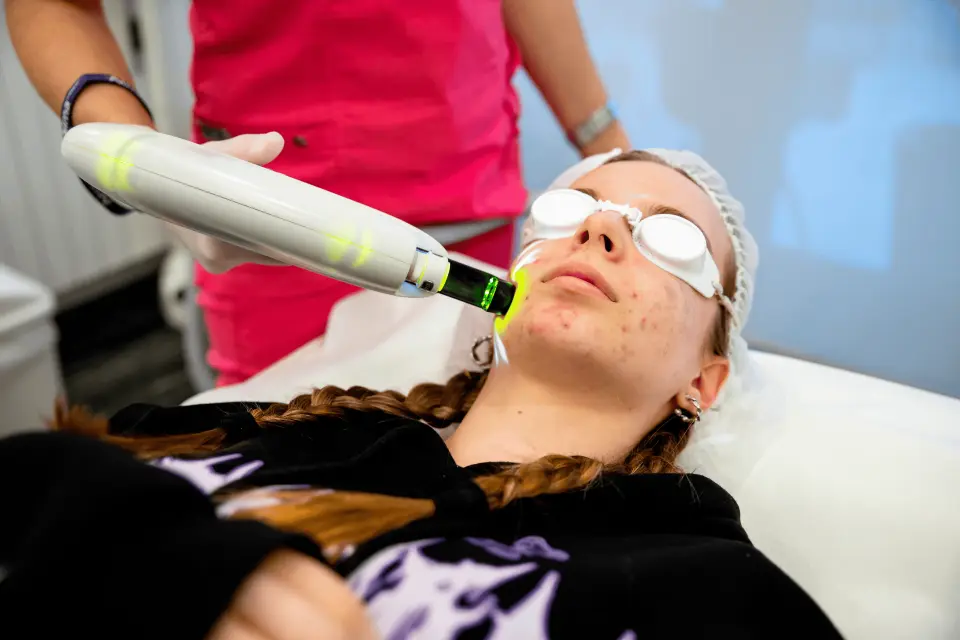
Most treatment plans call for three to six sessions, spaced four to eight weeks apart. Ablative lasers may produce significant results in fewer sessions but require longer recovery after each one. Non-ablative and fractional non-ablative approaches typically require more sessions for comparable improvement.
Topical numbing cream is applied before every session, and most people tolerate the procedure well. Ablative treatments can be more intense, and some providers offer oral sedation or nerve blocks for larger treatment areas. The sensation is commonly described as a warm snapping or pricking feeling.
In the hands of a qualified provider, the risk of worsening scars is low but not zero. Post-inflammatory hyperpigmentation is the most common concern, particularly in medium to dark skin tones. Choosing a provider with specific experience treating diverse skin tones significantly reduces this risk.
Collagen remodeling continues for three to six months after each session. Most people begin to notice visible improvement within four to eight weeks of a session, with full results emerging gradually over the full course of treatment.
Both are effective, and the right choice depends on scar type and skin tone. Microneedling carries a lower risk of post-inflammatory hyperpigmentation and works well across all skin tones. Laser is generally more effective per session for surface resurfacing but requires more careful patient selection. Many treatment plans use both.
Subcision is commonly performed before laser to release the fibrous bands causing rolling scars. Dermal fillers can elevate residual depressions after resurfacing. Chemical peels are sometimes used between sessions to maintain surface smoothness. Most providers map out a multi-modal plan based on scar type.
Laser treatment is one of the most effective options for atrophic acne scars, like boxcar and rolling scars. The key is matching the right laser to the right scar on the right skin tone, and going in with accurate expectations: improvement, not erasure.
Before committing, understanding your scar types and risk factors matters, since the right approach depends on whether your scars are atrophic, hypertrophic, or a mix of both.
Doctronic.ai connects you with licensed clinicians who can evaluate your skin and determine whether laser treatment is the right next step, so you can avoid investing in a procedure that may not fit your needs.
Explore treatment options
Chat Now