Bone & Joint Health
What Is a Dangerously High Calcium Level and What Does It Mean?
July 21, 2026
6 min read

Medically reviewed by Lauren Okafor | MD, The Frank H Netter MD School of Medicine, Loyola University Medical Center on April 19th, 2026.
Published on April 9th, 2026. Updated on July 23rd, 2026.
Sore knees after a winter exercise break are common and usually caused by deconditioning, increased load, and tightness in surrounding muscles.
The most frequent culprits include patellofemoral pain, IT band syndrome, and patellar tendinitis, all of which respond well to targeted stretching and strengthening.
Ice after activity, rest from aggravating movements (not full rest), and OTC anti-inflammatories can reduce short-term discomfort.
Gradually increasing mileage or training load using the 10% rule reduces the risk of overuse injuries.
If your knee locks, gives way, swells significantly, or hurts at rest, see a doctor. Doctronic.ai connects you with licensed clinicians to evaluate knee pain without leaving home.
Questions about sore knees?
Free. Anonymous. Built by doctors.
This article covers general information. Ask Doctronic about your symptoms, medications, side effects, or treatment options.
A few weeks off the trails feels harmless in January. But by spring, your body has quietly adapted to doing less. Muscles weaken, connective tissues tighten, and the neuromuscular patterns that made running feel effortless fade.
When you start pounding pavement again, your knees absorb the impact of that mismatch. Several factors compound this soreness:
Deconditioning is the foundation of the problem. After weeks of reduced activity, the quadriceps, hamstrings, and glutes lose strength and endurance. Because the knee is a hinge joint stabilized by the muscles above and below it, weaker surrounding muscles transfer more stress to the joint itself.
Sudden load increases amplify the issue. Jumping back to last fall's mileage after months off is a recipe for overuse injuries. Tendons and cartilage adapt more slowly than your cardiovascular system, so you may feel aerobically ready before your tissues actually are.
Tight quads and hamstrings pull on the kneecap (patella) from above and below, altering its tracking in the groove where it sits. When the patella does not track smoothly, repetitive movement creates friction and inflammation.
Weak glutes are an underappreciated driver of knee pain. The gluteus medius stabilizes the hip during single-leg activity like running. When this muscle is weak, the femur rotates inward with each stride, increasing load on the inner and outer knee structures.
This is the most common overuse knee pain complaint, especially among runners and hikers. It produces a dull ache around or behind the kneecap, often worsened by stairs, squatting, prolonged sitting with bent knees, and downhill running. It typically develops when the patella tracks improperly due to quad tightness, weak glutes, or both.
The iliotibial band is a thick strip of connective tissue that runs from the hip down the outer thigh to the knee. When it becomes tight or overloaded, it rubs against the outer femoral condyle, causing a sharp, burning pain on the outside of the knee. IT band syndrome is especially common when runners increase mileage quickly or add hill work.
Sometimes called jumper's knee, patellar tendinitis involves inflammation of the tendon connecting the kneecap to the shinbone. It produces pain just below the kneecap, typically worse with running, jumping, and squatting. It develops when the quad muscles are tight or weak, increasing tension on the tendon.
The menisci are two C-shaped cushions of cartilage that absorb shock inside the knee joint. Returning to exercise with tight hips and weak stabilizers can place asymmetrical load on them, causing dull aching or stiffness. A true meniscus tear typically involves a popping sensation and significant swelling. Mild irritation without structural damage is more common after a fitness break.
Ice after activity. Applying ice to the knee for 15 to 20 minutes after exercise reduces inflammation and post-workout swelling. Use a cloth barrier to protect your skin and repeat two to three times in the hours following activity.
OTC anti-inflammatories. Ibuprofen or naproxen sodium can reduce swelling and discomfort when used as directed. They are most useful during the first few days of a flare, not as an ongoing treatment.
Relative rest, not total rest. Stopping all movement allows muscles to weaken further and delays recovery. The goal is to pause the specific activity causing pain while maintaining low-impact movement like walking, swimming, or cycling. This keeps blood flowing to the tissues without repeating the aggravating load.
Compression and elevation. A compression sleeve can reduce swelling and provide mild proprioceptive support during activity. Elevating the leg after activity encourages fluid drainage from the joint.
Stretching the muscles that pull on the knee from above and below is one of the most effective ways to reduce irritation and prevent recurrence.
Stand near a wall for balance. Bend one knee and bring your heel toward your glute, holding your ankle with the same-side hand. Keep knees together and hips slightly forward. Hold for 30 seconds per side. Tight quads are a primary driver of patellofemoral pain.
Sit at the edge of a chair with one leg extended forward, heel on the floor. Keep your back straight and hinge at the hips until you feel a pull along the back of the thigh. Hold for 30 seconds per side. Tight hamstrings increase load on the back of the knee.
Lie on your side with a foam roller under your outer thigh, just below the hip. Using your arms for support, slowly roll from the hip to just above the knee. Pause on tender spots for 20 to 30 seconds. Avoid rolling directly over the joint. This is especially important for anyone with outer-knee pain.
Stand facing a wall with both hands on the surface. Step one foot back, heel pressed to the floor, knee straight. Lean into the wall until you feel a stretch in the lower leg. Hold for 30 seconds per side. Calf tightness can alter gait mechanics and increase knee stress.
Stretching addresses tightness. Strengthening addresses the root cause: muscles that are not capable of absorbing the loads placed on them. These exercises target the quad, hip, and glute groups most responsible for knee stability.
Stand with your back flat against a wall. Slide down until your thighs are parallel to the floor (or as close as pain allows) and hold for 30 to 60 seconds. Wall sits build quad endurance without the joint stress of a weighted squat.
Lie on your back with one leg bent and the other straight. Tighten the quads of the straight leg and raise it to the height of the bent knee. Hold briefly, then lower slowly. Do three sets of 15 per side. This strengthens the quad while keeping the knee in a safe, unloaded position.
Lie on your side with hips and knees bent at 45 degrees, feet stacked. Keeping your feet together, slowly lift your top knee. Hold two seconds, then lower. Do three sets of 15 per side. Clamshells target the gluteus medius, the key muscle for hip and knee alignment during running.
Stand in front of a low step (6 to 8 inches is ideal). Step one foot onto the surface and drive through that heel to bring the other foot up. Step down slowly. Do three sets of 12 per leg. Step-ups train the quad and glute together in a single-leg pattern that mirrors real-life loading.
See a doctor online today
A licensed doctor can review your symptoms online, talk through next steps, and send a prescription to your pharmacy if appropriate.
The 10% rule is the most widely cited guideline for return-to-activity progressions: increase your weekly mileage or training load by no more than 10% per week. A few additional principles help:
Run on softer surfaces where possible. Grass, packed dirt trails, and rubberized tracks absorb more impact than concrete or asphalt. Downhill terrain is especially hard on the patellofemoral joint and IT band.
Warm up before each session with five to ten minutes of brisk walking or low-intensity cycling.
Prioritize the strengthening exercises above before adding mileage. Two to three sessions per week of targeted hip and quad work during the first four to six weeks creates a more stable foundation. Understanding patellofemoral pain syndrome can help you recognize early warning signs and adjust your training before symptoms escalate.
Replace worn footwear. Running shoes lose cushioning before they look worn out. Most should be replaced every 300 to 500 miles.
If you are unsure whether your knee pain is simple return-to-exercise soreness or something more serious, an online knee pain symptom checker can help you assess your symptoms before deciding on your next step.
Most return-to-exercise knee soreness improves within one to two weeks with relative rest, stretching, and strengthening. These symptoms require professional evaluation:
Locking or catching inside the knee (the joint gets stuck mid-motion)
Giving way (the knee suddenly buckles or feels unstable during weight-bearing)
Significant swelling that developed rapidly after activity
Pain that is present at rest or wakes you up at night
Pain that does not improve after two weeks of self-care
A popping sensation at the time of injury, followed by swelling
These findings may indicate a meniscal tear, ligament injury, or cartilage damage, warranting imaging and hands-on assessment.
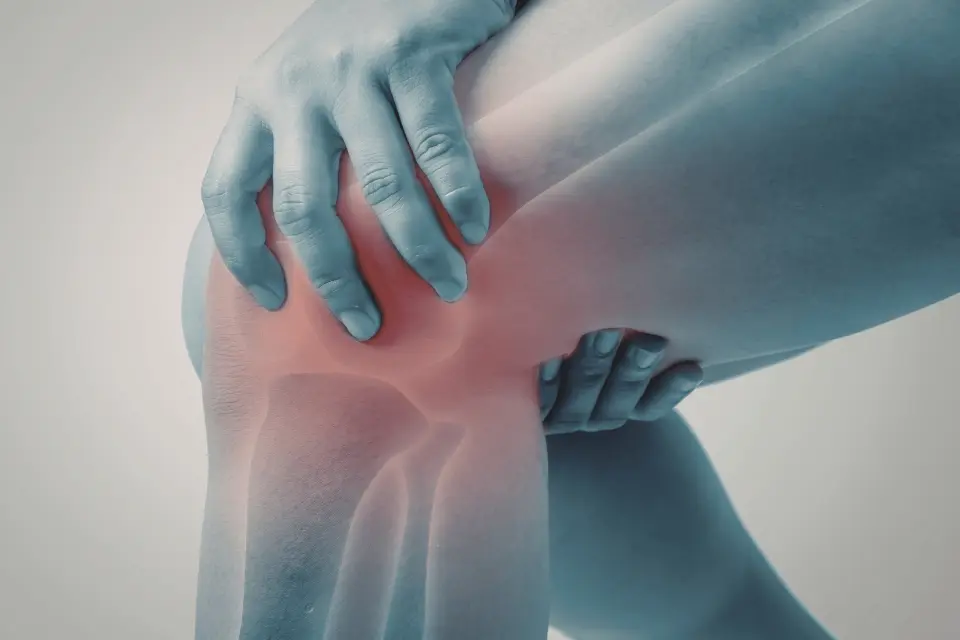
When you stop exercising for several weeks, the muscles that support and stabilize the knee, especially the quads, hamstrings, and glutes, weaken. When you restart activity, those muscles cannot absorb load as efficiently, so more stress falls on the tendons, cartilage, and joint surfaces. This produces soreness and sometimes inflammation.
It depends on the type and severity of the pain. Mild, diffuse soreness that fades within an hour after finishing a run and does not worsen across consecutive sessions is generally safe to train through at a reduced intensity. Sharp pain, pain that increases during a run, or pain accompanied by swelling are signals to stop and rest.
With appropriate rest, stretching, and strengthening, most overuse knee soreness improves within one to three weeks. If symptoms persist beyond that window without improvement, an evaluation with a clinician is appropriate.
Ice is generally preferred in the first 48 to 72 hours after onset or after activity, when inflammation is active. Heat can be useful for chronic stiffness or tight muscles before exercise, but applying it to an actively inflamed joint can increase swelling.
Yes. The gluteus medius controls hip alignment during single-leg loading. When it is weak, the thigh rotates inward with each step, increasing lateral force on the kneecap and outer knee structures. Clamshells and lateral band walks target this muscle effectively.
Telehealth is a practical option when knee pain has not improved with self-care within one to two weeks, or when you want guidance on whether imaging or an in-person orthopedic visit is needed. Doctronic.ai connects you with a clinician who can review your symptoms and recommend next steps.
Sore knees do not have to derail your spring plans. Most return-to-exercise knee pain is a predictable response to reloading tissues that rested all winter. Ice, relative rest, targeted stretching, and progressive strengthening address the underlying causes rather than just the symptoms. If your pain persists, escalates, or involves alarming signs like locking or giving way, Doctronic.ai makes it easy to get a clinical evaluation from home.
Get fitness and rehab advice
Chat Now