Bone & Joint Health
What Is a Dangerously High Calcium Level and What Does It Mean?
July 21, 2026
6 min read

Medically reviewed by Lauren Okafor | MD, The Frank H Netter MD School of Medicine, Loyola University Medical Center on April 12th, 2026.
Published on March 25th, 2026. Updated on July 23rd, 2026.
Achilles tendonitis affects the tendon connecting calf muscles to the heel bone, with early symptoms including morning stiffness and localized swelling
Active rest and proper load management speed recovery faster than complete immobilization
Eccentric strengthening exercises, particularly the Alfredson Protocol, remain the gold standard for rehabilitation
Progressive loading and proper running mechanics are essential for preventing re-injury
Chronic pain lasting beyond 12 weeks warrants professional evaluation through telehealth or in-person consultation
Dealing with persistent Achilles pain? Doctronic.ai offers free AI doctor consultations to help you assess your symptoms and decide on the right next step
Questions about Achilles tendonitis?
Free. Anonymous. Built by doctors.
This article covers general information. Ask Doctronic about your symptoms, medications, side effects, or treatment options.
That sharp pain behind your ankle isn't something to ignore. Achilles tendonitis affects approximately 2.35 per 1,000 people annually, with the vast majority of ruptures occurring during recreational sports. The good news: most cases respond well to conservative treatment when addressed early and correctly. The bad news: many people make recovery harder by following outdated advice or pushing through pain.
Understanding how to speed up recovery and prevent re-injury starts with recognizing what you're dealing with and applying the right strategies at the right time. Skipping steps or returning to activity too quickly almost guarantees a longer recovery or repeated injury.
The location of your pain determines which type of tendonitis you have. Non-insertional tendonitis affects the middle portion of the tendon, typically 2-6 centimeters above where it attaches to the heel. This type is more common in younger, active individuals and often responds well to eccentric exercises.
Insertional tendonitis occurs where the tendon meets the heel bone. It frequently involves bone spurs and can be more stubborn to treat. This type affects both active and sedentary people, and certain exercises that work well for non-insertional cases can actually aggravate insertional problems. Knowing which type you have guides your entire treatment approach.
Catching tendonitis early makes recovery significantly faster. Pain and stiffness are usually the first signs, with discomfort typically worse in the morning. Many people notice a characteristic "cigar-shaped" area of swelling over the affected tendon.
The pain pattern follows a predictable course. Initial discomfort during activity that fades with rest eventually becomes pain that persists after exercise. Left untreated, it progresses to constant discomfort that affects daily activities. If you're questioning whether your symptoms warrant attention, Doctronic.ai offers free AI doctor visits that can help you assess your condition and determine next steps.
Complete rest sounds logical but actually slows healing. Tendons need controlled stress to repair properly. The key is reducing load enough to allow healing while maintaining enough stress to stimulate tendon remodeling.
Active rest means modifying activities rather than stopping them entirely. Swimming, cycling, and upper body exercises maintain fitness without stressing the Achilles. Walking remains acceptable for most people when pain stays below 3 out of 10. Activities that cause pain above 5 out of 10 should be avoided until symptoms improve.
Cold therapy applied for 15-20 minutes after activity helps manage acute inflammation. Compression sleeves provide support and can reduce swelling throughout the day. These methods work best during the first 1-2 weeks of treatment.
Elevation above heart level when resting promotes fluid drainage from the injured area. Combining cold therapy, compression, and elevation creates an effective anti-inflammatory approach without medication side effects. Anti-inflammatory drugs can be used short-term but may actually impair tendon healing if used for extended periods.
Eccentric exercises involve lengthening the muscle under load rather than shortening it. The Alfredson Protocol involves heel drops performed with straight and bent knees, three sets of 15 repetitions, twice daily.
Start by standing on a step with heels hanging off the edge. Rise up on both feet, then slowly lower using only the affected leg over three seconds. The exercise should produce mild discomfort but not severe pain. Progress by adding weight in a backpack once bodyweight becomes easy.
Tight calf muscles contribute directly to Achilles tendon strain. Wall stretches with a straight leg target the gastrocnemius, while stretches with a bent knee address both major calf muscles. Hold each stretch for 30 seconds, three times per leg, twice daily.
Ankle mobility exercises improve range of motion that may be limited by pain or swelling. Alphabet exercises, where you trace letters with your foot, maintain joint mobility without stressing the tendon. Foam rolling the calves reduces muscle tension that contributes to tendon strain.
Isometric exercises provide immediate pain relief for many people. Standing calf raises held at the top position for 30-45 seconds, repeated five times, can reduce pain for several hours. This technique works well before activities that typically aggravate symptoms.
The pain-relieving effect of isometrics makes them valuable during early rehabilitation when other exercises are too painful. They also serve as a warm-up before eccentric exercises once recovery progresses.
See a doctor online today
A licensed doctor can review your symptoms online, talk through next steps, and send a prescription to your pharmacy if appropriate.
Extracorporeal shockwave therapy uses sound waves to stimulate healing in chronic cases. Research supports its effectiveness when conservative treatment fails after at least 3 months. Treatment typically involves weekly sessions for 3-6 weeks.
Platelet-rich plasma injections concentrate healing factors from your own blood and inject them into the damaged tendon. Results vary, and this treatment is typically reserved for cases that don't respond to exercise-based rehabilitation. Doctronic.ai can help you understand whether these advanced treatments might benefit your specific situation.
Heel lifts reduce tension on the Achilles tendon and can provide immediate relief. A 5-10 millimeter lift in both shoes prevents asymmetry that could cause other problems. Gradually reduce the lift height as symptoms improve.
Supportive shoes with adequate cushioning protect the tendon during daily activities. Avoid flat shoes and going barefoot during recovery. Custom orthotics may help people with foot mechanics that contribute to tendon overload, though over-the-counter options work for many people.
Returning to full activity too quickly is the primary cause of re-injury. A gradual progression over 8-12 weeks allows the tendon to rebuild strength. Start with low-impact activities and slowly increase duration and intensity.
The 10% rule provides a practical guideline: increase weekly training volume by no more than 10%. This applies to both mileage and intensity increases in training volume to prevent overload. Tendons adapt more slowly than muscles, so patience during this phase is essential.
Pain monitoring guides progression. Activities that cause pain above 3 out of 10 during exercise or increased symptoms the following morning indicate too much load. Backing off for a few days then progressing more gradually prevents setbacks.
Running form significantly affects Achilles tendon stress. Overstriding, where the foot lands far ahead of the body, increases tendon load. A slight forward lean and quicker cadence reduces this stress.
Strengthening hip and core muscles improves running mechanics indirectly. Weak hips cause compensations that increase ankle and tendon stress. A comprehensive strength program addressing the entire kinetic chain prevents the imbalances that contribute to tendonitis.
Pain lasting beyond 12 weeks despite appropriate treatment signals that professional guidance is needed. A sports medicine specialist or physical therapist can identify factors that self-treatment might miss, including biomechanical issues, training errors, or underlying conditions.
Imaging studies like ultrasound or MRI help assess tendon damage severity and guide treatment decisions. Early professional involvement often shortens overall recovery time compared to extended self-management. Doctronic.ai connects patients with licensed physicians through telehealth for convenient initial evaluation and specialist referrals when needed.
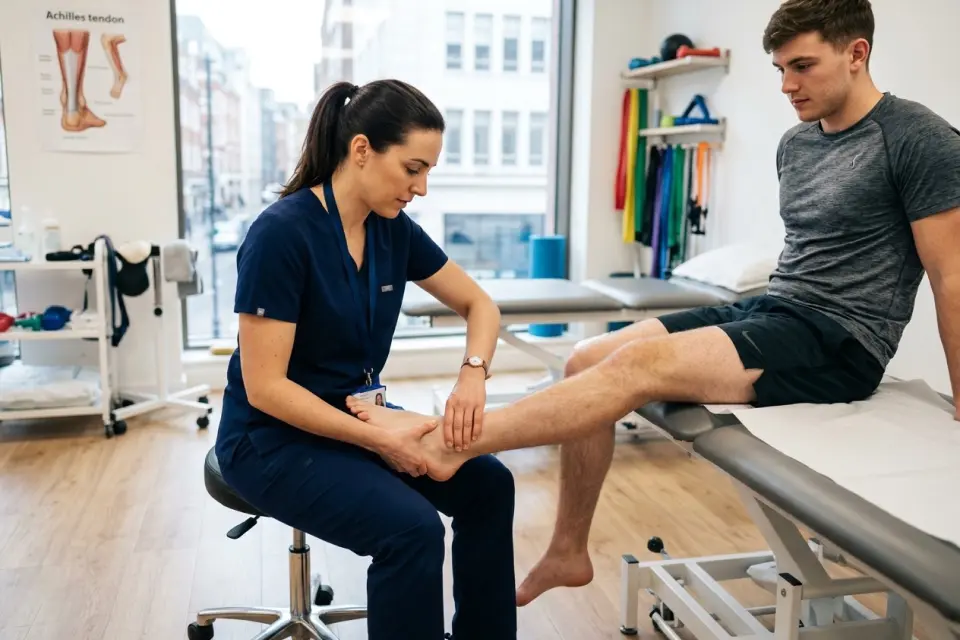
Most cases improve within 6-12 weeks with consistent treatment. Mild cases caught early may resolve in 3-4 weeks, while chronic tendonitis can take 3-6 months. Following a structured rehabilitation program and avoiding re-aggravation significantly shortens recovery time.
Yes, but you need to modify your activities. Low-impact exercises like swimming, cycling, and upper body strength training maintain fitness while allowing the tendon to heal. Running and jumping should be reduced or temporarily avoided. Gradual reintroduction of high-impact activities while building strength allows many runners to continue training during recovery.
Both are important, but strengthening through eccentric exercises produces better outcomes than stretching alone. Stretching the calf muscles complements strengthening exercises by reducing tension on the tendon.
Sudden increases in activity, wearing flat shoes, hill running, and ignoring early warning signs all worsen the condition. Complete rest can also delay healing by depriving the tendon of the controlled stress it needs to repair.
Achilles tendonitis recovery requires the right balance of rest, targeted exercises, and gradual return to activity. Following evidence-based rehabilitation protocols while monitoring symptoms prevents the frustrating cycle of re-injury that affects so many people. For personalized guidance on your recovery, visit Doctronic.ai for free AI consultations or affordable telehealth visits with licensed physicians.
Get personalized health advice
Chat Now