Bone & Joint Health
What Is a Dangerously High Calcium Level and What Does It Mean?
July 21, 2026
6 min read

Medically reviewed by Lauren Okafor | MD, The Frank H Netter MD School of Medicine, Loyola University Medical Center on March 16th, 2026.
Published on February 11th, 2026. Updated on July 23rd, 2026.
Scoliosis is a lateral curvature of the spine, typically defined as a Cobb angle ≥10°, and affects approximately 2–3% of the population, consistent with estimates of 6–9 million people in the United States.
Severity varies widely, ranging from mild curves that require only observation to more significant deformities that may require bracing or surgical correction.
Early detection—often through school or clinical screening—helps identify curves at a stage where monitoring or bracing may limit progression, although it does not guarantee prevention of worsening.
Treatment is individualized based on curve magnitude, skeletal maturity, and symptoms, and may include observation, bracing, physical therapy, or surgery.
Doctronic.ai offers AI-assisted health guidance to help answer questions about spinal conditions and connect patients with licensed providers
Questions about scoliosis?
Free. Anonymous. Built by doctors.
This article covers general information. Ask Doctronic about your symptoms, medications, side effects, or treatment options.
A healthy spine has natural curves when viewed from the side, but it should appear relatively straight when viewed from behind. When the spine develops a sideways (lateral) curvature, this is termed scoliosis. Scoliosis can affect individuals across all age groups, though it is most commonly identified during adolescence. Population estimates suggest that scoliosis affects approximately 2–3% of individuals, corresponding to roughly 6 to 9 million people in the United States.
Understanding scoliosis begins with recognizing how and why spinal alignment changes, and how those changes may impact overall function and health.
Scoliosis is defined as a lateral spinal curvature of at least 10 degrees, measured using the Cobb angle on radiographic imaging. In many cases, the curvature is accompanied by vertebral rotation, giving the spine a three-dimensional deformity rather than a simple side bend.
Curves may resemble an “S” or “C” shape and vary widely in severity.
Mild curves are often asymptomatic and discovered incidentally
Moderate to severe curves may lead to visible asymmetry, discomfort, or, in more advanced cases, cardiopulmonary compromise
It is important to distinguish between postural (non-structural) and structural scoliosis.
Postural scoliosis is a flexible curvature caused by external factors such as muscle imbalance, leg length discrepancy, or habitual positioning.
The spine itself is structurally normal
The curve typically resolves with position changes, such as lying supine or correcting posture
Structural scoliosis, in contrast, involves fixed anatomical changes within the spine.
The curvature does not correct with repositioning
It is often associated with vertebral rotation and structural alterations
Common causes include idiopathic scoliosis, congenital abnormalities, or neuromuscular conditions
Structural scoliosis requires clinical evaluation, monitoring, and sometimes intervention, depending on curve progression and patient-specific factors.
 Common Types and Classifications
Doctors group scoliosis into several categories based on when it appears and the causes. Each type has different treatment approaches and outcomes.
Idiopathic means "unknown cause," and this type accounts for about 80% of all scoliosis cases. It most commonly appears during the growth spurt before puberty, between ages 10 and 15. Girls are more likely than boys to have curves that worsen and need treatment.
If your child has scoliosis, don't be concerned. The key is being aware of it and getting an early diagnosis so you can begin treatment. When treated early, there's a lot of hope for stopping curve progression and allowing kids to live a perfectly active, normal life.
Congenital scoliosis develops before birth when the spinal bones form incorrectly. Some vertebrae may be missing, partially formed, or fused together. This type often appears alongside other birth differences affecting the heart or kidneys.
Neuromuscular scoliosis results from conditions that affect the nerves and muscles, such as cerebral palsy or muscular dystrophy. The muscles cannot support the spine properly, leading to curves that often progress quickly and become severe.
Adult-onset scoliosis develops from wear and tear on the spine over time. The discs between vertebrae break down unevenly, and arthritis changes the joints. Scoliosis prevalence increases with age, affecting approximately 12% of adults over 25 and up to 68% of adults over 60.
See a doctor online today
A licensed doctor can review your symptoms online, talk through next steps, and send a prescription to your pharmacy if appropriate.
Related medications we prescribe
Learn moreEarly detection of scoliosis makes treatment more effective. Parents, teachers, and individuals should watch for these warning signs.
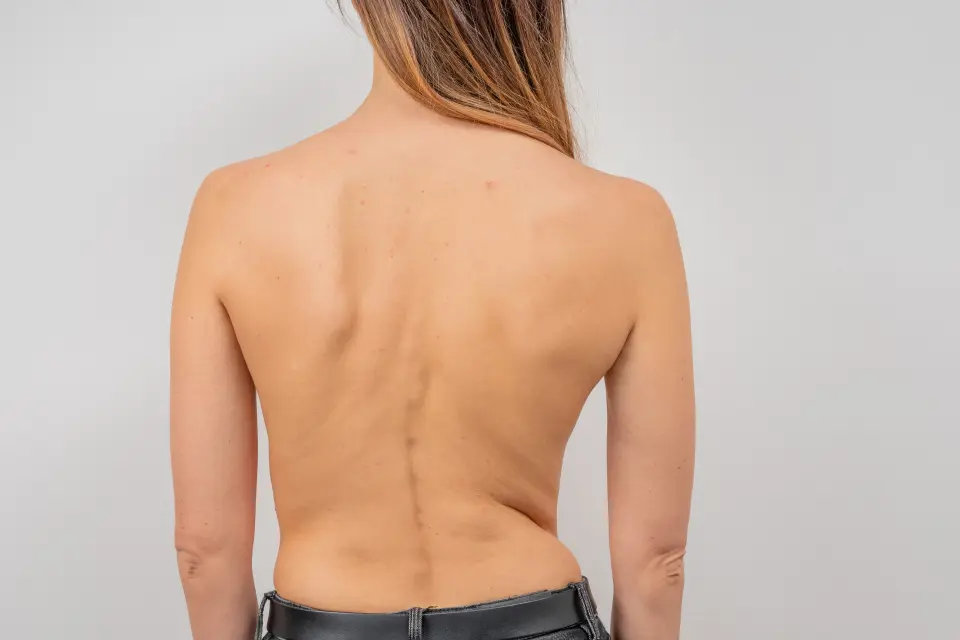
The most obvious signs include uneven shoulders or hips. One shoulder blade may stick out more than the other. The waist might appear uneven, with one side looking higher. Clothes may hang differently on each side of the body.
People with scoliosis may lean to one side when standing. Their head might not center directly over the pelvis. Walking patterns may change as the body compensates for a curved spine. Some individuals develop a noticeable limp or shuffle.
Children with scoliosis rarely experience pain, but adults often do. Back pain, muscle fatigue, and stiffness are common with adult scoliosis. Severe curves can compress the lungs, making breathing difficult. Leg pain or numbness may occur if the curve pinches nerves.
If you notice these symptoms, Doctronic.ai can help you understand what questions to ask your doctor and what steps to take next.
Proper diagnosis requires both physical examination and imaging studies. These tools help doctors track changes over time.
This simple screening test catches most cases of scoliosis. The person bends forward at the waist with arms hanging down and knees straight. The examiner looks at the back from behind, watching for a rib hump or uneven muscle prominence on one side. Schools often include this test during routine health screenings.
X-rays confirm the diagnosis and measure the curve precisely. Doctors use the Cobb angle method to determine severity. They draw lines along the top and bottom vertebrae of the curve and measure the angle where these lines meet.
Curves under 10 degrees are considered normal spine variation. Curves between 10 and 25 degrees need monitoring. Curves over 25 degrees in growing children often require bracing. Curves exceeding 45-50 degrees may need surgery.
Treatment depends on curve size, patient age, and growth remaining. The goal is to prevent progression while maintaining quality of life.
Small curves in patients who have finished growing often need only periodic checkups. Doctors typically schedule X-rays every 6 to 12 months to ensure the curve stays stable. Growing children with mild curves need closer monitoring since curves can worsen quickly during growth spurts.
Doctronic.ai helps patients track their symptoms between appointments and understand what changes warrant contacting their doctor.
Bracing is most effective for growing children with moderate curves between 25 and 40 degrees. The brace does not straighten the spine but can prevent the curve from worsening. Most braces must be worn 16 to 23 hours daily until growth stops.
Physical therapy strengthens the muscles supporting the spine. Specific exercises can improve posture, reduce pain, and increase flexibility. The Schroth method and similar approaches teach patients how to work against their curves through targeted movements.
Surgery becomes necessary when curves exceed 45-50 degrees or continue progressing despite other treatments. Spinal fusion remains the most common procedure. Surgeons straighten the spine using metal rods and screws, then fuse the vertebrae together so they heal as one solid bone.
Recovery takes several months, and patients must avoid certain activities during healing. Most people return to normal activities within a year, though the fused section of the spine will not bend.
Most scoliosis cannot be prevented because the cause remains unknown. Good posture and exercise do not prevent structural scoliosis, though they support overall spine health.
Curves under 30 degrees typically stay stable in adulthood. Larger curves may progress slowly over time, about 0.5 to 1 degree per year, depending on curve type and bone health. Degenerative scoliosis in older adults can worsen as the spine continues to change.
Most adults with scoliosis can exercise without restrictions. Low-impact activities like swimming, walking, and yoga often help manage symptoms. High-impact sports may require modifications based on curve severity.
Scoliosis does run in families, though no single gene causes it. Having a parent or sibling with scoliosis increases risk, making screening important for family members.
Scoliosis of the spine affects millions of Americans but responds well to early detection and proper treatment. Whether monitoring a mild curve or considering surgery for a severe one, understanding your options helps you make informed decisions about care.
For questions about spinal conditions or any health concerns, visit Doctronic.ai for AI-guided medical information and connections to licensed clinicians. Over 1 million people have used this service to get answers fast and connect with real doctors when needed.
Non-Structural Scoliosis (Postural Scoliosis) – Precision Health Spine and Sports Clinic
Why Early Scoliosis Screening Matters | Miller Children's & Women's Hospital
Hresko MT. Clinical practice. Idiopathic scoliosis in adolescents. New England Journal of Medicine. 2013;368(9):834–841.
Weinstein SL, Dolan LA, Cheng JCY, Danielsson A, Morcuende JA. Adolescent idiopathic scoliosis. The Lancet. 2008;371(9623):1527–1537.
Negrini S, Donzelli S, Aulisa AG, et al. 2016 SOSORT guidelines for the management of idiopathic scoliosis. Scoliosis and Spinal Disorders. 2018;13:3.
U.S. Preventive Services Task Force. Screening for adolescent idiopathic scoliosis. JAMA. 2018;319(2):165–172.
Get personalized health advice
Chat Now