
Rash on Your Stomach: Common Causes and When to Get It Checked

Medically reviewed by Oghenefejiro Okifo | MD, Harvard Medical School | Henry Ford Hospital - Detroit, MI on May 20th, 2026.
Published on April 17th, 2026. Updated on July 23rd, 2026.
Key takeaways
Stomach rashes are frequently caused by contact dermatitis from clothing waistbands, belt buckles, or skincare products, but heat rash, infections, and systemic conditions are also common
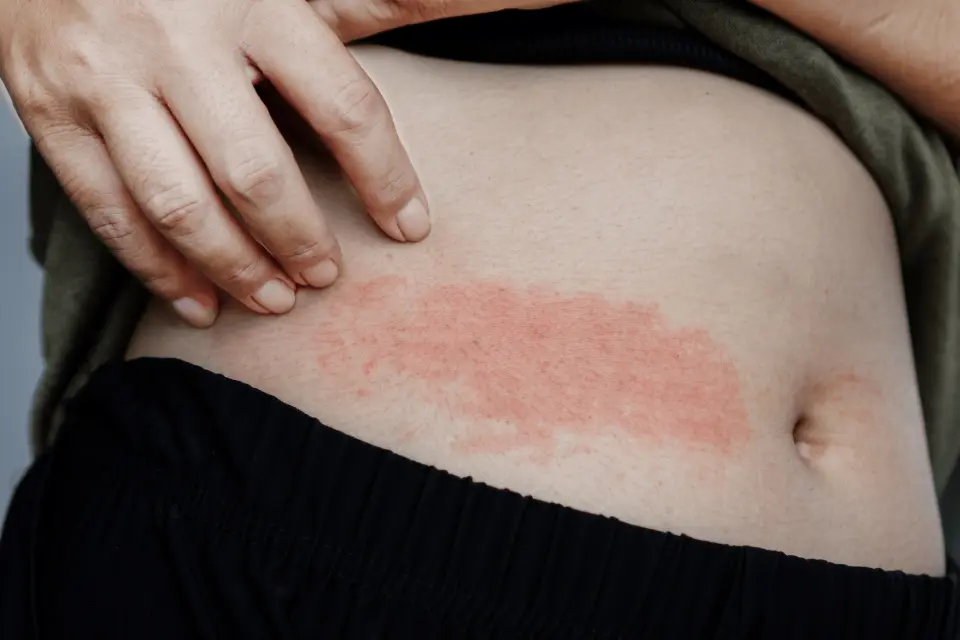
The shape, texture, and distribution of the rash provide the most reliable clues: a perfectly circular pattern suggests ringworm, a belt-like stripe suggests shingles, and itchy red patches in skin folds suggest heat rash or candidiasis
Many stomach rashes resolve within days with basic home care, including removing the trigger, keeping the area dry, and applying hydrocortisone cream
Rashes accompanied by fever, blistering, swollen lymph nodes, or spreading redness beyond the original area require medical evaluation
Hives on the stomach that come and go quickly, especially alongside throat tightness or difficulty breathing, may signal a serious allergic reaction requiring emergency care
Not sure what's causing your stomach rash? Doctronic.ai offers free AI doctor visits and affordable telehealth consultations to help identify the cause
Questions about stomach rashes?
Free. Anonymous. Built by doctors.
This article covers general information. Ask Doctronic about your symptoms, medications, side effects, or treatment options.
Why Stomach Rashes Are So Common
The abdomen and stomach area is a high-friction zone. Waistbands, belts, tight clothing, and elastic waistbands press against the skin for hours each day. Sweat collects in the skin folds at the lower abdomen. Sunscreen, lotion, or laundry detergent residue can linger on a large surface area of skin. All of these factors make the stomach an area where rashes are extremely common and often recurrent.
Most people experience a stomach rash at some point, and most cases are not serious. Identifying the most likely cause directs treatment efficiently and helps avoid repeating the trigger. Doctronic.ai can assist with symptom assessment before a clinical visit.
Contact Dermatitis from Waistbands and Accessories
Metal Hardware in Clothing
Nickel is present in jean buttons, belt buckles, snap fasteners, and zipper hardware. It is one of the most common contact allergens. Allergic contact dermatitis from nickel typically produces a round or oval itchy red patch on the lower abdomen directly beneath where the metal hardware presses against the skin. The rash appears 24 to 72 hours after exposure in someone already sensitized.
Switching to nickel-free clothing hardware or placing a fabric barrier between the skin and metal hardware resolves most cases. Patch testing by a dermatologist can confirm nickel allergy when the pattern is ambiguous.
Elastic Waistbands and Rubber
Elastic waistbands can cause irritation in two ways. Direct friction from tight elastic produces a linear, slightly raised red mark wherever the band presses. Some individuals develop true allergic contact dermatitis to chemical accelerators used in rubber elastic. This reaction produces a more clearly demarcated, intensely itchy stripe around the waist.
Laundry Products and Fabric Softeners
Fragrance and preservative residues in laundry detergents and fabric softeners accumulate in clothing fabric and press against the skin all day. The rash from laundry product sensitivity tends to be widespread and less sharply defined than metal contact dermatitis. Switching to fragrance-free, dye-free detergents and rinsing clothing an extra cycle often produces rapid improvement.
Heat Rash and Sweat-Related Irritation
The skin folds of the lower abdomen and pannus in overweight individuals create ideal conditions for heat rash. Blocked sweat ducts produce miliaria, which appears as tiny red or clear fluid-filled bumps in the area where skin folds trap heat and moisture. It is most common in summer and feels prickly or stinging rather than intensely itchy.
Treatment involves cooling and drying the area. Loose, breathable cotton clothing, cooling showers, and keeping skin folds dry with a soft cloth or absorbent powder help resolve it within days.
Candidal Intertrigo in Skin Folds
Candidiasis in skin folds produces a bright red, moist rash with a sharp border and characteristic satellite lesions, small spots scattered just outside the main rash border. It is caused by overgrowth of Candida yeast, which thrives in warm, moist environments. The lower abdominal fold, particularly in individuals with obesity, diabetes, or those who take antibiotics, is a prime location.
Candidiasis of the skin responds well to topical antifungal creams containing clotrimazole or miconazole applied twice daily. Keeping the fold dry is equally important. Recurrent cases may require oral antifungal treatment or evaluation for underlying diabetes.
Ringworm on the Abdomen
Tinea corporis, commonly called ringworm, is a superficial fungal infection that produces scaly, circular patches with a raised red border and a clearing center. On the abdomen, it can result from contact with an infected person or animal. It is not caused by a worm; the name comes from its ring-like appearance.
Mild cases respond to over-the-counter antifungal creams. The rash should improve within one to two weeks of consistent application. If it continues to spread or does not respond to topical treatment, oral antifungal medication may be needed.
Psoriasis on the Abdomen
Psoriasis produces well-defined, thick, silvery-scaled plaques on a red or pink base. On the abdomen, plaques often appear around the navel or in the skin folds. Unlike eczema, the plaques have a clearly defined edge and may feel less itchy than other rash types. Psoriasis is a chronic autoimmune condition; it does not spread from person to person.
Management depends on severity. Topical corticosteroids and vitamin D analogs are first-line for limited disease. More widespread or resistant psoriasis may require light therapy, biologics, or systemic medications.
Shingles Across the Abdomen
Shingles, or herpes zoster, results from reactivation of the varicella-zoster virus that causes chickenpox. It often appears on the abdomen and chest because it follows the path of intercostal nerves, which wrap around the trunk from the spine to the front of the body. The rash appears as a band of painful, fluid-filled blisters on one side only, often preceded by burning pain, tingling, or sensitivity to touch for several days before blisters emerge.
Antiviral medications including valacyclovir, famciclovir, and acyclovir are most effective when started within 72 hours of rash onset. Early treatment reduces both the severity of the rash and the risk of postherpetic neuralgia, a painful nerve complication that can persist for months. Any blistering, one-sided, painful rash on the abdomen should be evaluated promptly.
Get rash treatment online today
A licensed doctor can review your symptoms and send a prescription to your pharmacy, often the same day.
- $39 video visit
- Insurance accepted
- 4.8 on Trustpilot
Related medications we prescribe
Learn moreEczema on the Abdomen
Atopic dermatitis can affect the abdomen, though it more commonly affects skin folds. On the stomach, it produces dry, scaly, intensely itchy patches that may become thickened from repeated scratching. Triggers include harsh soaps, wool fabrics, sweat, and stress.
Management involves identifying and avoiding triggers, regular use of fragrance-free moisturizers, and applying topical corticosteroids or calcineurin inhibitors during flares. Atopic dermatitis is a chronic condition that typically requires long-term management rather than a cure.
Hives and Allergic Reactions
Urticaria, or hives, produces raised, blanching welts that can appear anywhere on the body, including the stomach. Hives itch intensely and tend to move around, with individual lesions resolving within 24 hours while new ones appear elsewhere. Common triggers include certain foods, medications, viral infections, insect stings, and physical factors like pressure or cold.
Hives limited to the skin are uncomfortable but not dangerous. Hives accompanied by throat tightness, difficulty breathing, dizziness, or tongue swelling may indicate anaphylaxis, which is a medical emergency requiring epinephrine and immediate emergency care.
When to Get a Stomach Rash Checked
Most stomach rashes can be managed at home when they are mild and the likely cause is apparent. Evaluation is appropriate when:
The rash is spreading rapidly or covers a large area of the body. The rash is accompanied by fever, chills, or significant malaise. Blistering is present, especially if it follows a stripe pattern on one side of the body. The rash shows signs of infection including increasing pain, pus, or red streaks extending from the rash. Over-the-counter treatment has not improved the rash after two weeks. The rash is recurrent and the cause is unclear.
Frequently Asked Questions
A recurring linear rash at the waistband line is typically nickel contact dermatitis from a metal button or snap, rubber latex allergy from elastic, or friction irritation from a tight band. Nickel allergy is the most common. Try switching to clothing with fabric-covered elastic waistbands and no metal hardware to see if the rash resolves.
Stress can trigger flares of underlying conditions, including eczema and psoriasis, and can cause hives directly. It does not cause most other types of rashes, but can worsen existing skin conditions significantly.
Fungal rashes typically have a few distinguishing features: ringworm produces a ring-shaped patch with a clearing center, while candidiasis in a skin fold produces a bright red moist rash with satellite spots. Both are more common in warm, humid conditions. Over-the-counter antifungal creams can be tried for suspected mild fungal rashes.
Several rashes occur specifically in pregnancy. Pruritic urticarial papules and plaques of pregnancy (PUPPP) are the most common, causing itchy red bumps and plaques that typically start on the abdomen. Intrahepatic cholestasis of pregnancy can cause intense itching without a primary rash. Any new rash during pregnancy should be evaluated by a healthcare provider.
Mild allergic or inflammatory rashes often respond well to 1% over-the-counter hydrocortisone cream applied twice daily for up to one week. It is not appropriate for fungal rashes (it can worsen them), infected skin, or shingles blisters. If the cause is uncertain, it is better to have the rash evaluated before applying corticosteroids.
The Bottom Line
Most stomach rashes have an identifiable and treatable cause. Removing triggers, keeping the area dry, and using appropriate topical treatments resolves the majority of cases. For rashes that spread, blister, come with fever, or keep returning without explanation, get a clinical evaluation.
Doctronic.ai connects you with a licensed provider at any hour to assess your symptoms and guide next steps, including referrals to in-person care when needed.
Related articles
Get advice about rash on your stomach
Chat Now