
Psoriasis vs. Rosacea: Key Differences and How Sun Affects Both

Medically reviewed by Oghenefejiro Okifo | MD, Harvard Medical School | Henry Ford Hospital - Detroit, MI on May 22nd, 2026.
Published on April 17th, 2026. Updated on May 28th, 2026.
Key takeaways
Psoriasis and rosacea both cause visible skin changes, but are caused by different mechanisms and require different treatments
Psoriasis is an autoimmune condition that produces thick, scaly plaques; rosacea is a chronic vascular condition that causes persistent redness, flushing, and sometimes papules on the face
Sun exposure affects the two conditions differently: ultraviolet light often improves psoriasis plaques but consistently triggers and worsens rosacea flares
Neither condition is contagious
Accurate diagnosis is essential before starting treatment since approaches that help one condition can worsen the other
For an evaluation of your skin symptoms and a treatment plan, Doctronic.ai connects you with a licensed provider on demand
What Is Psoriasis
Psoriasis is an autoimmune skin disease in which the immune system signals the body to overproduce skin cells. Normally, skin cells take about a month to cycle from production to shedding. In psoriasis, that cycle compresses to days, causing cells to accumulate faster than they can be shed.
The result is thick, raised plaques covered with silvery or white scales. Plaques are most common on the knees, elbows, lower back, and scalp, though they can appear anywhere, including nails, palms, and the soles of the feet. Skin beneath the scales is typically red and inflamed and may crack or bleed.
Psoriasis affects roughly 2 to 3 percent of the global population. It tends to run in families and may be triggered or worsened by infections, certain medications, stress, injury to the skin, and smoking. The condition follows a pattern of flares and remissions for most people.
What Is Rosacea
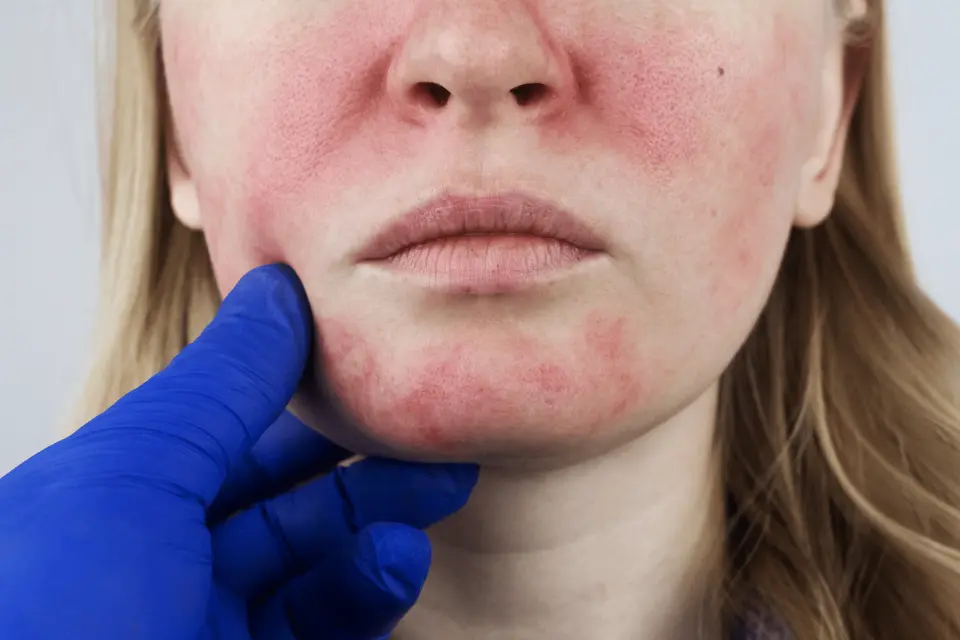
Rosacea is a chronic inflammatory skin condition that primarily affects the face. It causes persistent redness, visible blood vessels, and a tendency to flush easily. In some subtypes, small red bumps or pus-filled papules appear on the nose, cheeks, chin, and forehead, making it easy to confuse with adult acne.
Ocular rosacea, which involves redness, irritation, and sensitivity in the eyes, affects a substantial portion of people with rosacea and may develop before or after the skin symptoms.
Rosacea affects an estimated 5 to 10 percent of the global population and most commonly presents in fair-skinned people in their 30s through 50s, though it can appear in any skin tone or age group. Triggers include sun exposure, heat, spicy foods, alcohol, exercise, emotional stress, and certain skincare products. The condition is chronic and does not resolve on its own, but it can be managed effectively with treatment and trigger avoidance.
Key Differences at a Glance
The most important differentiators between the two conditions involve location, appearance, and texture.
Psoriasis produces raised, scaly plaques on the body, often on extensor surfaces like elbows and knees. Rosacea is almost entirely facial, typically affecting the central face, including nose, cheeks, and chin.
Psoriasis scales are thick and silvery. Rosacea produces no scaling. The primary visual signs of rosacea are redness, visible blood vessels (telangiectasia), and a tendency to flush.
Both conditions can involve the face, but psoriasis on the face tends to appear on the hairline, eyebrows, and around the nose, with visible scaling. Facial rosacea produces diffuse redness without the buildup of scale.
Itching is common with psoriasis and less typical with rosacea, though some people with rosacea report burning or stinging sensations.
Get psoriasis treatment online today
A licensed doctor can review your symptoms and send a prescription to your pharmacy, often the same day.
- $39 video visit
- Insurance accepted
- 4.8 on Trustpilot
Related medications we prescribe
Learn moreHow Sun Affects Psoriasis
Ultraviolet (UV) radiation has a well-documented therapeutic effect on psoriasis for many people. Narrowband UVB phototherapy, a controlled medical treatment using specific UV wavelengths, is an established and effective treatment for moderate to severe psoriasis. Many people with psoriasis notice improvement in their plaques with moderate, unprotected sun exposure during summer months.
However, the relationship is not uniformly positive. Severe sunburns can trigger a psoriasis flare through a phenomenon called the Koebner response, in which new plaques develop at sites of skin injury. People with psoriasis who sun-expose should do so moderately and avoid burning.
Additionally, immunosuppressive medications used to treat psoriasis, including some biologics, increase photosensitivity and skin cancer risk, making sun protection important for those patients even if UV helps their plaques when unmedicated.
How Sun Affects Rosacea
Sun exposure is one of the most consistent and powerful triggers for rosacea flares. UV radiation dilates superficial blood vessels and worsens the persistent redness, flushing, and papules characteristic of rosacea. Many people with rosacea report that even brief sun exposure triggers a flush that lasts hours.
Daily broad-spectrum sunscreen with SPF 30 or higher is a cornerstone of rosacea management. Mineral sunscreens containing zinc oxide or titanium dioxide are generally better tolerated than chemical sunscreens for rosacea-prone skin, since chemical UV filters can cause stinging or irritation. The mineral vs. chemical sunscreen distinction is worth understanding before choosing a product.
Protective clothing, hats with brims, and avoiding midday sun reduce cumulative UV exposure. Sun protection alone does not treat rosacea but significantly reduces the frequency and severity of flares.
Why the Distinction Matters for Treatment
Getting the diagnosis right before starting treatment is important because some approaches that help one condition can worsen the other.
Topical corticosteroids are commonly used for psoriasis flares but are generally not recommended for long-term use on rosacea. Prolonged steroid use on facial skin can thin the skin, worsen redness, and cause a steroid-induced rosacea variant called perioral or periorificial dermatitis.
Psoriasis treatments range from topical vitamin D analogs and corticosteroids to systemic medications and injectable biologics targeting specific immune pathways. Rosacea treatment options focus on topical metronidazole, azelaic acid, or ivermectin for papular subtypes, oral antibiotics for moderate cases, and laser or light-based therapies for persistent redness and visible vessels.
A dermatology evaluation establishes the correct diagnosis and guides an appropriate treatment plan. If in-person access is limited, a telehealth provider can review images and symptom history to help differentiate the two conditions and recommend next steps.
Frequently Asked Questions
Yes. The two conditions are unrelated mechanistically, and having one does not protect against or cause the other. People with both conditions need separate treatment approaches for each.
No. Rosacea and acne share some visual similarities, including red papules on the face, but they are caused by different mechanisms and require different treatments. Acne involves clogged pores and bacterial overgrowth. Rosacea is a vascular and inflammatory condition without comedones (blackheads or whiteheads). Applying acne treatments like benzoyl peroxide to rosacea-prone skin often worsens irritation.
Many people with plaque psoriasis notice improvement with moderate sun exposure. UV light slows the overgrowth of skin cells that produce plaques. However, sunburns worsen psoriasis, and people on certain psoriasis medications should use sun protection regardless of how UV affects their plaques.
Sun exposure, heat, spicy foods, alcohol, vigorous exercise, emotional stress, and harsh skincare products are the most commonly reported triggers. Triggers vary between individuals, and keeping a symptom journal helps identify personal patterns.
Both conditions have a genetic component. Psoriasis has a stronger hereditary link, with identified genes involved in immune regulation that increase susceptibility. Rosacea also clusters in families and is more common in people of Northern European descent, suggesting genetic factors, though the specific genes are less well characterized.
For psoriasis, some evidence links anti-inflammatory diets, weight management, and reduced alcohol intake to improved outcomes, though diet is not a substitute for medical treatment. For rosacea, dietary triggers like alcohol and spicy food reliably worsen flares in many patients. No single diet cures either condition.
Yes, in most cases. While moderate UV exposure may help psoriasis, sunscreen is still important to prevent burns (which can trigger flares), reduce skin cancer risk, and protect any skin not directly involved in phototherapy. People on immunosuppressive treatments for psoriasis have an increased risk of skin cancer and should use sun protection consistently.
The Bottom Line
Psoriasis and rosacea have distinct causes and require different treatments. Psoriasis produces scaly plaques from immune overactivity; UV light often helps. Rosacea causes facial redness from vascular sensitivity, and the sun consistently makes it worse. Treating the wrong condition makes things worse.
Doctronic.ai connects you with a licensed provider to evaluate your skin, clarify the diagnosis, and build a tailored treatment plan.
Related articles
Compare your treatment options
Chat Now