Bone & Joint Health
What Is a Dangerously High Calcium Level and What Does It Mean?
July 21, 2026
6 min read

Medically reviewed by Lauren Okafor | MD, The Frank H Netter MD School of Medicine, Loyola University Medical Center on April 20th, 2026.
Published on April 17th, 2026. Updated on July 23rd, 2026.
Early physical therapy intervention can reduce the need for surgery by approximately 40 percent when patients stay consistent with their program.
Recovery unfolds in three phases: acute protection (weeks 1-2), mobility restoration (weeks 2-6), and functional return to daily activity (week 6 and beyond).
The first PT appointment establishes baseline measurements, including range of motion, muscle strength, and swelling, that guide the entire treatment plan.
Home exercise programs performed between clinic visits are essential. Progress depends on what happens outside the clinic as much as inside it.
Non-surgical treatment typically spans 8-16 weeks. Post-surgical rehabilitation often takes 4-9 months.
If you are unsure whether your knee symptoms require imaging, surgery consultation, or physical therapy, Doctronic.ai can connect you with a licensed clinician who can evaluate your situation and give you a clear next step.
The knee is the largest joint in the body, and also among the most vulnerable. Ligament sprains, meniscus tears, tendinitis, and patellofemoral syndrome are among the most common orthopedic complaints seen by clinicians, and all of them respond to physical therapy as a first-line intervention.
Physical therapy works by addressing the underlying contributors to knee pain and dysfunction: weakness in the surrounding muscles, restricted range of motion, poor movement mechanics, and impaired proprioception. Treating these factors directly produces recovery that is more durable than rest alone, and often eliminates the need for more invasive interventions.
Understanding what to expect from the process helps patients commit to it fully. Physical therapy requires active participation, patience, and consistency. The results are proportional to the effort.
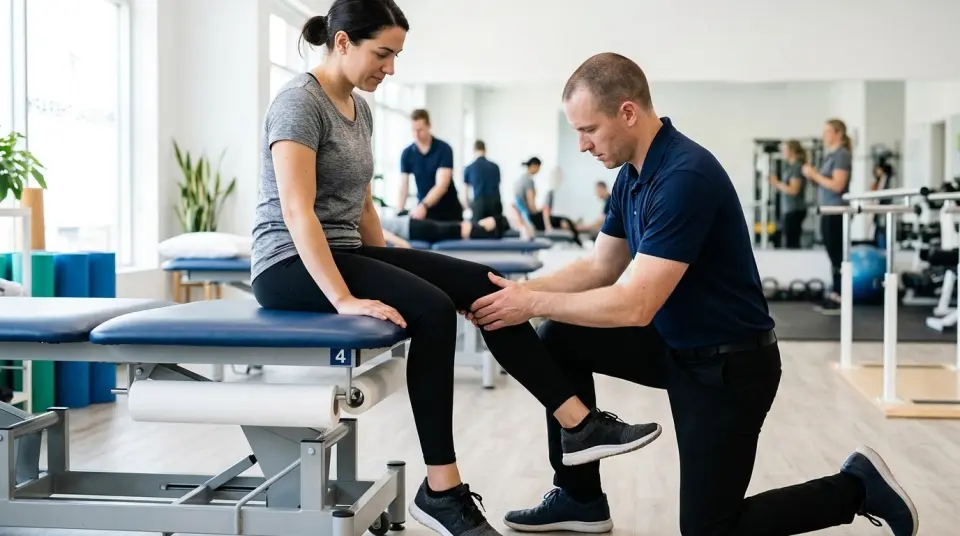
The first session is primarily an evaluation. The physical therapist measures your current range of motion in both flexion (bending) and extension (straightening), tests the strength of your quadriceps, hamstrings, calf muscles, and hip stabilizers, and assesses how swelling and pain affect movement.
Gait analysis, observing how you walk, reveals compensatory movement patterns that often contribute to knee pain or complicate recovery. A history of the injury, including when and how it occurred, what makes it better or worse, and what you want to return to, shapes the goals of the plan.
Rather than working from generic timelines, experienced physical therapists calibrate expectations to individual circumstances: injury type and severity, pre-injury fitness level, surgical or non-surgical status, and what functional demands matter most to the patient.
A competitive athlete returning to sport has different benchmarks than someone recovering from knee replacement surgery. Both deserve a plan tailored to their specific situation.
The first phase prioritizes damage control and pain management. Ice, compression, and elevation reduce acute swelling. Weight-bearing is limited based on injury severity. The goal is not to push through pain but to create the conditions under which healing can begin.
Gentle range-of-motion exercises are often introduced in this phase to prevent stiffness. Quadriceps setting (tightening the muscle without moving the joint) helps maintain muscle activation even when weight-bearing is restricted.
As inflammation subsides, the focus shifts to restoring full range of motion and rebuilding foundational strength. Exercises in this phase include straight-leg raises, heel slides, mini squats, and terminal knee extensions, progressing in resistance and complexity as strength returns.
Manual therapy, hands-on techniques including joint mobilizations and soft tissue work, complements exercise during this phase. These techniques improve joint mechanics and tissue extensibility in ways that exercise alone cannot fully achieve.
Knee injuries and disorders vary considerably in the structures involved and how each responds to rehabilitation, which is why diagnosis precedes any effective physical therapy plan.
The third phase prepares the knee for real-world demands. Exercises become progressively loaded and complex: lunges, step-ups, single-leg squats, lateral movements. The criteria for advancement are objective measures, not just time elapsed.
Proprioception training, exercises that challenge balance and joint position sense, is a critical component of this phase. An injury that disrupts proprioception without being addressed leaves the knee vulnerable to re-injury even after pain resolves.
The quadriceps are the primary shock absorbers for the knee joint. Weakness in the quads is consistently associated with both knee injury risk and poor recovery outcomes. Rebuilding quad strength is therefore central to almost every knee rehabilitation program.
Hip abductors and external rotators are equally important but often overlooked. Weakness in these muscles alters lower-limb alignment, placing excessive stress on the knee during walking, stairs, and impact activities. A comprehensive program addresses the entire kinetic chain from the hip down.
Tight hamstrings restrict full knee extension and contribute to chronic anterior knee pain. Tight calves affect ankle mechanics in ways that transfer stress upward to the knee. Stretching and mobility work are not optional parts of knee rehab: they are prerequisites for moving correctly under load.
Beyond ice and compression, physical therapists use transcutaneous electrical nerve stimulation (TENS), ultrasound, and dry needling to manage pain and promote tissue healing. These modalities support the primary work of exercise without replacing it.
Get knee pain treatment online today
A licensed doctor can review your symptoms and send a prescription to your pharmacy, often the same day.
Related medications we prescribe
The exercises done between clinic visits account for more total volume than those performed in sessions. A well-designed home exercise program, carried out consistently and with proper form, is the single most reliable predictor of how quickly a patient progresses.
Common reasons people fall short: exercises are too numerous, too time-consuming, or unclear. Communicating honestly with your physical therapist when the program is not working allows adjustments that keep you on track.
Doctronic.ai can supplement your physical therapy with clinical guidance on symptoms, medication questions, or secondary concerns that arise during recovery, without requiring a separate in-person appointment.
Acute ligament sprains, meniscus irritation, patellofemoral syndrome, and mild tendinitis typically resolve in 8-16 weeks with consistent physical therapy. Severity of injury, age, baseline fitness, and adherence to home exercises all influence where within that range a specific case falls.
ACL reconstruction typically requires 9-12 months before return to sport, with strict phase criteria governing advancement. Meniscectomy (partial meniscus removal) often recovers faster, in 4-8 weeks, while meniscus repair requires a longer protected period to allow the repaired tissue to heal. Total knee replacement rehabilitation generally spans 3-6 months for functional recovery.
A plateau in progress, where symptoms stop improving for two or more weeks, warrants a reassessment. This might reveal that the underlying diagnosis was incomplete, that a secondary issue is limiting progress, or that program modifications are needed. Doctronic.ai can help triage questions that come up mid-recovery about whether to request imaging, a second opinion, or an orthopaedic referral.
For people navigating a specific diagnosis like a torn meniscus, the Doctronic.ai post on meniscus healing without surgery covers which cases tend to respond well to conservative treatment.
Returning to sport based on time alone is a pattern that can contribute to re-injury. Evidence-based criteria include achieving a specific percentage of strength symmetry between the injured and uninjured limb, passing single-leg hop tests, and demonstrating confident movement mechanics under fatigue. Return-to-activity standards after knee surgery for ACL patients illustrate how objective benchmarks like strength symmetry and hop tests are applied in practice.
For everyday activities, criteria are less formal but the principle applies: return when you can perform the activity without compensating, not simply when pain has subsided. Limping through an activity because it is tolerable is different from performing it correctly.
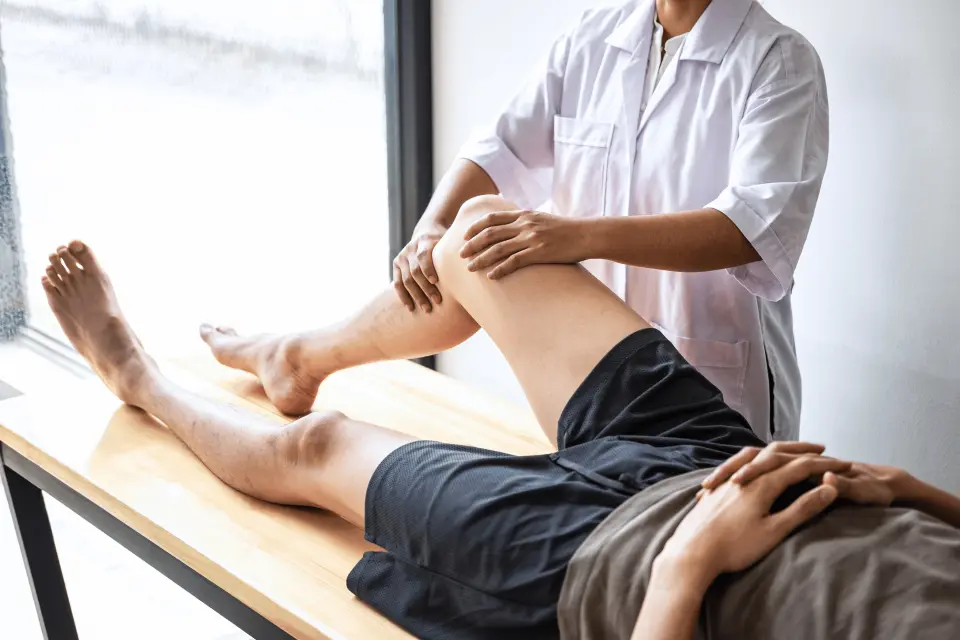
Starting within the first few days of a non-surgical injury (once acute swelling has begun to stabilize) improves outcomes. Delayed PT allows muscle atrophy and stiffness to develop, making the later stages of rehab harder. For post-surgical cases, PT often begins within 24-48 hours.
Mild discomfort during and after sessions is normal, particularly early in rehabilitation. Sharp pain during an exercise indicates the load or range should be modified. The goal is therapeutic challenge, not pain tolerance.
Generic exercise programs lack the individualized assessment that makes PT effective. A personalized program from a licensed physical therapist, even if most sessions are done at home, is significantly more effective than following generic exercises alone.
Many knee injuries, including certain meniscus tears and ligament sprains, respond well to PT without surgery. Others require surgical repair before PT can be effective. A clinician evaluation, including appropriate imaging, determines which approach is indicated. Doctronic.ai can help you navigate whether to start with conservative care or pursue a surgical consultation.
Wear clothing that allows the therapist to observe and access the knee: shorts or athletic pants you can roll up. Bring any imaging reports and a list of current medications. Comfortable athletic footwear helps the therapist assess your gait accurately.
Knee injury recovery through physical therapy follows clear phases with measurable milestones. What drives results is consistent participation, honest communication with your therapist, and adherence to the home program between sessions.
If you have questions about whether your symptoms warrant PT, imaging, or a specialist referral, Doctronic.ai makes it easy to speak with a licensed clinician who can help you figure out the right first step.
Get fitness and rehab advice
Chat Now