
Get Alopecia Areata Treatment Online
Patchy hair loss from alopecia areata can be unpredictable and distressing. Doctronic connects you with licensed physicians who understand the condition and can guide you toward proven treatments, quickly, safely, and entirely online.


What Is Alopecia Areata?
Alopecia areata is an autoimmune condition marked by sudden, patchy loss of hair on the scalp, face, or body. It can progress to complete scalp hair loss (alopecia totalis) or loss of all body hair (alopecia universalis), significantly affecting quality of life and self-esteem. With the right treatment and support, many people with alopecia areata experience meaningful hair regrowth and long-term disease control.
- An autoimmune disorder in which the immune system attacks hair follicles, causing non-scarring hair loss
- Get personalized guidance from doctor-trained AI
- Explore treatment and prescription options

Is Online Alopecia Areata Treatment Right for You?
Doctronic can evaluate adults who are experiencing hair loss consistent with alopecia areata, including patchy scalp hair loss, eyebrow or eyelash involvement, or more extensive forms of the condition. Our physicians can assess your history, pattern of loss, and prior treatments to determine the most appropriate management plan, which may include topical, oral, or injectable therapies.
Because alopecia areata is driven by immune system dysfunction, your physician will also consider your broader health history, including any other autoimmune conditions, current medications, and any previous response to treatments such as corticosteroids or JAK inhibitors, to ensure the plan is safe and tailored to you.
- Diagnosed with alopecia areata (patchy, totalis, or universalis)
- Get personalized guidance from AI and clinicians
- Explore treatment and prescription refill options
- Access care from home, often the same day
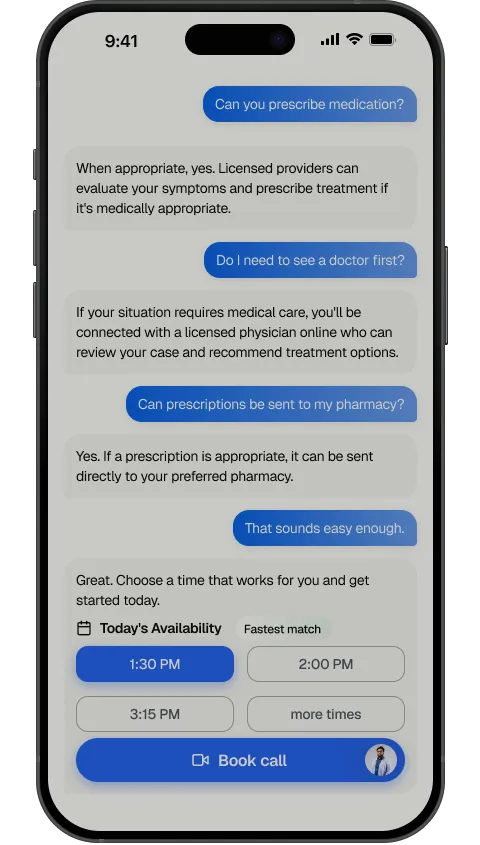

Medications We Prescribe for Alopecia Areata

Olumiant
Baricitinib
An FDA-approved oral JAK inhibitor specifically indicated for severe alopecia areata in adults, targeting the immune pathways that attack hair follicles.
Rinvoq
Upadacitinib
An oral JAK inhibitor used for moderate-to-severe alopecia areata, helping to reduce immune-mediated follicle damage and support regrowth.
Xeljanz
Tofacitinib
A JAK inhibitor used off-label for alopecia areata to suppress the inflammatory immune response responsible for hair follicle destruction.
Deltasone
Prednisone
An oral corticosteroid used for short-term management of active alopecia areata flares, helping to suppress localized immune activity.
How Alopecia Areata Treatment Works at Doctronic

Chat With The #1 AI Doctor
Doctronic answers your health questions with personalized medical insights and helps our doctors create a better treatment plan for you.

Meet With a Licensed Doctor For Treatment
Book a $39 telehealth appointment (or copay) within 30 minutes. Our doctors create personalized treatment plans with prescriptions when needed.

Pick Up Your Prescription
Our doctors prescribe non-controlled medications in all 50 states and send prescriptions to your pharmacy for same-day pickup.
Pricing that won't make you sick
Chat for free, see an online doctor for $39/visit, or refill a prescription online for as low as $0
-
 Available in all 50 states + DC
-
 Insurance accepted

- 24/7 medical care Free
- Specialist referrals Free
- Lifelong health record Free
- Unlimited questions Free
- Prescription refills Starting as low as $0
- Video visit with real doctors $39/visit
These are stories from real users who turned to Doctronic for answers when it mattered most.
- Preparing for a doctor visit
- Finding peace of mind
- Understanding a diagnosis
- Managing chronic illness
- Navigating healthcare
- A second opinion
- Improving health


Frequently asked questions
Alopecia areata is an autoimmune condition in which the immune system mistakenly targets hair follicles, disrupting normal hair growth. The exact trigger is not fully understood, but genetic predisposition and environmental factors are thought to play a role. It is not contagious and does not cause permanent follicle destruction in most cases.
Some people with mild, patchy alopecia areata do experience spontaneous regrowth, particularly within the first year of a new episode. However, the course of the condition is unpredictable. More extensive forms, such as alopecia totalis or universalis, are less likely to resolve without treatment. A physician can help assess your prognosis and discuss options.
Treatment options include intralesional or topical corticosteroids for localized disease, oral JAK inhibitors such as baricitinib (Olumiant) and upadacitinib (Rinvoq) for severe or extensive cases, and off-label use of agents like tofacitinib. The right choice depends on disease severity, extent of hair loss, and your overall health history.
FDA-approved JAK inhibitors like baricitinib have been shown to be effective and generally well tolerated in clinical trials for severe alopecia areata. As with all medications, they carry potential risks, including increased susceptibility to infection and other immune-related effects. Your physician will review your health history to determine whether a JAK inhibitor is appropriate for you.
Psychological stress is frequently reported as a trigger or aggravating factor by people with alopecia areata, though the evidence for a direct causal link is still being studied. Managing stress through lifestyle strategies may be a helpful complement to medical treatment, but it is not a substitute for targeted therapy in moderate or severe cases.
Yes. Alopecia areata can cause hair loss from eyebrows, eyelashes, the beard area, and other body hair. Some people also develop nail changes such as pitting, ridging, or brittleness. These features can help confirm the diagnosis and guide treatment decisions.
Doctronic uses an AI-powered evaluation to gather information about your symptoms and health history. A licensed physician then reviews your case, makes a clinical assessment, and creates a personalized treatment plan. The entire process happens online, so you can get expert care without leaving home.
Yes. Doctronic connects you with fully licensed physicians whose consultations are doctor-reviewed, clinically audited, and conducted in a HIPAA-aligned environment. Your health information is kept private and secure, and all treatment decisions are made by qualified medical professionals.
Top Conditions We Can Help With
People turn to Doctronic and our licensed medical team for support with all types of conditions.