Treatments and Prevention
Blue Light vs. Red Light Therapy: Which One Works for Acne, Wrinkles, or Rosacea?
March 30, 2026
5 min read

Medically reviewed by Alan Lucks | MD, Alan Lucks MDPC Private Practice - New York on May 24th, 2026.
Published on April 17th, 2026. Updated on July 23rd, 2026.
Red light therapy uses wavelengths between 630 and 700 nanometers to stimulate cellular energy production in the mitochondria, which supports collagen synthesis and reduces inflammation
At-home LED masks deliver significantly lower power than clinical devices, which affects treatment outcomes; more sessions are required to approximate clinical results
The strongest evidence supports red light therapy for mild to moderate acne and for stimulating collagen production, leading to modest improvements in fine lines and skin texture
Red light therapy does not treat infections, fungal conditions, or diseases requiring systemic medication; it is a complementary tool, not a replacement for medical treatment
Near-infrared wavelengths (around 830nm) penetrate deeper than visible red light and are used for anti-inflammatory effects, while visible red light primarily affects superficial skin cells
Questions about whether red light therapy is right for your skin condition? Doctronic.ai offers free AI doctor visits and affordable telehealth consultations
Questions about red light therapy?
Free. Anonymous. Built by doctors.
This article covers general information. Ask Doctronic about your symptoms, medications, side effects, or treatment options.
Red light therapy, also called photobiomodulation or low-level laser therapy in clinical settings, uses specific wavelengths of red and near-infrared light to interact with cells in the skin and underlying tissue. Unlike UV light, which can damage DNA, red light in therapeutic wavelength ranges does not cause thermal injury or photocarcinogenesis at the doses used in clinical and consumer devices. Red light therapy is applied in clinical settings at specific wavelengths and doses that differ substantially from most consumer devices.
The proposed mechanism centers on mitochondrial cytochrome c oxidase, an enzyme involved in cellular energy production. Red light wavelengths are thought to stimulate this enzyme, increasing production of adenosine triphosphate (ATP), the molecule cells use for energy. More cellular energy translates to increased collagen synthesis, accelerated tissue repair, and reduced inflammatory signaling.
Consumer LED face masks use this same principle at lower power densities than clinical devices. Whether the power delivered by at-home masks is sufficient to produce meaningful biological effects is one of the central questions about this technology.
Acne treatment is the area where evidence for red light therapy is most consistent. Multiple randomized controlled trials have shown that red light at around 630-660 nanometers reduces inflammatory acne lesions. The mechanism likely involves reducing inflammation in sebaceous glands and potentially exerting mild antibacterial effects against Cutibacterium acnes (formerly Propionibacterium acnes), the bacterium central to inflammatory acne.
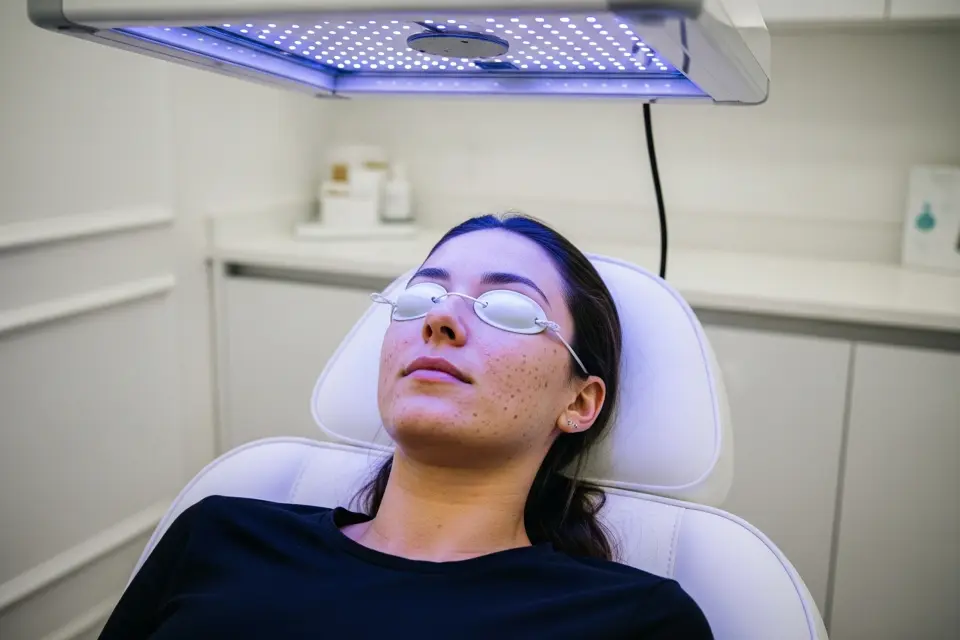
Blue light (around 415nm) is actually more directly antibacterial against C. acnes. Most clinical LED devices for acne combine red and blue light, with the red component addressing inflammation and the blue addressing bacterial load. At-home masks that include both wavelengths may be more effective for acne than red-only devices. For a direct comparison of what each wavelength does, this guide about blue light vs. red light therapy breaks down the evidence for each.
Red light therapy for skin rejuvenation has been studied in multiple clinical trials. Results show modest but statistically significant improvements in fine lines, skin texture, and collagen density as measured by ultrasound and skin biopsy. A systematic review found meaningful improvements in photoaging with consistent treatment over weeks to months.
The keyword is modest. Red light therapy is not equivalent to retinoids, chemical peels, or fractional laser resurfacing in terms of magnitude of effect. It works gradually and requires consistent treatment to maintain results.
In wound healing research, red light therapy consistently accelerates tissue repair and reduces inflammatory markers. This has practical applications for post-procedure skin recovery, rosacea-related inflammation, and general skin sensitivity. The anti-inflammatory effects appear more robust in clinical research than the anti-aging effects.
Red light therapy has been marketed for hair loss, psoriasis, eczema, and hyperpigmentation, with less consistent evidence supporting these uses. The data on androgenetic alopecia (common hair loss) are reasonably supportive of laser-based devices, though the evidence for LED masks specifically for the scalp is thinner. For eczema and psoriasis, red light may reduce some inflammation, but does not address the underlying immune dysfunction driving these conditions.
The central limitation of at-home red light therapy masks is power density, measured in milliwatts per square centimeter. Clinical devices typically deliver 100 to 200 mW/cm2, while most at-home masks deliver 10 to 50 mW/cm2. This means that achieving a comparable dose of light energy (measured in joules per square centimeter) requires significantly more treatment time.
A clinical session delivering an effective dose in 10 minutes might require 20 to 40 minutes of at-home mask use to deliver equivalent energy. Many consumer masks have programmed session times of 10 minutes, which may not be long enough, given their power density, to deliver a therapeutically relevant dose.
This does not mean at-home masks do not work; it means expectations need to be calibrated appropriately. Clinical-grade results are not realistic from consumer devices. Modest improvements with consistent use over months are the more accurate expectation.
Not all LED masks are created equal. Key factors to evaluate include:
Wavelength specificity: Look for devices that specify the exact wavelengths emitted (ideally 630-660nm for red and 810-850nm for near-infrared). Vague claims about "red light" without specific wavelengths are a warning sign of low-quality manufacturing.
Power density: The device should list irradiance in mW/cm2. Devices that publish this information are generally more credible than those that only list total wattage, which does not account for the area being treated.
LED count and coverage: More LEDs distributed across the mask surface provide more even coverage. Sparse LED arrays create uneven dosing.
FDA clearance: The FDA has cleared several LED devices as Class II medical devices for acne treatment and anti-aging. This does not prove efficacy but indicates the device has met safety standards and passed some level of clinical review.
Red light therapy at the wavelengths used for skin treatment has a strong safety profile for most people. However, several groups should consult a physician before use:
People taking photosensitizing medications, including some antibiotics (doxycycline, tetracycline), certain diuretics, and St. John's Wort, may experience increased skin sensitivity to light.
People with active cancers or a history of skin cancer should not use light therapy on affected areas without medical clearance.
People with lupus or other photosensitive conditions may experience flares.
Eye protection is important. Most reputable at-home masks include built-in eye protection, but using masks without it or pointing LED panels directly at the eyes is not safe.
Pregnant individuals should avoid extended use on the abdomen until more safety data is available, though brief use on the face is not considered high-risk.
Understanding the limitations prevents wasted money and delayed appropriate treatment. Red light therapy cannot:
Treat active bacterial skin infections. Folliculitis, impetigo, and infected wounds require antibiotics, not light therapy. Eliminate fungal infections. Antifungal medications are required for tinea and candidiasis. Reverse significant pigmentation disorders like melasma. Melasma requires sun avoidance and topical treatments targeting melanin production. Replace medical treatment for moderate to severe acne. Acne diagnosis and treatment for moderate to severe inflammatory cases involves prescription options that significantly outperform light therapy. Prevent or treat skin cancer.
Red light therapy works best as part of a broader skin care approach rather than as a standalone intervention. Applying vitamin C serum or retinol before a session may enhance treatment benefits; some evidence suggests light therapy can improve penetration of certain topical actives. However, using strong acids (AHAs, BHAs) or prescription retinoids immediately before a session can increase skin sensitivity, so applying those after rather than before is generally better.
Photobiomodulation for skin health is an active area of research, and protocols continue to be refined as evidence accumulates.
For individuals with active skin conditions, including rosacea, eczema, psoriasis, or persistent acne, discussing red light therapy with a dermatologist helps ensure it is used appropriately alongside, not instead of, evidence-based treatments.
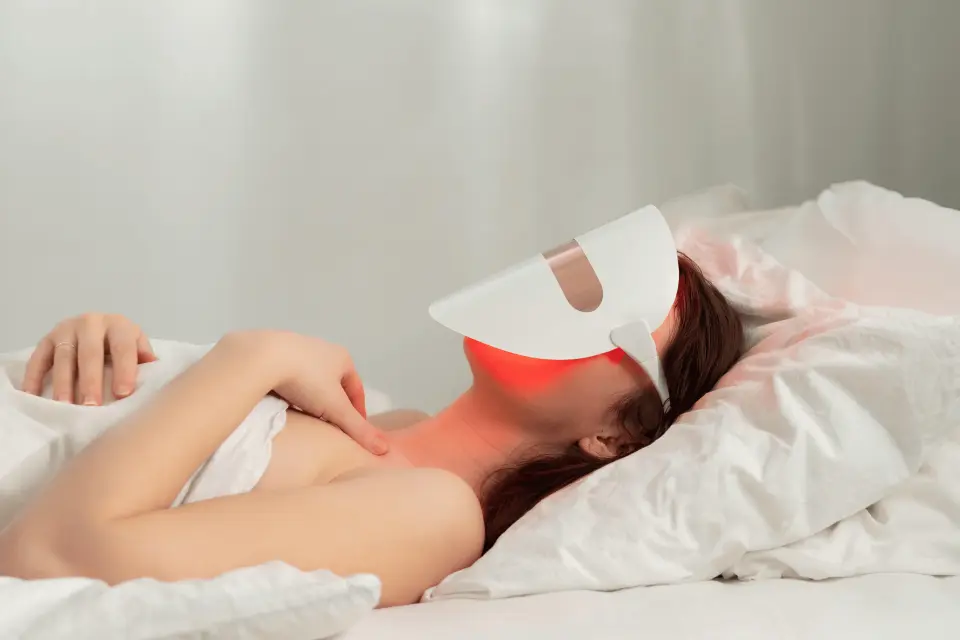
Most clinical research uses treatment protocols of three to five sessions per week. At-home devices, given their lower power density, typically benefit from daily 10 to 20-minute sessions. Visible improvements in acne inflammation may appear within two to four weeks. Anti-aging effects from collagen stimulation typically require consistent use over two to three months.
Rosacea is characterized by inflammation and hypersensitivity of the skin. Red light therapy, with its anti-inflammatory properties, may actually benefit rosacea. Some dermatologists use in-office LED treatments for rosacea management. However, individual skin responses vary, and starting with shorter sessions to observe tolerance before committing to full sessions is advisable.
At the power densities produced by most consumer masks, daily use is considered safe for most people. Unlike UV light, red and near-infrared light at therapeutic doses does not cause cumulative DNA damage. Rest days are built into most protocols to allow cellular repair processes to complete, but there is no evidence that daily use is harmful.
Warmth from an LED mask comes from heat produced by the LEDs, not from the therapeutic light itself. True red light therapy works via photochemical mechanisms, not thermal effects. A mask that feels very hot is producing inefficient LEDs. The therapeutic effect should not require heat to work.
Red light (630-660nm) and near-infrared light (810-850nm) have different tissue penetration depths. Red light primarily affects the epidermis and superficial dermis, making it most relevant for acne and superficial collagen. Near-infrared penetrates deeper into the dermis and has more pronounced anti-inflammatory effects. Combination devices addressing both goals may be worth considering for people targeting both anti-aging and anti-inflammatory benefits.
Red light therapy masks have genuine scientific backing for acne reduction and modest anti-aging effects — provided the device delivers adequate power at the correct wavelengths. They cannot replace prescription therapies, but used consistently with realistic expectations, they are a useful addition to a routine.
For guidance on whether red light therapy fits your skin concern, Doctronic.ai offers telehealth visits with licensed physicians around the clock.
Get skin care advice
Chat Now