Bone & Joint Health
What Is a Dangerously High Calcium Level and What Does It Mean?
July 21, 2026
6 min read

Medically reviewed by Lauren Okafor | MD, The Frank H Netter MD School of Medicine, Loyola University Medical Center on April 12th, 2026.
Published on April 9th, 2026. Updated on July 23rd, 2026.
Inner knee pain most often comes from the MCL, medial meniscus, pes anserine bursa, or the cartilage changes of osteoarthritis
Each cause has a distinct symptom pattern: location, onset, and what makes it worse all point toward a diagnosis
Most cases respond well to relative rest, ice, OTC anti-inflammatories, and targeted strengthening of the quad and hip muscles
Exercises like wall sits, straight leg raises, clamshells, and hamstring curls address the muscle imbalances that drive inner knee stress
Locking, giving way, significant swelling, or pain at rest are red flags that require professional evaluation
If your inner knee pain is not improving with home care, Doctronic.ai connects you with licensed clinicians for a telehealth knee assessment without leaving home
Questions about knee pain?
Free. Anonymous. Built by doctors.
This article covers general information. Ask Doctronic about your symptoms, medications, side effects, or treatment options.
The medial (inner) side of the knee houses three structures responsible for most inner knee pain diagnoses.
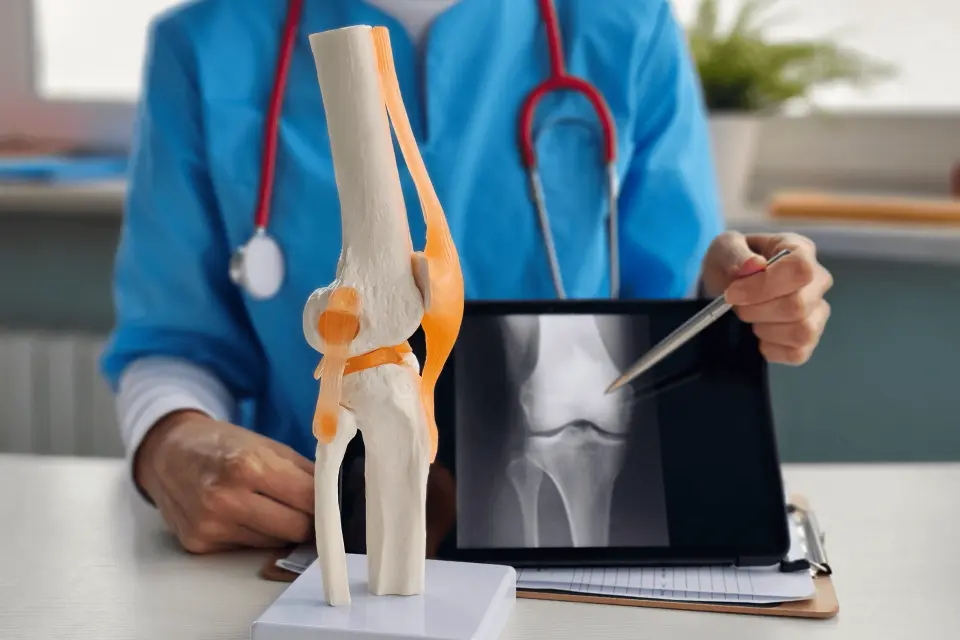
The medial collateral ligament (MCL) runs along the inside of the knee from the femur to the tibia, resisting inward forces. The medial meniscus is a C-shaped cartilage wedge that cushions the joint; because it is attached to the MCL, it is less mobile than the outer meniscus and more prone to tearing. The pes anserine bursa sits two to three inches below the inner joint line, where three tendons attach to the shinbone. When inflamed, it produces pain below and slightly behind the medial joint line, sometimes mistaken for a ligament or meniscus problem.
The symptom patterns below help identify which structure is involved.
The MCL is sprained when a force pushes the knee sideways or inward, stretching or tearing the ligament fibers. This can happen during a tackle in football, an awkward landing from a jump, or even a misstep on uneven ground.
Symptoms of an MCL sprain include immediate inner knee pain at the time of injury, tenderness directly over the ligament, mild to moderate swelling along the inner joint line, and stiffness when bending or straightening the knee. Grade 1 sprains involve minor stretching without tearing and typically heal within one to two weeks. Grade 2 sprains involve partial tearing and may take four to six weeks. Grade 3 sprains are complete tears and often require several months of rehabilitation, though most heal without surgery.
Meniscus tears occur in two patterns. Acute tears occur from a sudden twisting motion with the foot planted, which is common in sports. Degenerative tears develop gradually as the cartilage weakens with age, sometimes without any single identifiable event.
Inner knee pain from a meniscus tear is typically felt along the joint line, often described as a deep ache that worsens with twisting, squatting, or pivoting. Swelling usually develops within 24 to 48 hours of an acute tear. A distinctive sign of a significant tear is mechanical locking or catching, in which the knee gets stuck at a certain angle because a piece of torn cartilage interferes with smooth joint movement. If your knee locks or gives way, that is a signal to seek evaluation rather than treat it at home.
Pes anserine bursitis produces pain slightly below and behind the medial joint line, not directly on it, which helps separate it from MCL or meniscus problems. Pain is often worse at night, when climbing stairs, or when rising from prolonged sitting.
It is most common in people with osteoarthritis, women over 50, and runners or cyclists. Tight hamstrings are a frequent contributing factor because they increase tension on the tendons near the bursa.
Medial compartment osteoarthritis is the most common form of knee arthritis. The inner side of the joint bears more load than the outer side in most people, so cartilage there tends to wear down first. The result is a gradual onset of aching inner knee pain that worsens with weight-bearing activity and improves with rest, particularly in the morning or after sitting for a while.
Unlike the acute onset of an MCL sprain or meniscus tear, knee pain from osteoarthritis builds over months to years. Crepitus (grinding or clicking sensations) during movement is common. Stiffness after rest that loosens up with movement is a classic feature.
The plica is a fold of synovial tissue left over from fetal development. Most people have one without ever knowing it. In some runners who increase mileage quickly, the knee becomes irritated and inflamed, producing a snapping or popping sensation with knee bending and pain that worsens on stairs or after prolonged sitting. It can mimic a meniscus problem. Rest and activity modification typically resolve it.
Location, timing, and triggers offer important clues:
Pain directly on the inner joint line that appeared suddenly after a twisting injury: think MCL or medial meniscus
Pain below the joint line that is worse at night or after climbing stairs: points toward the pes anserine bursitis
Gradual aching that worsens with activity and improves with rest, present for months: consistent with osteoarthritis
Snapping or popping with knee bending after a period of increased activity: consider plica syndrome
Locking (knee gets stuck) or giving way (knee buckles unexpectedly): these suggest a meniscus tear or ligament instability and warrant clinical evaluation
Learning about the full range of knee injuries can help you understand how your symptoms fit the bigger picture.
Get knee pain treatment online today
A licensed doctor can review your symptoms and send a prescription to your pharmacy, often the same day.
Related medications we prescribe
The older RICE method has been updated to the POLICE framework: Protection, Optimal Loading, Ice, Compression, and Elevation. The key shift is from complete rest to optimal loading, meaning gentle movement rather than immobilization.
Protect the joint by avoiding aggravating activities for the first two to three days; a compression sleeve or brace helps if weight-bearing is painful. Reintroduce gentle movement as soon as pain allows, including walking and the exercises below. Ice for 15 to 20 minutes several times daily during the first 72 hours, with a cloth barrier between skin and ice. Elevate above heart level to drain fluid from the joint.
Ibuprofen or naproxen sodium taken as directed helps manage pain and inflammation during a flare. They are most useful in the first few days of an acute injury or during an osteoarthritis or bursitis episode. Do not use them as a long-term daily treatment without physician guidance.
Tight hamstrings increase tension on the tendons near the pes anserine bursa and shift load onto the medial meniscus. A simple hamstring stretch: sit at the edge of a chair, extend one leg with the heel on the floor, and hinge forward from the hips until you feel a pull along the back of the thigh. Hold 30 seconds per side. A standing calf stretch helps correct gait mechanics that push load toward the inner knee.
These four exercises target the quadriceps and hip abductors, the muscle groups most directly responsible for medial knee stability, reducing load on every step.
Stand with your back flat against a wall, feet about two feet forward, hip-width apart. Slide down until your thighs are as close to parallel with the floor as pain allows. Hold for 20 to 45 seconds, rest, and repeat three times. Wall sits build quad endurance without placing the knee in the high-stress deep-bend range. Building knee-strengthening habits early is one of the most effective ways to prevent recurring problems.
Lie on your back with one knee bent and the other leg straight. Tighten the quads of the straight leg by pressing the back of the knee toward the floor. Raise the straight leg to the height of the opposite knee, hold briefly, and lower slowly. Do three sets of 15 per side. This exercise loads the quadriceps without bending the knee, making it safe even during early recovery.
Lie on your side with hips and knees bent at about 45 degrees, feet stacked. Keeping your feet together, slowly rotate the top knee upward as far as comfortable, then lower with control. Do three sets of 15 per side. Clamshells strengthen the gluteus medius, the hip muscle that controls how the femur tracks over the knee during walking and running. Weak glutes are a leading driver of medial knee overload.
Lie face down with your legs straight. Slowly bend one knee, bringing the heel toward the glutes, then lower with control. Do three sets of 15 per side. If you have resistance bands, loop one around the ankle for added challenge. Balanced hamstring strength protects the medial meniscus and reduces strain on the posterior knee structures.
For more context on how these exercises fit into a complete knee program, the guide on knees that hurt after running covers related muscle imbalances that affect the entire knee joint.
Most inner knee pain improves within two to three weeks of home care. Seek evaluation for any of the following:
The knee locks or gets stuck mid-motion
The knee gives way when bearing weight
Significant swelling developed rapidly after an injury
Pain is present at rest or wakes you at night
You cannot bear weight on the leg
Pain does not improve after two weeks of home treatment
The injury involved a loud pop or forceful impact
These signs can indicate a complete ligament tear, displaced meniscus fragment, or joint infection requiring imaging and in-person assessment.
It most commonly points to an MCL sprain, medial meniscus irritation, pes anserine bursitis, or early osteoarthritis. Location, onset, and aggravating factors usually identify the cause.
Minor MCL sprains and pes anserine bursitis often resolve with rest, ice, and strengthening over one to three weeks. Meniscus tears and osteoarthritis need more structured management and sometimes medical intervention. Pain that persists beyond two weeks warrants evaluation.
Gentle low-impact activity like walking and the strengthening exercises above is generally beneficial. Avoid deep squats, pivoting sports, and running until the acute phase settles. Stop any activity that causes sharp pain.
MCL sprains have tenderness directly over the ligament with no locking or giving way. Meniscus tears more often involve joint-line pain, catching or locking, and swelling that develops 24 to 48 hours after the injury. A physician can differentiate with a physical exam, and an MRI confirms the diagnosis.
Most cases respond well to conservative care. Surgery is typically reserved for complete ligament tears, displaced meniscus fragments causing persistent locking, or severe osteoarthritis that has not responded to other treatments.
Telehealth is a practical first step when pain has not improved after two weeks or when you want guidance on whether imaging or an orthopedic referral is warranted.
Inner knee pain has several distinct causes, each with its own symptom pattern and recovery path. Understanding the anatomy helps you identify what is likely involved. The POLICE framework, OTC anti-inflammatories, targeted stretching, and quad and hip strengthening address most cases at home. If your knee locks, gives way, swells significantly, or fails to improve within two weeks, get it evaluated. Doctronic.ai makes it easy to connect with a licensed clinician for a telehealth assessment on your schedule.
Explore treatment options
Chat Now