
Melasma vs. Hyperpigmentation: Key Differences and Treatment Approaches

Medically reviewed by Oghenefejiro Okifo | MD, Harvard Medical School | Henry Ford Hospital - Detroit, MI on April 20th, 2026.
Published on April 17th, 2026. Updated on July 23rd, 2026.
Key takeaways
Hyperpigmentation is an umbrella term covering any darkened skin patch; melasma is one specific type with distinct hormonal triggers and behavior
Getting the diagnosis right matters: treating melasma with aggressive lasers can worsen it, while PIH often responds to approaches that would not help melasma at all
Location, symmetry, trigger history, and seasonal fading patterns are the most reliable clues for telling these conditions apart at home
Melasma requires visible light protection and hormonal management in addition to standard depigmenting agents; other types of hyperpigmentation do not
Sun spots respond best to laser and cryotherapy; post-inflammatory hyperpigmentation often improves with time, retinoids, and by treating the root cause
If you are uncertain which type of pigmentation you have, Doctronic.ai connects you with licensed physicians through telehealth for an accurate assessment before you invest in the wrong treatment
Why Getting the Diagnosis Right Matters
Not all dark spots are created equal, and that distinction has real treatment consequences. Hyperpigmentation is a broad category describing any area of skin that appears darker than the surrounding complexion. Melasma, post-inflammatory hyperpigmentation (PIH), and solar lentigines all fall under that umbrella, but they arise from different mechanisms and respond to very different interventions.
The cost of misidentification is not just wasted money. Aggressive laser treatments that clear sun spots can worsen melasma by triggering inflammation that stimulates more pigment production. Applying hydroquinone alone to PIH without addressing underlying breakouts lets new spots form faster than existing ones fade. Knowing which condition you have is the prerequisite for a treatment that works, and the diagnostic criteria for melasma in particular are distinct enough that a trained eye can usually identify it on appearance alone.
What Is Hyperpigmentation?
Hyperpigmentation refers to any patch of skin where melanocytes, the pigment-producing cells in the epidermis, have overproduced melanin. This excess pigment deposits unevenly, creating areas that look darker than the baseline skin tone. The trigger can be UV radiation, physical trauma, hormonal changes, inflammation, or a combination. The different types share the same visual result but have distinct origins, and understanding what started the process is the key to reversing it.
Types of Hyperpigmentation: How Each One Works
Melasma
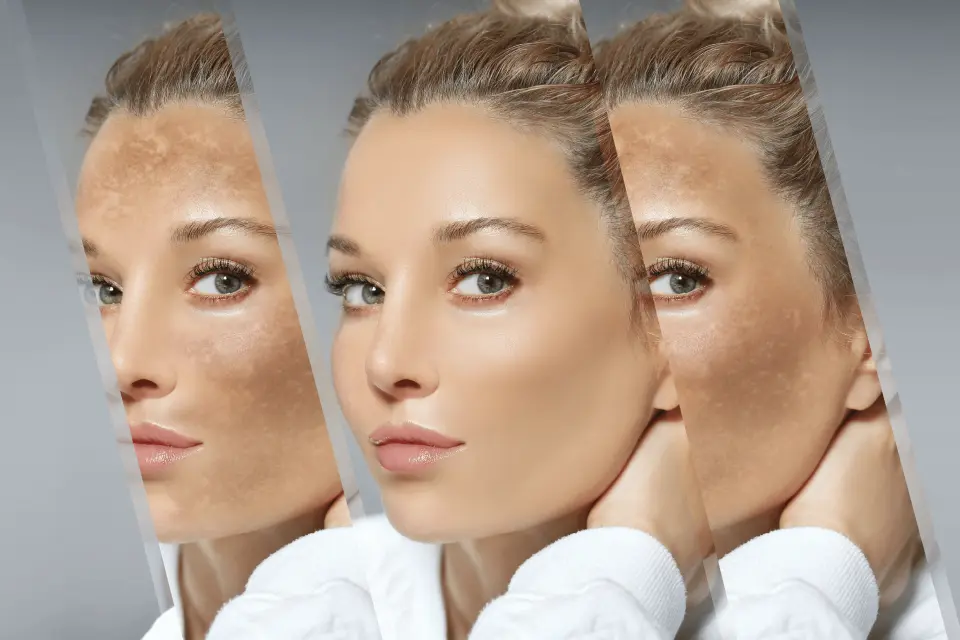
Melasma develops when melanocytes become chronically overactive in response to hormonal stimulation, UV exposure, and visible light. It presents as symmetrical brown or grayish-brown patches, most commonly on the cheeks, forehead, upper lip, and chin. The symmetry is one of its most distinctive features: if the right cheek has a patch, the left usually mirrors it.
Hormonal fluctuations are the dominant driver, which is why melasma appears frequently during pregnancy (sometimes called the mask of pregnancy) and in people using oral contraceptives or hormone replacement therapy. Genetic predisposition also plays a role: medium to dark skin tones and a family history of melasma both increase susceptibility.
One important characteristic that separates melasma from other types: visible light and heat can trigger flares, not just UV radiation. This means standard sunscreens may be insufficient without additional visible light protection. Melasma is a chronic, recurring condition. It may fade in winter when UV exposure decreases, but it typically returns with sun exposure or hormonal changes.
Post-Inflammatory Hyperpigmentation
PIH develops after the skin experiences inflammation or injury. Acne, eczema, psoriasis, cuts, burns, insect bites, and even aggressive skincare procedures can all trigger it. During healing, melanocytes in the affected area produce excess pigment as part of the repair response.
Unlike melasma, PIH is localized to the site of injury. It does not appear symmetrically. A patch of PIH on the right cheek from a breakout will not produce a matching patch on the left. Deeper skin tones develop PIH more readily because their melanocytes are more reactive to inflammatory signals.
Superficial PIH often fades on its own within three to six months. Deeper discoloration embedded in the dermis can take a year or longer and usually requires targeted treatment to resolve. Because new inflammation creates new PIH, treating the underlying cause (such as acne) is an essential part of management.
Solar Lentigines
Solar lentigines, commonly called sun spots or age spots, result from cumulative UV exposure over years or decades. They appear most often on the face, hands, shoulders, and chest, where sun exposure accumulates over a lifetime. Unlike freckles, which lighten in winter when UV exposure decreases, solar lentigines are permanent. They have well-defined borders and a consistent color throughout the lesion. The terms age spots vs. sun spots are often used interchangeably, though they can refer to slightly different presentations depending on the clinical context.
Get melasma treatment online today
A licensed doctor can review your symptoms and send a prescription to your pharmacy, often the same day.
- $39 video visit
- Insurance accepted
- 4.8 on Trustpilot
Related medications we prescribe
- Retin-A tretinoin
- Glycolic Acid glycolic acid
- Tazorac tazarotene
- Fluocinolone Hydroquinone Tretinoin
How to Tell Them Apart
No home assessment replaces a professional evaluation, but these four questions can help narrow down the most likely type:
Where are the patches located? Melasma appears across the cheeks, forehead, and upper lip. PIH appears at the site of trauma. Sun spots concentrate on chronically sun-exposed areas: face, hands, and shoulders.
Are they symmetrical? Symmetry is a hallmark of melasma. PIH and sun spots are typically asymmetrical and distributed according to where injury or UV exposure occurred.
What triggered them? Patches that appeared during pregnancy or while taking hormonal contraception point to melasma. Spots that followed a breakout or skin injury suggest PIH. Spots that developed gradually over years of sun exposure are likely solar lentigines.
Do they fade in winter? Melasma often lightens when UV exposure decreases, though it does not disappear. PIH fades over time if the underlying trigger is controlled. Solar lentigines do not fade seasonally.
Because skin discoloration has such a wide range of causes, getting the type right before starting treatment prevents wasted time and potential worsening.
Treatment Comparison
The following outlines the most effective approaches for each type. These are general frameworks; individual cases vary, and a clinician can tailor a protocol to your specific situation.
Condition |
Primary Treatments |
What to Avoid |
|---|---|---|
Melasma |
Tinted mineral SPF with iron oxides, hydroquinone (cycled), azelaic acid, tranexamic acid, hormonal management |
Aggressive lasers, high-heat procedures, unprotected visible light exposure |
PIH |
Retinoids, vitamin C, azelaic acid, niacinamide, treating underlying cause |
Continuing the inflammatory trigger (untreated acne, harsh scrubbing) |
Solar lentigines |
Q-switched or picosecond lasers, cryotherapy, chemical peels, retinoids for maintenance |
Skipping post-procedure SPF, which allows rapid recurrence |
Treating Melasma
Melasma requires a multi-pronged approach because it responds to multiple triggers. Visible light protection using tinted mineral sunscreens with iron oxides is the foundation; standard chemical SPF formulas block UV but do not address the visible light wavelengths that stimulate melasma-prone melanocytes. Hydroquinone remains the most studied topical, used in cycles of two to three months to prevent the side effect of paradoxical darkening from prolonged use. Azelaic acid and tranexamic acid provide alternatives for those who cannot tolerate hydroquinone.
Hormonal management matters for people whose melasma is driven by contraception or hormone therapy. Switching contraceptive methods or adjusting dosing under medical supervision can reduce the hormonal stimulus that topical products cannot address on their own.
Aggressive laser procedures carry significant risk in melasma: the heat and inflammation they generate can trigger flares that worsen pigmentation rather than improve it. Low-fluence picosecond lasers in experienced hands are an option for stubborn cases, but they require careful patient selection.
Treating PIH
PIH is often the most forgiving type to treat, particularly when it is superficial and the underlying trigger has been resolved. Retinoids accelerate cell turnover, moving pigmented cells to the surface faster. Vitamin C interrupts melanin synthesis while providing antioxidant protection. Niacinamide blocks the transfer of melanin from melanocytes to surrounding cells without causing irritation in most skin types.
The most common mistake with PIH is applying depigmenting products while the inflammatory trigger continues. If acne is generating new PIH faster than treatments can address existing spots, the priority is controlling the acne first. Adding an acne treatment alongside brightening actives produces better long-term results than topicals alone.
Treating Solar Lentigines
Solar lentigines are permanent and do not fade without intervention. Topical retinoids provide modest improvement over time by accelerating surface turnover. For faster results, Q-switched and picosecond lasers target melanin with high precision while minimizing damage to surrounding tissue. Cryotherapy, which freezes lesions with liquid nitrogen, is another effective option for isolated spots. Chemical peels remove pigmented surface cells and can improve overall skin tone.
Post-treatment sun protection is non-negotiable. Without consistent SPF, lentigines return within months of any procedure.
Common Mistakes That Set Treatment Back
Using aggressive lasers on melasma is the most consequential error. The inflammation from high-energy procedures stimulates melanocytes and can cause flares that leave patients worse off than before treatment began.
Relying on hydroquinone alone for PIH without addressing the underlying acne allows new spots to develop continuously. Treating both the root cause and the pigmentation simultaneously produces better results.
Using standard SPF for melasma without visible light protection leaves the condition partially unmanaged. Tinted mineral sunscreens with iron oxides block the visible spectrum that transparent formulas miss.
Applying prescription-strength treatments without a confirmed diagnosis can cause unnecessary irritation or treat the wrong target. When the type of pigmentation is unclear, a telehealth consultation is faster and lower-risk than trial and error with potent actives.
Frequently Asked Questions
Melasma itself is not precancerous and does not increase the risk of skin cancer. However, because it presents as dark facial patches, it is important to have any spot that is asymmetrical, has irregular borders, changes shape, or bleeds evaluated by a dermatologist to rule out other causes.
Pregnancy-related melasma sometimes fades significantly after delivery, particularly when hormonal levels stabilize and sun exposure is managed carefully. However, the underlying predisposition to melasma typically remains. Most people require ongoing maintenance with SPF and occasional topical treatments to prevent recurrence.
PIH develops more readily and takes longer to fade in darker skin tones because melanocytes are more reactive to inflammation. Treatments that cause irritation, including high-strength retinoids or aggressive peels, can paradoxically worsen PIH in darker skin. A gentler, more gradual approach is often more effective.
A dermatologist visit is appropriate when you cannot identify the type of pigmentation, when the spot is changing in size or color, when over-the-counter treatments have not worked after three to four months, or when you are considering prescription treatments or in-office procedures. Telehealth platforms make it easier to get a professional opinion without waiting weeks for an in-person appointment.
Solar lentigines are benign and do not become cancerous. However, a type of early-stage melanoma called lentigo maligna can resemble a sun spot and is sometimes confused with one. Any sun spot that is growing, has uneven coloration, or has an irregular border should be evaluated promptly.
The Bottom Line
Melasma, PIH, and solar lentigines may all look like dark patches, but they require different treatments and respond to different interventions. Treating the wrong type not only wastes time and money but can actively worsen some conditions, particularly melasma. Identifying your specific type of hyperpigmentation through its location, symmetry, triggers, and seasonal behavior gives you the clearest path to an effective protocol. For a clinical assessment that matches the correct treatment to your specific pigmentation, visit Doctronic.ai to speak with a licensed physician through telehealth.
Related articles
Compare your treatment options
Chat Now