
Dermatologist Treatments for Acne Scars: What Actually Works

Medically reviewed by Oghenefejiro Okifo | MD, Harvard Medical School | Henry Ford Hospital - Detroit, MI on May 24th, 2026.
Published on April 17th, 2026. Updated on September 11th, 2026.
Key takeaways
Acne scars rarely fade significantly on their own; the type of scar determines which treatment produces the best result
The three main scar categories (atrophic/pitted, hypertrophic/raised, and post-inflammatory hyperpigmentation) respond to different treatments and should not be treated interchangeably
Laser resurfacing, microneedling, chemical peels, subcision, and dermal fillers are the most evidence-supported in-office treatments; results depend heavily on scar type and depth
Topical retinoids and OTC brightening ingredients address PIH but do little for true atrophic or hypertrophic scarring, which requires structural intervention
Multiple treatment sessions are the rule rather than the exception, and most dermatologists combine approaches tailored to the individual's scar pattern and skin tone
For a professional evaluation of your acne scars and access to treatment options, Doctronic.ai connects you with licensed physicians through free AI consultations and affordable telehealth visits available any time
Understanding Acne Scar Types
Acne formation produces scarring through two mechanisms: the inflammatory process destroys collagen in the dermis, creating depressions, or triggers excess collagen production, creating raised tissue. The type of scar formed depends on genetics, acne severity, inflammation depth, and whether the blemish was manipulated.
Getting treatment right requires identifying scar type first. Many people use "acne scar" to describe several distinct tissue changes that require different interventions.
Atrophic scars are the most common and include three subtypes. Ice pick scars are deep, narrow channels that extend into the dermis and are the hardest to treat because of their depth. Boxcar scars are broad depressions with defined edges, shallower than ice pick scars, and more amenable to resurfacing. Rolling scars are shallow but wide depressions with sloped, irregular edges that create a wavy skin texture and respond well to subcision and fillers.
Hypertrophic scars and keloids are raised, thickened scar tissue that forms when the skin overproduces collagen during healing. Hypertrophic scars remain within the original wound boundary; keloids extend beyond it. Both are more common in people with deeper skin tones and require entirely different treatment from atrophic scars.
Post-inflammatory hyperpigmentation (PIH) is not a scar in the structural sense. It is a flat dark mark left by inflammation, does not represent tissue damage, and fades over time, though treatment accelerates that process.
Laser Resurfacing
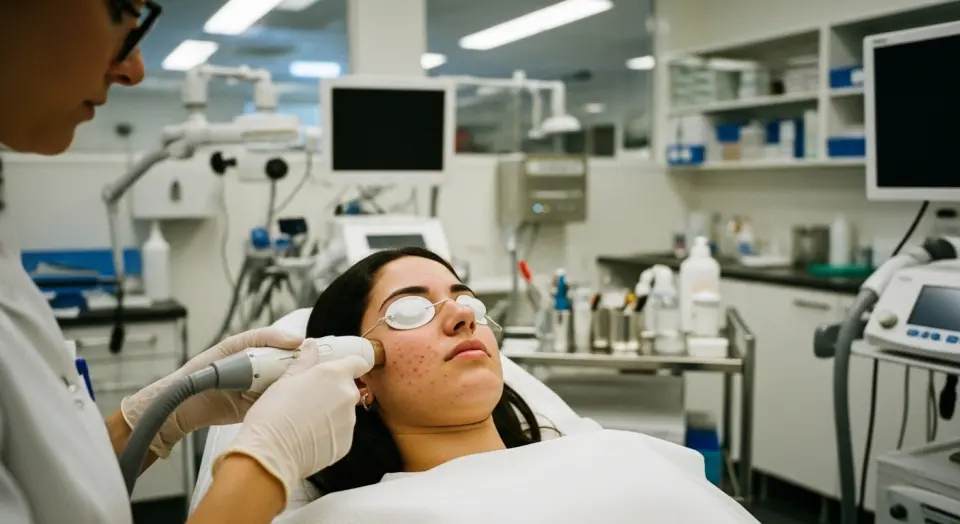
Laser resurfacing is among the most effective treatments for moderate to severe atrophic acne scars, particularly boxcar and rolling scars. Ablative lasers (CO2 and erbium:YAG) remove the outer skin layers and stimulate collagen remodeling over several months. They produce significant improvement but require one to two weeks of downtime and carry higher risk of hyperpigmentation in medium-to-deep skin tones.
Non-ablative and fractional lasers create controlled micro-injuries that stimulate collagen without removing surface skin. They require more sessions (typically three to six) but have shorter recovery times and lower risk of pigmentation changes, making them more suitable for a wider range of skin tones.
Laser selection requires a dermatologist who evaluates scar type, skin tone, and treatment history. A laser appropriate for light skin tones can worsen hyperpigmentation in darker skin.
Microneedling
Microneedling uses fine needles to create controlled micro-injuries in the dermis, stimulating collagen and elastin production. It is effective for rolling and boxcar scars and has a favorable safety profile across skin tones, making it one of the more versatile options.
Results from in-office microneedling require three to six sessions spaced four to six weeks apart. Radiofrequency microneedling, which delivers energy through the needles to stimulate deeper collagen remodeling, produces more significant results than standard microneedling. At-home microneedling devices are too shallow to achieve the same effect and are not a substitute for professional treatment.
Chemical Peels
Chemical peels for acne scars range from superficial to deep, with the depth determining the recovery time and degree of improvement. Superficial peels with glycolic or salicylic acid improve PIH and mild surface irregularities with minimal downtime but require a series of treatments. Medium-depth peels with TCA (trichloroacetic acid) can address boxcar and rolling scars more effectively at the cost of one to two weeks of recovery.
Peels work best as part of a combination approach and are often used to treat PIH alongside more structural treatments for atrophic scarring. Like lasers, chemical peels require careful selection based on skin tone to avoid post-peel hyperpigmentation in darker skin.
Subcision
Subcision is a minimally invasive procedure specifically designed for rolling acne scars. A needle is inserted beneath the scar and moved horizontally to break up the fibrous bands of tissue that tether the depressed scar to the underlying tissue. Releasing these tethers allows the depression to lift and fill with new collagen over time.
Subcision is one of the most effective treatments for rolling scars and works well in combination with fillers or microneedling. It is an underutilized option because it requires specific dermatologist training, but for rolling scar patterns it often outperforms lasers and peels.
Dermal Fillers
Temporary dermal fillers, including hyaluronic acid fillers, can lift depressed atrophic scars immediately and improve contour. They are most effective for rolling and boxcar scars and provide results that last six to eighteen months depending on the filler. Fillers are not a permanent solution but are useful for immediate improvement while other collagen-stimulating treatments are working.
Treatments for Hypertrophic Scars and Keloids
Acne scar treatment for raised scars requires a different approach entirely. Intralesional corticosteroid injections flatten hypertrophic scars by breaking down excess collagen. Silicone sheets or gels applied consistently over several months reduce raised scar tissue. For keloids, combination treatment with steroid injections and laser therapy (pulsed dye laser) produces the best results. Surgical removal of keloids alone has a high recurrence rate and is not recommended without adjunctive treatment.
Managing Expectations
Acne scars rarely disappear completely with any single treatment. The realistic goal is significant improvement: a 50 to 70 percent reduction in scar visibility is a meaningful outcome for severe atrophic scarring. Results depend on scar depth and type, number of sessions, combination of treatments used, and adherence to post-treatment sun protection. Full results from collagen-stimulating treatments such as microneedling and laser continue to develop for three to six months after the final session.
Skin tone significantly affects treatment selection. Treatments appropriate for lighter skin tones can cause permanent hyperpigmentation in darker skin tones. Choosing a dermatologist experienced in treating your skin tone is as important as choosing the right procedure.
Frequently Asked Questions
Neither is universally better; the right choice depends on scar type and skin tone. Microneedling has a broader safety profile across skin tones and works well for rolling and boxcar scars. Fractional lasers produce more significant improvement per session but carry more risk in darker skin tones. Most dermatologists recommend microneedling as a starting point for diverse skin tones and reserve lasers for lighter skin tones or cases that haven't responded to microneedling.
Most in-office treatments require a series of three to six sessions for meaningful improvement. Sessions are typically spaced four to six weeks apart to allow healing and collagen development between treatments. Deep or severe atrophic scarring may require ongoing maintenance treatment.
Topical retinoids, vitamin C, and niacinamide can improve post-inflammatory hyperpigmentation over time but do not meaningfully improve the texture of true atrophic or hypertrophic scars. At-home microneedling devices are too shallow to stimulate the dermal collagen remodeling that produces structural improvement. For PIH in darker skin tones, a consistent topical regimen with daily SPF can produce significant clearing over several months.
Most acne scar treatments are considered cosmetic and are not covered by health insurance. In some cases, when scarring is severe and affects quality of life, partial coverage may be available for specific procedures, but this is rare. Out-of-pocket costs for professional treatments vary widely based on location, provider, and procedure type.
Surface treatments like peels and superficial procedures may show improvement within weeks. Collagen-stimulating treatments (microneedling, laser, subcision) produce ongoing improvement for three to six months after treatment, with maximum results visible at the six-month mark. Filler results are immediate but temporary.
The Bottom Line
Dermatologist treatments for acne scars work, but matching the treatment to the scar type is essential. Atrophic scars respond to laser resurfacing, microneedling, subcision, and fillers depending on their subtype. Hypertrophic scars and keloids require steroid injections and laser, not the same treatments used for depressions. PIH is the most treatable category and responds to topicals and peels. Skin tone must guide treatment selection to avoid worsening hyperpigmentation. Most people require a combination approach over multiple sessions rather than a single procedure. For a professional evaluation and access to treatment planning, Doctronic.ai offers affordable telehealth visits with licensed physicians available any time.
Related articles
Get skin care advice
Chat Now