
Poison Ivy Plant Identification: Leaves of Three, Let It Be

Medically reviewed by Faith Coleman, University of New Mexico School of Medicine on May 28th, 2026.
Published on April 17th, 2026. Updated on July 23rd, 2026.
Key takeaways
"Leaves of three, let it be" is a reliable starting rule, but knowing the full set of visual markers (leaf shape, surface texture, stem arrangement, and berries) significantly reduces misidentification.
Poison ivy grows as a ground vine, climbing vine, or shrub, depending on its environment, and can look dramatically different across seasons.
Urushiol, the oil that causes the allergic rash, is present in all parts of the plant throughout the year, including in winter when leaves have dropped.
Poison oak and poison sumac are close relatives that cause identical rashes and require similar identification awareness.
Touching dead or dried plant material can still cause a severe reaction, and burning poison ivy releases urushiol into airborne particles that can affect airways.
If you develop a rash after outdoor exposure and need guidance on severity and treatment options, Doctronic.ai connects you with a licensed clinician 24/7 without waiting for a scheduled appointment.
The Leaves of Three Rule
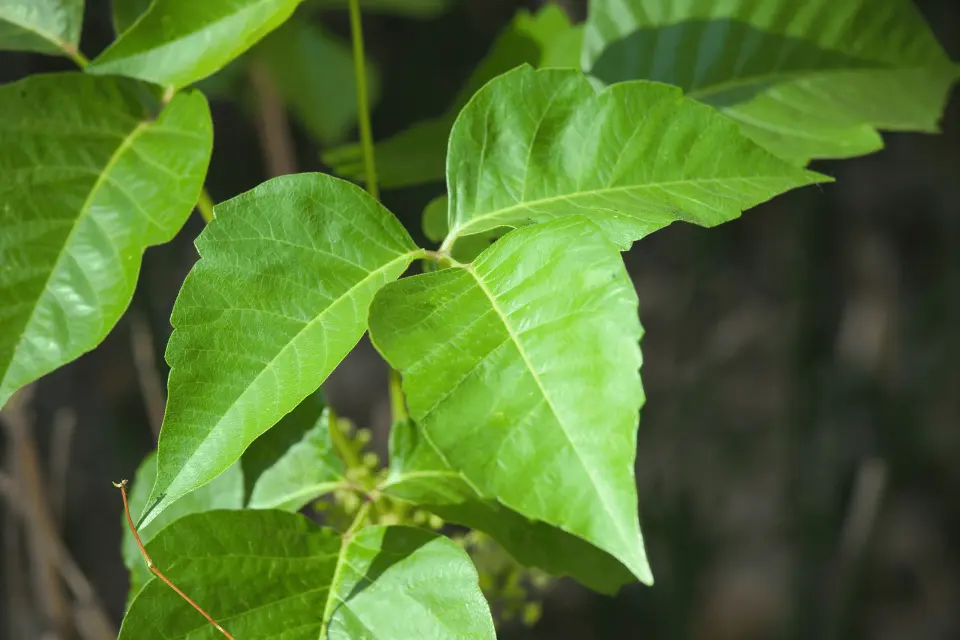
The most widely known identification tip for poison ivy is accurate as far as it goes. Every leaf on a poison ivy plant consists of three leaflets growing from a single stem. The middle leaflet is positioned at the end of a longer stalk than the two side leaflets. That asymmetry is an important secondary marker that distinguishes poison ivy from several look-alikes.
However, the leaves-of-three rule alone is insufficient because many harmless plants also have compound leaves with three leaflets. Wild strawberry, blackberry, raspberry, and Virginia creeper (which usually has five leaflets but occasionally produces three-leaflet clusters) are common sources of confusion. Relying on leaf count alone leads to both false alarms and dangerous misidentifications.
Full Visual Identification Guide
Leaf Shape and Margins
Poison ivy leaflets are broadly oval to teardrop shaped. The tip tapers to a point. Leaflet edges are variable: some plants produce leaflets with smooth edges, others have coarsely toothed or slightly lobed margins. This variability is a source of confusion because no single leaf shape is universal to the plant.
The middle leaflet typically has a slightly longer stalk and may have a few small notches or lobes that resemble a mitten shape. Side leaflets often have one lobe on the outer edge and none on the inner edge, creating a subtle asymmetry.
Surface Texture and Color
Leaf texture varies by season and growth stage. Young leaves in spring are often red, orange, or bronze in color and have a shiny or oily appearance. As the season progresses, leaves become green and may be shiny or somewhat dull, depending on sun exposure and moisture. In fall, poison ivy leaves turn vibrant shades of red, orange, and yellow before dropping.
The upper surface of mature leaves often has a glossy sheen. This reflectiveness is sometimes described as looking waxy or oily. Not all plants show this, but when present it is a useful identification marker.
Stem Arrangement
Poison ivy always produces leaves in an alternate arrangement, meaning leaves attach singly at alternating positions along the stem rather than in opposite pairs. Examining stem attachment helps rule out several look-alikes that produce opposite leaves.
The leaf stalk (petiole) is long and flexible. The three leaflets branch from the end of this main stalk, with the middle one extending slightly further than the side pair.
Growth Form
Poison ivy is unusually adaptable and grows in three distinct forms depending on its environment:
As a ground cover: low, spreading vines that creep along soil and ground-level rocks in open fields, roadsides, and forest edges.
As a climbing vine: thick woody vines with prominent fibrous root hairs that cling to tree trunks and fences. A climbing poison ivy vine on a mature tree is sometimes described as having a hairy or fuzzy appearance from the aerial rootlets. This form is particularly hazardous because it can grow to substantial size.
As a shrub: upright, freestanding plants in open areas or disturbed ground. This shrubby form is common in open fields, beach edges, and disturbed roadsides.
Berries and Flowers
In late summer and fall, poison ivy produces small, round, white to pale yellow berries that grow in clusters. These berries are a reliable identification feature when present. Birds eat them without being affected and contribute to seed dispersal.
Spring flowers are small, yellow-green, and inconspicuous in small clusters. They are rarely the first thing someone notices but are useful for confirming identification.
What Poison Ivy Looks Like Through the Seasons
Spring
New growth emerges as reddish, bronze, or orange leaflets with a notably shiny surface. This is one of the most visually distinct phases, and many people find spring poison ivy easier to identify because of the color contrast with surrounding greenery.
Summer
Fully leafed-out plants are medium to dark green with variable sheen. Plants are at their fullest and densest. Ground-cover forms may blend into surrounding vegetation at this stage.
Fall
One of poison ivy's most striking seasonal appearances. Leaves turn brilliant red, orange, or yellow, often outpacing surrounding tree color change. Many people encounter it during fall hikes precisely because it stands out visually, and touching colorful leaves without recognizing them as poison ivy is a common way reactions occur.
Winter
Leafless stems and vines remain in place. Climbing vines with their characteristic hairy root hairs on tree trunks are identifiable by form alone. Dried berries may persist. Urushiol remains potent on bare stems, so contact with winter vine material still causes reactions.
Related Plants That Cause the Same Rash
Poison Oak
Western poison oak is common in Pacific coastal regions and can grow as a low shrub or climbing vine. Eastern poison oak is found mainly in dry, sandy soils in the southeastern United States. Both have three-leaflet leaves with lobed, oak-like leaflets. The lobed margins distinguish it from poison ivy's smoother or less dramatically notched leaves.
Poison Sumac
Poison sumac grows in wet, boggy areas, primarily in the eastern United States. Unlike poison ivy, it has 7 to 13 leaflets arranged in pairs along a central stem, with a single terminal leaflet. It produces white berries similar to poison ivy. Because its leaf count differs, it does not fit the leaves-of-three rule, making it important to recognize separately.
Get poison ivy treatment online today
A licensed doctor can review your symptoms and send a prescription to your pharmacy, often the same day.
- $39 video visit
- Insurance accepted
- 4.8 on Trustpilot
Related medications we prescribe
- Deltasone prednisone
- Atarax hydroxyzine pamoate
- Westcort hydrocortisone valerate
- Benadryl diphenhydramine
Common Look-Alikes to Know
Boxelder: Compound leaves can have three to five leaflets. Leaflets have more irregular, toothed margins than poison ivy, and the plant typically produces samara seed pods distinctive to maples.
Wild strawberry: Three leaflets with distinctly toothed margins and a low ground-covering growth form. The leaflets are more rounded with less of a pointed tip than poison ivy.
Virginia creeper: Usually five leaflets radiating from a central point, though occasional three-leaflet groupings occur. Berries are dark blue to black, not white.
Blackberry and raspberry: Three to five leaflets with distinctly toothed edges and prominent prickles or thorns on the stems.
Knowing the differences between poison ivy, oak, and sumac builds identification confidence and helps avoid contact with all three urushiol-producing plants.
High-Risk Environments
Poison ivy thrives in disturbed habitat: roadsides, trail edges, property line fences, overgrown garden borders, and forest edges where light reaches the ground. It is less common in dense forest interiors but widespread in suburban and rural transitional zones. It is also common along riverbanks, creek edges, and moist lowland areas.
Burning or composting plant material is dangerous. When urushiol-containing material is burned, the oil becomes airborne and can be inhaled or contact the eyes, causing severe mucosal reactions that require emergency evaluation. Never burn unknown vegetation, particularly vines or ground cover.
Urushiol: The Substance That Causes the Reaction
Urushiol is a sticky, colorless or pale yellow oily resin found in all parts of the plant year-round. Quantities as small as 50 micrograms (far less than can be seen with the naked eye) are enough to cause a reaction in sensitive individuals. Understanding how urushiol triggers contact dermatitis helps clarify why even brief contact with a plant part or contaminated surface can produce a severe rash. If a rash does develop, calamine lotion for poison ivy outlines how to use it effectively to control itching and dry blisters. Knowing how to treat a poison ivy rash helps manage the reaction at home and clarifies when symptoms warrant prescription treatment.
Urushiol remains active on surfaces, clothing, tools, and pet fur for months to years. A gardening glove that contacted poison ivy two seasons ago and was stored without washing can still transfer urushiol on next contact. Washing contaminated items with soap and water neutralizes residual resin.
Frequently Asked Questions
Both have three leaflets, but wild strawberry leaflets have distinctly toothed edges, are more rounded, and the plant stays low to the ground with a clearly different growth form. Wild strawberry does not have the shiny or oily leaf texture that younger poison ivy often shows.
No. Leaf shine is common in young spring growth and in some plants, but it is not universal. Mature summer leaves can be dull or waxy rather than glossy. Leaf shine is a supporting marker, not a definitive one.
Yes. Bare winter stems and roots still contain urushiol. Handling pruned vines, clearing brush, or touching a climbing vine on a tree in winter can cause a full reaction. The leaves-of-three rule does not apply to leafless winter plants, so learning the growth form and vine characteristics matters.
Mature climbing vines have a thick, rope-like woody stem covered in dense reddish-brown root hairs that give the vine a hairy or fuzzy appearance. This distinctive hairy vine on a tree trunk is a reliable identification marker in all seasons.
Removal is possible but carries significant exposure risk. Wear long sleeves, long pants, and impermeable gloves. Bag all material immediately rather than leaving it on the ground. Wash all clothing and exposed skin thoroughly with soap and water afterward. Never burn it. For large infestations, professional removal is worth considering.
No. Many common plants have three-leaflet compound leaves, including wild strawberry, clover, and blackberry. The combination of leaf shape, stem arrangement, growth form, and seasonal color change determines identification. No single feature is reliable in isolation.
The Bottom Line
Confident poison ivy identification means looking beyond leaf count to include growth form, stem arrangement, berry color, and the hairy vine texture. The leaves-of-three rule is a useful starting point, but plants vary significantly by season and environment. When in doubt, don't touch it.
If you develop a rash after outdoor exposure, Doctronic.ai connects you with a licensed clinician at any hour to assess your symptoms and recommend appropriate treatment.
Related articles
Get allergy care advice
Chat Now