
Get Actinic Keratosis Treatment Online
Rough, scaly skin patches from sun damage are more than a cosmetic concern. Actinic keratosis is a precancerous skin condition that deserves prompt, expert attention. Doctronic makes it easy to get a physician-reviewed treatment plan without leaving home.


What Is Actinic Keratosis?
Actinic keratosis is a precancerous skin condition marked by rough, scaly, or crusty patches that develop on chronically sun-exposed skin, such as the face, scalp, ears, neck, forearms, and hands. It can progress to squamous cell carcinoma if left untreated. With the right treatment and support, actinic keratosis can be effectively managed and the risk of malignant transformation significantly reduced.
- Caused by years of cumulative ultraviolet (UV) radiation exposure damaging keratinocytes in the outer skin layer
- Get personalized guidance from doctor-trained AI
- Explore treatment and prescription options

Is Online Actinic Keratosis Treatment Right for You?
Doctronic evaluates adults who have developed actinic keratosis, including those with new or recurring rough, scaly, or discolored skin patches consistent with sun-related skin damage. Our licensed physicians review your symptoms, photos, and history to recommend appropriate topical or procedural therapy.
Because actinic keratosis is linked to UV exposure history and carries a risk of progression to skin cancer, your physician will also consider your overall skin cancer risk factors, including your skin type, history of immunosuppression, and any prior skin cancers, to ensure the safest and most effective treatment plan for you.
- Diagnosed with actinic keratosis by a provider
- Get personalized guidance from AI and clinicians
- Explore treatment and prescription refill options
- Access care from home, often the same day

Medications We Prescribe for Actinic Keratosis

Aldara
Imiquimod 5%
A topical immune response modifier applied directly to actinic keratosis lesions to stimulate local immune clearance of abnormal cells.
Zyclara
Imiquimod 3.75%
A lower-concentration imiquimod cream formulated for once-daily application to larger treatment areas on the face or scalp.
Adrucil
5-Fluorouracil
A topical chemotherapy agent that interferes with DNA synthesis in rapidly dividing abnormal keratinocytes, commonly used as a field treatment for multiple lesions.
Glycolic Acid
Glycolic Acid
An alpha-hydroxy acid used topically to promote exfoliation of damaged skin cells and improve the appearance of sun-damaged skin.
How Actinic Keratosis Treatment Works at Doctronic

Chat With The #1 AI Doctor
Doctronic answers your health questions with personalized medical insights and helps our doctors create a better treatment plan for you.

Meet With a Licensed Doctor For Treatment
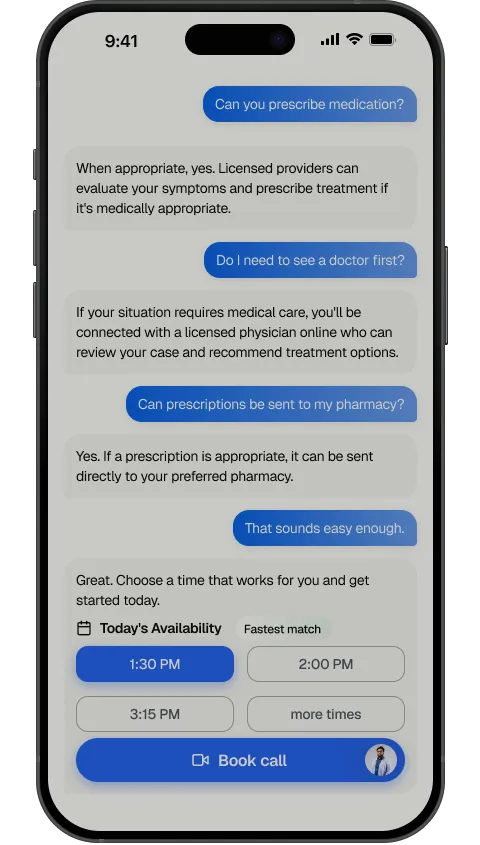
Book a $39 telehealth appointment (or copay) within 30 minutes. Our doctors create personalized treatment plans with prescriptions when needed.

Pick Up Your Prescription
Our doctors prescribe non-controlled medications in all 50 states and send prescriptions to your pharmacy for same-day pickup.
Pricing that won't make you sick
Chat for free, see an online doctor for $39/visit, or refill a prescription online for as low as $0
-
 Available in all 50 states + DC
-
 Insurance accepted

- 24/7 medical care Free
- Specialist referrals Free
- Lifelong health record Free
- Unlimited questions Free
- Prescription refills Starting as low as $0
- Video visit with real doctors $39/visit
These are stories from real users who turned to Doctronic for answers when it mattered most.
- Preparing for a doctor visit
- Finding peace of mind
- Understanding a diagnosis
- Managing chronic illness
- Navigating healthcare
- A second opinion
- Improving health











Frequently asked questions
Actinic keratoses typically appear as rough, dry, scaly patches of skin about 1 to 2 centimeters in diameter. They may be flat or slightly raised, and the skin surface can feel like sandpaper. Color varies from pink to red to brown. Some lesions are more easily felt than seen. They most often appear on areas that receive the most sun exposure, including the face, lips, ears, forearms, scalp, and back of the hands.
Actinic keratosis is considered precancerous. Without treatment, a small percentage of lesions can progress to squamous cell carcinoma, a type of skin cancer. The risk of any single lesion becoming cancerous is low, but people who develop actinic keratoses often have multiple lesions over time, which increases overall risk. Early treatment greatly reduces the chance of progression.
People with fair skin, light-colored eyes, and blond or red hair who have had significant lifetime sun exposure are at highest risk. Other risk factors include a history of frequent sunburns, living in sunny or high-altitude climates, having a weakened immune system, and being older than 40. Outdoor workers and those who used tanning beds are also at elevated risk.
Treatment options include topical medications such as imiquimod or 5-fluorouracil, which work over several weeks to clear lesions. In-office procedures like cryotherapy (liquid nitrogen), chemical peels with trichloroacetic acid, or photodynamic therapy may also be used. The best approach depends on the number, size, and location of lesions, as well as your overall health and skin cancer risk.
Yes. Even after successful treatment of individual lesions, new actinic keratoses can develop because the surrounding sun-damaged skin remains at risk. This is sometimes called field cancerization. Ongoing sun protection, including daily sunscreen use, protective clothing, and regular skin exams, is important for reducing the likelihood of recurrence.
Topical treatments typically require several weeks of consistent daily or twice-daily application. Imiquimod regimens often run 12 to 16 weeks, while 5-fluorouracil courses generally last 2 to 4 weeks. Treated skin often becomes red, inflamed, or crusted during therapy, which is an expected sign that the medication is working. Your physician will guide you on how to manage these reactions.
Doctronic uses an AI-guided evaluation to gather detailed information about your symptoms, medical history, and current medications. A licensed physician then reviews your case, confirms the appropriate diagnosis and treatment, and creates a personalized treatment plan. The entire process is designed to be thorough, convenient, and medically sound.
Yes. Doctronic connects you with licensed physicians who review and approve every treatment plan. All consultations are doctor-reviewed and audited for quality, and the platform is fully HIPAA-aligned to protect your personal health information. Doctronic is available to adults 18 and older in any U.S. state.
Top Conditions We Can Help With
People turn to Doctronic and our licensed medical team for support with all types of conditions.