
Seasonal Depression Lamps: The Best Light Therapy Options Ranked

Medically reviewed by Veronica Hackethal | MD, MSc, Harvard University | University of Oxford | Columbia Vagelos College of Physicians and Surgeons on May 25th, 2026.
Published on April 17th, 2026. Updated on July 24th, 2026.
Key takeaways
Light therapy lamps, also called SAD lamps or bright light therapy boxes, deliver 10,000 lux of white light for 20 to 30 minutes each morning to treat seasonal affective disorder; this is the evidence-based standard for effective treatment
The most important specifications when choosing a light therapy lamp are luminous intensity (must reach 10,000 lux at the stated distance), UV filtering, and surface area large enough to maintain 10,000 lux without sitting uncomfortably close
Light therapy boxes vary by format: full-panel desktop lamps provide the broadest light field; portable and travel-sized units offer flexibility; sunrise simulators target the first phase of waking; and light therapy alarm clocks combine both functions
Timing matters more than most people realize: morning use, within the first hour of waking, produces significantly better results than evening use, which can disrupt sleep by suppressing nighttime melatonin
Light therapy is safe for most people but is contraindicated or requires physician supervision for people with bipolar disorder, certain eye conditions, and those taking photosensitizing medications
To connect with a licensed physician who can evaluate seasonal mood symptoms and confirm light therapy is appropriate, Doctronic.ai offers free AI consultations and affordable telehealth visits available any time
Questions about light therapy for seasonal depression?
Free. Anonymous. Built by doctors.
This article covers general information. Ask Doctronic about your symptoms, medications, side effects, or treatment options.
How Light Therapy Works for Seasonal Depression
Seasonal affective disorder (SAD) is a pattern of recurrent depression that follows seasonal changes in light. In the fall and winter months, reduced daylight alters the timing of the body's internal clock by changing melatonin secretion and serotonin activity. Light therapy addresses this disruption by exposing the eyes to bright light that mimics summer daylight, resetting circadian timing and influencing the neurotransmitter systems involved in mood regulation.
The mechanism behind seasonal circadian disruption explains why morning light exposure is particularly effective: the circadian system uses bright morning light to anchor the timing of its daily cycle. When that signal is absent in winter, the internal clock drifts, and the mismatch between circadian timing and the sleep-wake schedule contributes to the fatigue, low mood, and sleep disturbance characteristic of SAD.
Light therapy has strong clinical evidence, with studies consistently showing response rates between 50 and 80 percent in SAD, comparable to antidepressant medications. Light therapy is considered a first-line treatment among the available SAD treatment options, which also include antidepressant medications, psychotherapy, and Vitamin D supplementation.
The Key Specifications That Actually Matter
10,000 Lux at the Stated Distance
The standard therapeutic dose is 10,000 lux delivered 20 to 30 cm from the face for 20 to 30 minutes per session. Lux is a measure of illuminance (the amount of light that reaches a surface), and it diminishes rapidly with distance. A lamp that produces 10,000 lux at 15 cm delivers significantly less at 30 cm. Manufacturers should specify the distance at which their product achieves 10,000 lux; any product that claims 10,000 lux without stating the distance is providing incomplete information.
Lower-intensity devices (2,500 lux) are also effective but require longer exposure times (up to two hours) to deliver the equivalent dose, which is impractical for most people.
UV Filtering
Light therapy works through the eyes, not the skin, and UV exposure to the eyes is harmful. All well-designed light therapy lamps should filter out UV radiation. This is a non-negotiable specification; never use tanning lamps, which emit UV, as a substitute for a light therapy box.
Surface Area
A larger light surface makes it easier to maintain the necessary lux level without positioning your face uncomfortably close to the lamp. Larger panels (typically 10 inches or wider) provide a broader field that reaches the required intensity at a more comfortable working distance, allowing multitasking during the session.
Format Options and Their Trade-offs
Full-Panel Desktop Lamps
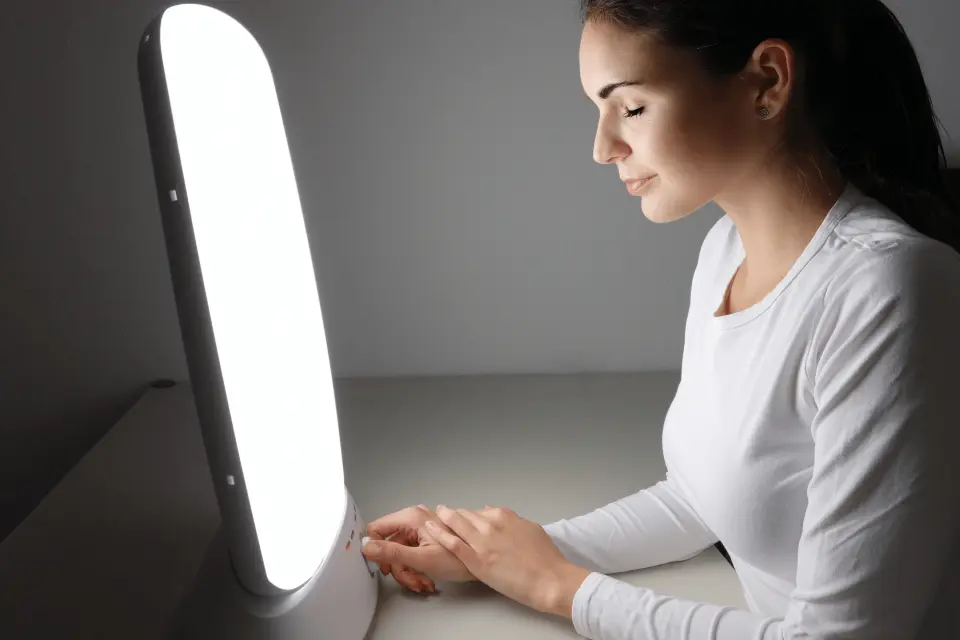
Full-panel light therapy boxes are the gold standard for home use. They provide a large, consistent light surface that is easy to position on a desk or table at the appropriate distance while reading, eating, or working. Models in this category are typically plugged in, making them unsuitable for travel, but their size and stability make consistent daily use more practical than smaller alternatives.
This format is the most thoroughly studied in clinical research and the most reliable way to achieve consistent 10,000-lux exposure at a comfortable distance.
Portable and Travel-Sized Units
Smaller units offer flexibility for travel and compact spaces. The trade-off is that smaller surface areas require closer positioning to achieve 10,000 lux, and the angle and position need to be managed more carefully. Portable models with a kickstand or adjustable angle make this easier.
For daily home use, a portable unit works well if the discipline to position it correctly is maintained. For travelers or people who alternate between locations, a portable unit may be the most practical option even if it requires more attention to positioning.
Sunrise Simulators
Sunrise simulators gradually increase light intensity in the 30 to 90 minutes before the set wake time, mimicking the light progression of a natural sunrise. Research suggests they can reduce morning grogginess (sleep inertia) and support mood, and they are particularly useful for people who find it difficult to wake in darkness during winter months.
The light levels produced by sunrise simulators are generally lower than the 10,000-lux standard. They are most effective as a complement to morning light therapy rather than a complete substitute for it. As a standalone intervention, the evidence for their efficacy compared to full bright-light therapy is less robust.
Light Therapy Alarm Clocks
Light therapy alarm clocks combine a sunrise simulator with an alarm and clock. They address the same gradual awakening function as standalone sunrise simulators while consolidating devices. The 10,000-lux delivery is not their primary function; they are most useful for the pre-wake phase and as part of a broader approach that includes a dedicated light therapy session.
How to Use a Light Therapy Lamp Effectively
Position the lamp so that light enters your eyes from an angle, not directly. Sit within the manufacturer's stated effective distance (typically 20 to 30 cm for 10,000-lux models) and keep your eyes open but do not stare directly at the lamp.
Morning timing is essential. Use the lamp within the first hour of waking, ideally at the same time each day. Evening use is not recommended because bright light in the evening suppresses melatonin production and can delay sleep onset and worsen insomnia.
Consistency produces better results than occasional use. Most people who respond to light therapy begin to notice improvement within one to two weeks of daily sessions. Whether physician evaluation is appropriate before starting depends on individual presentation, including the range of seasonal affective disorder symptoms that suggest a clinical condition rather than subclinical seasonal adjustment.
Who Should Consult a Doctor Before Using Light Therapy
Light therapy is safe for most people, but several groups should seek physician guidance before starting:
People with bipolar disorder should use light therapy only under physician supervision because bright light can trigger hypomanic or manic episodes in susceptible individuals.
People with eye conditions including glaucoma, cataracts, retinal disease, or any history of photosensitivity should confirm that light therapy is safe with their eye care provider.
People taking photosensitizing medications including certain antibiotics, antipsychotics, and acne medications may have increased sensitivity to bright light and should discuss this with their prescribing physician.
Frequently Asked Questions
Most people who respond to light therapy notice improvement within one to two weeks of daily morning sessions. Full response typically requires three to four weeks of consistent use. Some people experience initial side effects including headache or irritability in the first few days, which usually resolve with continued use or by reducing session length initially.
No. Standard household bulbs and overhead lighting do not produce the 10,000-lux intensity required for therapeutic effect. Light therapy requires a lamp specifically designed to deliver the correct luminous intensity, UV filtering, and light spectrum for this use.
Daily use during the symptomatic months (typically October through March in the Northern Hemisphere) is recommended for consistent effect. Stopping therapy while still symptomatic typically leads to rapid return of symptoms. Some people continue at a reduced frequency in spring and summer as a preventive measure, though this is more variable.
For mild to moderate SAD, light therapy alone is effective and is often the preferred first-line treatment because it avoids medication side effects and produces rapid results. For moderate to severe SAD, or for people who do not respond adequately to light therapy, combining it with antidepressants is recommended. The decision should be made with a physician based on symptom severity and treatment history.
Coverage varies by plan. Some insurers cover light therapy boxes when prescribed by a physician for SAD diagnosis; others classify them as medical devices and provide coverage through health savings accounts (HSAs). Checking with your insurance provider and asking your physician for documentation of the prescription is the starting point for exploring coverage.
The Bottom Line
Light therapy lamps are an effective first-line treatment for seasonal affective disorder, delivering 10,000 lux of bright white light for 20 to 30 minutes each morning to reset circadian timing and improve mood. The most important specifications are lux output at the stated distance, UV filtering, and surface area. Full-panel desktop models provide the most reliable delivery for home use; portable units offer flexibility with careful positioning. Sunrise simulators complement rather than replace full bright-light therapy. Consistent morning timing is essential, and most people notice improvement within one to two weeks. People with bipolar disorder, eye conditions, or photosensitizing medications should confirm appropriateness with a physician before starting. For evaluation of seasonal mood symptoms and guidance on light therapy, Doctronic.ai offers affordable telehealth visits with licensed physicians available anytime.
Related articles
Get advice about seasonal depression lamps
Chat Now