
Pimples Around the Mouth: Perioral Dermatitis or Acne?

Medically reviewed by Oghenefejiro Okifo | MD, Harvard Medical School | Henry Ford Hospital - Detroit, MI on May 24th, 2026.
Published on April 17th, 2026. Updated on July 23rd, 2026.
Key takeaways
Pimples around the mouth can result from either acne or perioral dermatitis, two distinct conditions that look similar but have different causes and require different treatment approaches
Perioral dermatitis produces clusters of small red papules and pustules specifically around the mouth, nose folds, and sometimes around the eyes; common triggers include topical steroid use, heavy facial moisturizers, and fluorinated toothpaste
Acne around the mouth tends to involve comedones (blackheads and whiteheads) alongside inflammatory papules and is caused by clogged pores, sebum, and bacteria rather than the skin barrier disruption that underlies perioral dermatitis
Treating perioral dermatitis with steroid creams makes it worse, which is a key diagnostic clue; acne does not behave this way
A dermatologist can distinguish the two conditions based on clinical appearance, distribution, and history of triggers
To connect with a licensed physician who can evaluate skin conditions and recommend treatment, Doctronic.ai offers free AI consultations and affordable telehealth visits available any time
Questions about perioral dermatitis?
Free. Anonymous. Built by doctors.
This article covers general information. Ask Doctronic about your symptoms, medications, side effects, or treatment options.
Why the Distinction Matters
The area around the mouth is susceptible to both acne and perioral dermatitis, and the two can look superficially similar: small red bumps, occasional pustules, and skin irritation that comes and goes. The resemblance leads many people to treat perioral dermatitis with acne products or steroid creams, which reliably makes perioral dermatitis worse rather than better.
Getting the diagnosis right is not just a technicality. Topical steroids, which are sometimes used for general skin irritation, will temporarily suppress perioral dermatitis and then cause it to rebound more severely when the steroid is stopped. This cycle can trap people in months of worsening skin problems if the condition is not correctly identified.
What Perioral Dermatitis Looks Like
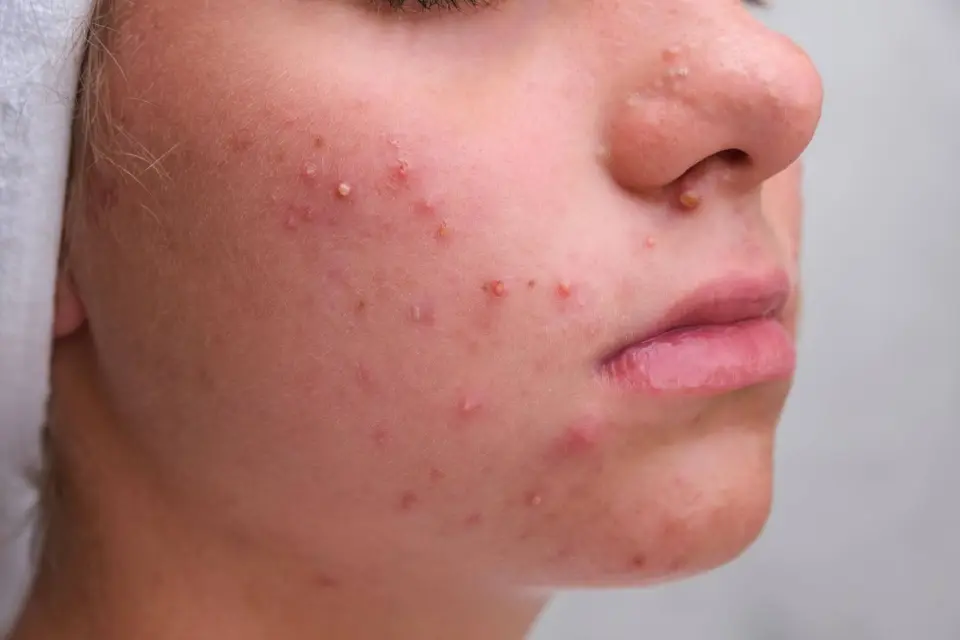
Perioral dermatitis presents as clusters of small papules and pustules on skin that appears slightly red and may have a scaly or dry texture. The distribution is characteristic: lesions concentrate in the area surrounding the mouth, often with a clear margin of normal skin immediately adjacent to the lips. The condition frequently extends to the skin alongside the nose and in the nasolabial folds, and a variant called periocular dermatitis affects the skin around the eyes.
The bumps in perioral dermatitis are typically small, uniform, and closely grouped. They tend not to be as deeply rooted as cystic acne, and true comedones (clogged pores visible as blackheads or whiteheads) are not characteristic of perioral dermatitis.
Perioral dermatitis affects women more often than men and is most common between the ages of 20 and 45. It is a recognized side effect of inhaled corticosteroids used for asthma and nasal sprays as well as topical steroid application to the face.
What Causes Perioral Dermatitis
The exact mechanism of perioral dermatitis is not fully established, but several triggers are consistently associated with its onset. Topical corticosteroid use is the most common identifiable cause: even low-potency over-the-counter steroid creams used on the face can trigger or maintain the condition. Fluorinated toothpaste is frequently cited as a contributing factor, and switching to non-fluorinated toothpaste is often recommended as part of management.
Heavy moisturizers, foundations with occlusive ingredients, and skin care products with strong preservatives or fragrances may disrupt the skin barrier in ways that contribute to perioral dermatitis. Some people find that simplifying their skin care routine dramatically reduces flares.
Hormonal fluctuations, oral contraceptives, and prolonged stress are additional associated factors. The overlap in risk factors and clinical appearance between perioral dermatitis and other facial redness conditions can complicate self-diagnosis.
What Perioral Acne Looks Like
Acne around the mouth and chin is extremely common, particularly in adults. Hormonal fluctuations drive acne in the lower third of the face by increasing sebum production in the chin and jaw area, which is why many women experience cyclical breakouts in this zone around menstruation.
Perioral acne typically includes a mix of comedones and inflammatory lesions. Blackheads and whiteheads are caused by blocked pores filled with sebum and dead skin cells. Inflammatory papules and pustules develop when bacteria involved in acne pathogenesis proliferate within blocked follicles. Nodules and cysts represent deeper inflammatory lesions.
Unlike perioral dermatitis, acne lesions tend to be more variable in size and stage of development. Some will be non-inflammatory blackheads, others will be red and inflamed, and others may be larger cysts. The simultaneous presence of multiple stages is characteristic of acne rather than perioral dermatitis.
How to Tell Them Apart
Several features help distinguish perioral dermatitis from acne in the perioral area:
The presence of comedones strongly favors acne. Perioral dermatitis does not produce blackheads or whiteheads. If pimples around the mouth coexist with visible clogged pores, acne is the more likely diagnosis.
The response to steroid creams is diagnostically revealing. If applying a topical steroid initially improved the eruption but stopping it caused a rebound flare, perioral dermatitis is highly likely.
Distribution matters. Perioral dermatitis characteristically spares the skin immediately adjacent to the lips (the vermilion border area). Acne has no such pattern and can occur directly at the lip margins.
Skin care history can point to perioral dermatitis. A history of heavy moisturizer use, steroid-containing products, or use of fluorinated toothpaste is more consistent with perioral dermatitis than acne.
Body distribution helps as well. Acne commonly appears on the forehead, nose, and back alongside facial lesions. Perioral dermatitis is typically confined to the face.
How Each Is Treated
Acne treatment is stratified by severity. Mild acne responds to topical retinoids, benzoyl peroxide, or salicylic acid. Moderate acne may require topical or oral antibiotics combined with topical retinoids. Severe acne, particularly cystic nodular acne, is often treated with oral isotretinoin.
Perioral dermatitis is treated differently. The first step is identifying and stopping the triggering factor, particularly topical steroids. This is called zero therapy. Perioral dermatitis management centers on simplifying the skin care routine, removing the triggering agent, and using oral antibiotics such as doxycycline or tetracycline for moderate to severe cases. Topical antibiotics like metronidazole or erythromycin address milder presentations, and topical pimecrolimus is an alternative non-steroid option.
Because treatment approaches are so different, and because steroid application actively worsens perioral dermatitis, correctly identifying which condition is present before treating is important.
Frequently Asked Questions
Yes. Both conditions can coexist, particularly in adults prone to acne who also have a history of steroid use or heavy moisturizer application. A dermatologist can identify the components of each and recommend targeted treatment for both.
Fluoride toothpaste is a commonly identified trigger for perioral dermatitis in susceptible individuals, but not everyone who uses fluoride toothpaste will develop the condition. If a breakout specifically surrounds the mouth and has been persistent, switching to a fluoride-free toothpaste for four to six weeks to see if it improves is a reasonable trial.
As part of zero therapy, reducing heavy moisturizer use is typically recommended, particularly products with occlusive ingredients like petrolatum, mineral oil, or silicones. A lightweight non-comedogenic moisturizer or no moisturizer during the initial treatment period may help resolve the condition faster.
Stress increases cortisol, which can increase sebum production and worsen acne. Stress is also associated with perioral dermatitis flares, though the mechanism is less clearly established. If breakouts around the mouth consistently worsen with high-stress periods, addressing stress management alongside skin care may reduce flare frequency.
Evaluation is warranted when breakouts are persistent, recurring, or not responding to over-the-counter treatments; when there is significant redness, inflammation, or spreading; when previous steroid cream use may be involved; or when the eruption involves the area around the nose and eyes as well as the mouth. A dermatologist or physician can examine the lesions and recommend appropriate treatment.
The Bottom Line
Pimples around the mouth can be acne or perioral dermatitis, and the distinction matters because treatment differs significantly. Acne involves comedones, is driven by sebum and bacteria, and responds to retinoids and benzoyl peroxide. Perioral dermatitis involves uniform small papules around the mouth and chin, is triggered by topical steroids and heavy skincare products, and worsens with steroid use. Treatment for perioral dermatitis involves stopping triggers and using oral or topical antibiotics. A dermatologist can accurately diagnose the condition based on clinical features and treatment history. For evaluation of skin conditions by a licensed physician, Doctronic.ai offers affordable telehealth visits available at any time.
Related articles
Get skin care advice
Chat Now