
Mental Health
Mindfulness Activities for Stress: Simple Exercises for Daily Life
April 17, 2026
6 min read

Medically reviewed by Alan Lucks | MD, Alan Lucks MDPC Private Practice - New York on May 24th, 2026.
Published on April 17th, 2026. Updated on May 28th, 2026.
You do not need a quiet room, closed eyes, or dedicated time to practice mindfulness for anxiety
Extending the exhale to twice the length of the inhale activates the parasympathetic nervous system within about 60 seconds
Tactile grounding (pressing your feet into the floor, gripping an armrest) works during meetings, on transit, and in conversations without drawing attention
Observational techniques like silent category naming redirect anxious brain activity toward a neutral task
Practicing portable techniques during calm moments makes them more automatic when anxiety actually spikes
When self-management is not enough, Doctronic.ai connects you with licensed telehealth providers for personalized anxiety care available anytime, anywhere
Anxiety disorders affect a large share of the population, and the hardest moments tend to happen in places where a formal meditation session is not possible: a boardroom presentation, a crowded commute, a family dinner. Portable mindfulness techniques solve this. They work through the same mechanisms as longer formal practice by interrupting the brain's threat-detection loop and returning attention to the present moment, but they are designed to fit the constraints of ordinary life. Every technique in this article can be done with your eyes open, sitting upright, without anyone around you noticing.
Breath is the fastest route to the nervous system because it is the only automatic function you can consciously control. In public settings, the goal is not dramatic breathing exercises but subtle shifts that still produce a calming physiological response.
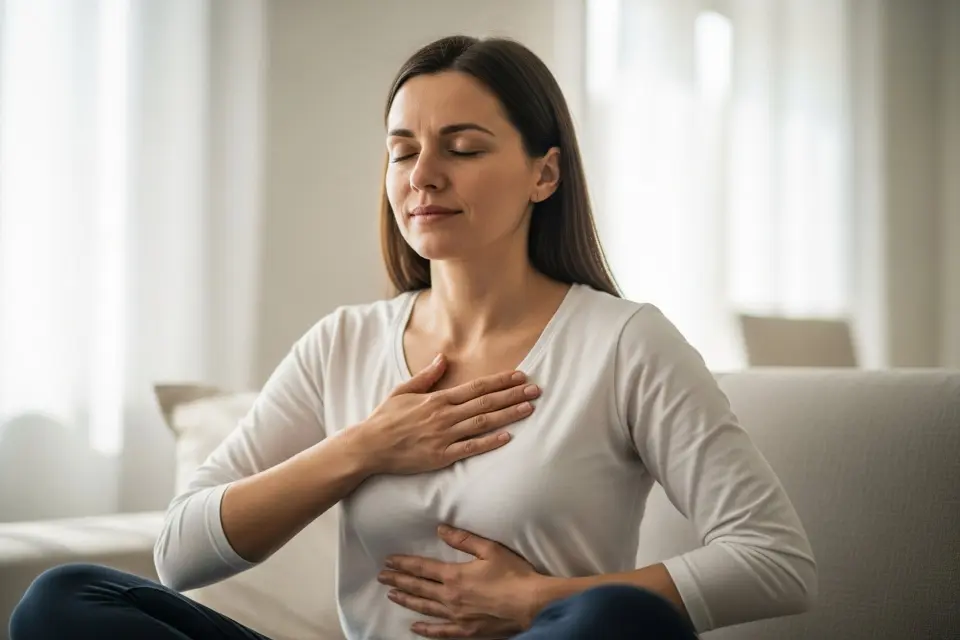
Inhale through your nose for about four counts, then exhale slowly for six to eight counts. The ratio matters more than exact numbers: an exhale longer than the inhale stimulates the vagus nerve and signals to the brain that no active threat is present. You can do this while listening in a meeting, waiting in a checkout line, or sitting in a waiting room. The movement is too small for anyone nearby to notice.
Inhale for four counts and exhale for four, repeating three to four times with no breath hold. Because there is no pause phase, this version is easier to do while walking or during a conversation. Counting also occupies the verbal region of the brain that tends to generate anxious narration, redirecting it to a neutral task.
Grounding anchors attention to physical reality rather than imagined threat. These techniques require nothing visible from the outside.
Press your feet firmly into the floor and hold that contact for a few seconds. If seated, press your palms flat on your thighs or grip the armrests of your chair. The pressure generates proprioceptive input that directly competes with the abstract signal of fear. The technique takes about three seconds and is entirely invisible to anyone nearby.
Pick a category, such as animals, cities, or foods, and mentally list as many examples as you can. This technique redirects the same verbal and analytical brain functions that anxiety uses for catastrophizing. It works particularly well during unavoidable situations where you must appear engaged but cannot speak, like waiting to begin a presentation or sitting in a difficult meeting.
Choose one nearby object and examine it for 60 seconds: color variations, texture, how light falls on it, what materials it appears to be made from. Focused perceptual attention disrupts abstract worry by giving the brain a concrete task it cannot perform simultaneously with catastrophizing.
Anxiety often builds gradually across a workday before it becomes noticeable. Short practices at your desk can interrupt that accumulation before it compounds.
Set a quiet phone reminder once or twice a day. When it fires, pause for two minutes and ask three questions: What physical sensations am I aware of right now? What emotion is present? What is actually happening, and what am I only imagining might happen? This brief check-in catches autopilot anxiety before it escalates.
Tighten and release individual muscle groups without visible movement. Curl your toes inside your shoes and hold for five seconds, then release. Squeeze your hands together in your lap for five seconds, then release. Anxiety stores in physical tension that often accumulates unnoticed throughout a workday. Targeted release addresses it directly.
Get anxiety treatment online today
A licensed doctor can review your symptoms and send a prescription to your pharmacy, often the same day.
Anxiety symptoms often intensify during unstructured time because there is no immediate task to anchor attention. These techniques transform transitions into practice opportunities rather than anxiety windows.
During walks between locations, feel each footfall, the rhythm of your stride, the temperature of the air on your face. When a worry thought appears, acknowledge it and redirect attention to physical sensation. This portable version of mindful walking requires no extra time, only redirected attention.
On public transit, instead of scrolling through a phone, practice sustained attention on one fixed point: the view through a window, the ambient sound environment, or the physical sensation of your seat. Allow thoughts to arise and pass without following them. Five focused minutes builds attentional capacity that carries over when anxiety spikes.
Social anxiety often creates a self-reinforcing loop: anxious self-monitoring pulls attention inward, making you less present in the conversation, which feeds more anxiety. The antidote is deliberate outward attention.
During a conversation that triggers anxiety, focus entirely on what the other person is actually saying rather than on how you are coming across or what you will say next. Notice their word choices, their tone, and what they emphasize. Sustained outward focus breaks the internal spiral. As a side effect, it typically makes the interaction go better.
These techniques are most effective when practiced regularly, not only during anxious moments. A few uses during calm periods builds the neural association between the technique and a calmer state, making it more automatic when anxiety arrives.
Combining portable mindfulness with coping skills for anxiety recommended by therapists, including behavioral and cognitive tools, gives you the most consistent relief across different types of situations.
Several work well during acute anxiety, particularly extended exhale breathing and tactile anchoring. They are most effective when practiced in calm moments first, so the pattern is familiar under pressure. If panic attacks are frequent or severe, a healthcare provider can recommend additional treatment.
Daily practice of even two to three minutes produces more reliable results than using techniques only when anxious. Consistent practice builds a stronger conditioned response so the tools are available when you actually need them.
Most can be adapted for younger ages. Tactile anchoring and the 5-4-3-2-1 method (naming things you can see, hear, and touch) are particularly accessible for children. A pediatrician or child psychologist can offer age-appropriate guidance.
Difficulty focusing is a symptom of anxiety, not a failure of technique. Start with the shortest options, such as counted breath cycling or object observation, and gradually extend duration as your attentional capacity builds.
Yes. Portable mindfulness is effective for manageable, situational anxiety. Persistent anxiety, panic disorder, or anxiety that significantly limits daily functioning typically requires professional evaluation and a structured treatment plan.
Mindfulness exercises for anxiety do not require retreat from the world. Extended exhale breathing, tactile anchoring, silent category naming, and observation-based techniques work in offices, waiting rooms, transit, and social settings without drawing any notice. The key is practicing regularly before anxiety peaks so the tools are automatic when they matter most. For anxiety that persists or worsens despite self-management, Doctronic.ai provides immediate access to licensed telehealth providers at any hour.
Get mental health advice
Chat Now