Mental Health
How to Calm an Anxiety Attack: Techniques That Work in the Moment
April 17, 2026
6 min read

Medically reviewed by Lauren Okafor | MD, The Frank H Netter MD School of Medicine, Loyola University Medical Center on April 23rd, 2026.
Published on April 9th, 2026. Updated on July 24th, 2026.
Tight quads, hamstrings, IT band, and calves all pull on the knee joint, making regular stretching essential for runners who want to stay pain-free.
Static stretching belongs after your run, not before (a dynamic warm-up is better pre-run).
Hold each stretch for 30 seconds and repeat 2-3 times per side for meaningful flexibility gains.
Stretching alone won't fix structural knee problems; pairing it with strengthening work gives better long-term results.
If a stretch causes sharp or shooting knee pain, stop immediately and consider whether an injury needs professional evaluation.
Persistent knee pain that doesn't respond to rest and stretching is worth discussing with a provider. Doctronic.ai connects you with a licensed clinician via telehealth, without the wait.
Questions about knee pain?
Free. Anonymous. Built by doctors.
This article covers general information. Ask Doctronic about your symptoms, medications, side effects, or treatment options.
Knee pain is one of the most common complaints among runners, and most of it doesn't start in the knee itself. The joint is caught between three major muscle groups above and below, and when any one of them gets tight, something has to give. Usually it's the knee.
Tight quadriceps increase the pull on the patellar tendon and compress the kneecap (patella) against the femur. The IT band, a thick strip of connective tissue running down the outside of the thigh, creates friction against the outer knee when it shortens over miles of repetitive hip flexion. Tight hamstrings alter gait mechanics and shift load onto the knee joint. Even tight calves can change ankle mobility enough to force compensatory strain upward through the knee.
The good news is that all of these areas respond well to consistent, post-run stretching. The goal isn't to become a yoga practitioner. It's to offset the shortening that happens mile after mile, so your knee isn't fighting tension from every direction.
There's a persistent myth that static stretching before a run prevents injury. Research has consistently shown the opposite: holding a muscle in a lengthened position before activity can temporarily reduce its force output and doesn't meaningfully lower injury risk. Before running, your goal is to increase blood flow and prepare your joints for movement through a dynamic warm-up, such as leg swings, walking lunges, and high knees.
Static stretching, the kind where you hold a position for 30 or more seconds, earns its place after your run. Your muscles are warm, pliable, and most responsive to lengthening at that point. A post-run routine of 10-15 minutes spent on the stretches below will do more for your knees than anything you might attempt at the trailhead.
Understanding the principles behind stretching basics helps you apply them more effectively, especially when it comes to timing and how far to push each movement.
Work through these eight stretches after every run. Each one targets a specific structure that contributes to knee stress.
Stand on one foot and pull the opposite foot toward your glute, keeping your knees together. Hold for 30 seconds, then switch. If balance is a challenge, rest your free hand on a wall. You should feel a stretch along the front of the thigh, not a pull in the knee itself. If there's discomfort at the knee, reduce the bend slightly.
Sit on the floor with both legs extended. Lean forward from the hips (not by rounding your back) and reach toward your feet until you feel a pull along the back of the thigh. Hold for 30 seconds. You can also do this one leg at a time by extending one leg and folding the other. The stretch should be felt behind the thigh and knee, not in the lower back.
Stand and cross your right leg behind your left. Lean your upper body to the left, pressing your hips gently to the right. You'll feel a stretch along the outer right hip and thigh. Hold for 30 seconds, then switch. This is one of the most important stretches for runners prone to outer-knee pain, often called IT band syndrome.
Face a wall and step one foot back, keeping that heel flat on the floor and the knee straight. Lean into the wall until you feel a stretch through the calf. Hold 30 seconds for the gastrocnemius (upper calf), then bend the back knee slightly to shift the stretch into the soleus (lower calf). Switch sides. Calf tightness is consistently underestimated as a contributor to knee mechanics.
Lie on your back with both knees bent. Cross your right ankle over your left thigh, just above the knee. Gently press the right knee away from your body. For more intensity, lift your left foot off the floor and clasp your hands behind the left thigh. Hold for 30 seconds per side. This stretch targets the piriformis and outer hip, which are directly linked to IT band tension.
Still on your back, pull one knee toward your chest with both hands and hold for 30 seconds. Switch sides. This decompresses the lower back and gently lengthens the hip flexors and gluteal muscles, both of which affect knee tracking during your stride.
Kneel on one knee with your front foot flat on the floor (a half-kneeling position). Shift your hips forward slightly until you feel a stretch at the front of the back hip. Keep your torso upright rather than leaning forward. Hold for 30 seconds per side. Tight hip flexors tilt the pelvis forward, shortening the quads and increasing patellofemoral pressure over time.
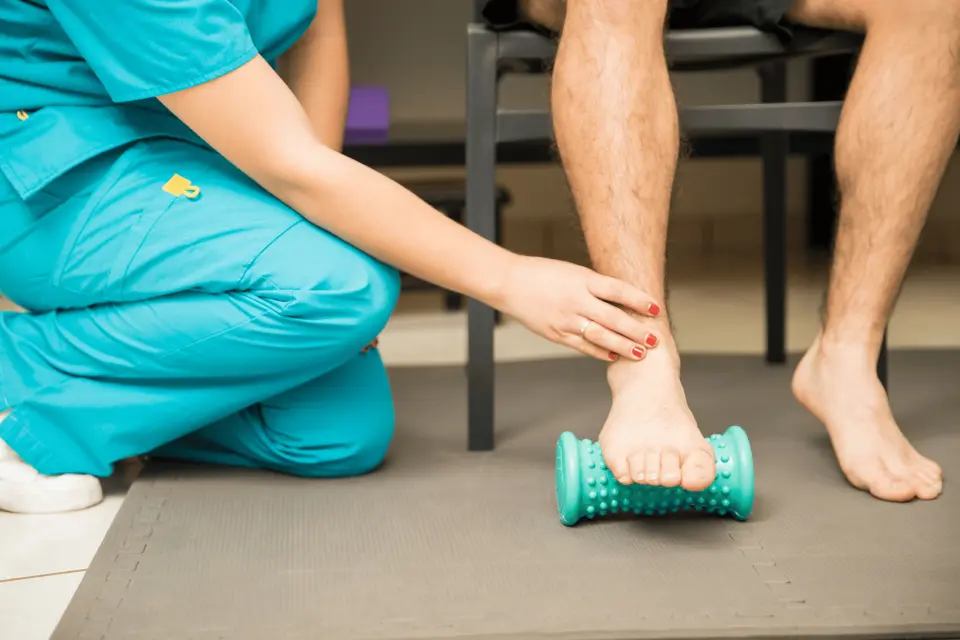
Foam rolling isn't technically stretching, but it's an important part of the same post-run routine. Slowly roll the front of each thigh, pausing on any areas of tension, for 60-90 seconds per side. Then roll the outer thigh from just below the hip to just above the knee. Go slowly and avoid rolling directly over the knee joint itself. Foam rolling helps reduce myofascial tightness that static stretching alone can't fully address.
For any static stretch, 30 seconds per repetition is the effective minimum. Shorter holds don't produce lasting changes in flexibility. Aim for 2-3 repetitions per side for each stretch. If time is tight after a run, prioritize the quads, IT band, and calves, since these three have the greatest impact on knee mechanics in runners.
Consistency matters more than depth. A 70% stretch held consistently every day will improve flexibility faster than an aggressive stretch done twice a week.
Flexibility work is half the equation. If the muscles around the knee are both weak and tight, releasing the tightness without building strength leaves the joint vulnerable. The glutes and hip abductors, in particular, control how the knee tracks during each footfall. Weak glutes are among the most common contributing factors to patellofemoral pain and IT band syndrome.
A complete knee health routine for runners includes targeted strengthening (single-leg squats, clamshells, step-downs) alongside the stretches above. Stretching alone can temporarily relieve pain and improve range of motion, but it won't correct the muscle imbalances that often drive overuse injuries.
Stretching should produce a mild pulling sensation, not pain. Stop immediately if you experience any of the following during a stretch:
Sharp or shooting pain in the knee
Pain that worsens as the stretch progresses instead of easing
Clicking, locking, or giving-way sensations in the joint
Swelling that increases after stretching
These symptoms suggest a structural issue rather than simple muscle tightness. Meniscus injuries, ligament sprains, and cartilage damage can all be aggravated by certain movements. Stretching into pain prolongs recovery. Understanding broader principles of exercise and physical fitness can help you recognize when rest and professional evaluation are the smarter choice.
Stretch |
Target Area |
Hold Time |
Reps Per Side |
|---|---|---|---|
Standing quad stretch |
Quadriceps |
30 sec |
2-3 |
Seated hamstring stretch |
Hamstrings |
30 sec |
2-3 |
IT band cross-body stretch |
IT band, outer hip |
30 sec |
2-3 |
Standing calf stretch |
Gastrocnemius, soleus |
30 sec each |
2-3 |
Figure-4 hip opener |
Piriformis, outer hip |
30 sec |
2-3 |
Supine knee-to-chest |
Hip flexors, glutes |
30 sec |
2-3 |
Wall-assisted hip flexor stretch |
Hip flexors |
30 sec |
2-3 |
Foam rolling: quads and IT band |
Myofascial tissue |
60-90 sec |
1 |
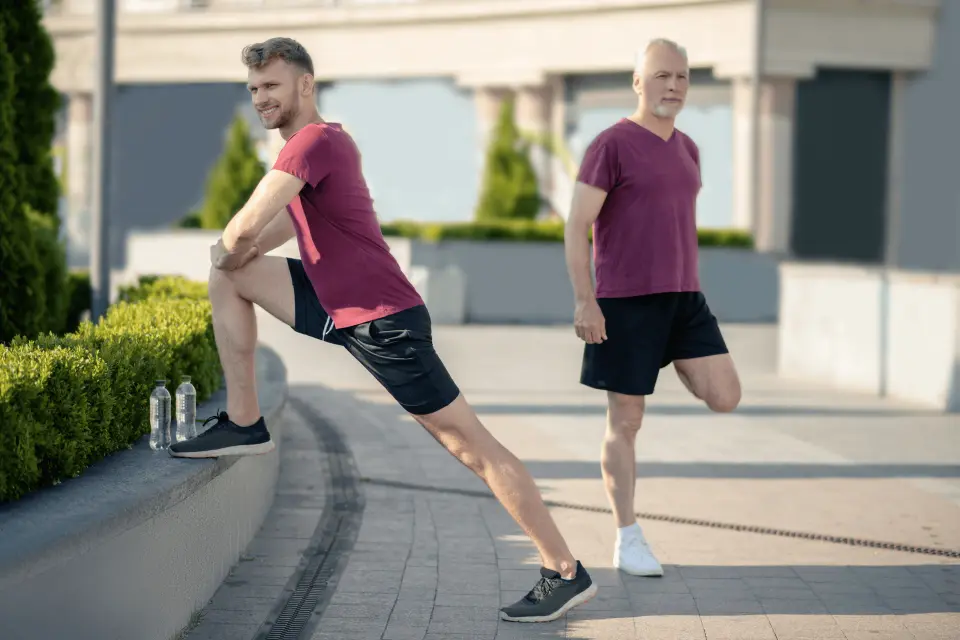
Static stretching belongs after running, not before. Before your run, use a dynamic warm-up (leg swings, walking lunges, hip circles) to prepare your joints and muscles for movement. Static stretches are most effective when muscles are already warm, which is why post-run timing produces better flexibility gains.
Hold each static stretch for at least 30 seconds. Shorter holds don’t produce lasting changes in flexibility. Repeat each stretch 2-3 times per side. The total post-run routine should take about 10-15 minutes.
Stretching can reduce tension in the muscles that contribute to runner’s knee (patellofemoral pain syndrome), but it’s rarely a complete solution on its own. Most cases improve with a combination of stretching, hip and glute strengthening, and modifications to training load.
There’s no single answer because different runners have different tightness patterns. The quad stretch and IT band cross-body stretch are the two most commonly beneficial, but a calf stretch is also essential since calf tightness affects how force travels through the ankle and into the knee.
See a provider if your knee pain is accompanied by swelling, locking, giving-way, or sharp pain during activity; if pain persists for more than two weeks despite rest and stretching; or if the pain came on suddenly during a run. These signs point to a structural issue that needs evaluation.
Knee pain doesn't have to sideline your running. A consistent post-run stretching routine targeting the quads, hamstrings, IT band, calves, and hip flexors takes less than 15 minutes and pays dividends in both comfort and injury prevention. Pair it with hip strengthening and sensible mileage increases, and most runners see meaningful improvement within a few weeks.
If your knee pain is persistent, severe, or comes with swelling and instability, it's time to get it evaluated. Doctronic.ai lets you connect with a licensed clinician by telehealth to discuss your symptoms, get a professional assessment, and explore next steps without leaving home.
Get pain relief advice
Chat Now