Bone & Joint Health
What Is a Dangerously High Calcium Level and What Does It Mean?
July 21, 2026
6 min read

Medically reviewed by Lauren Okafor | MD, The Frank H Netter MD School of Medicine, Loyola University Medical Center on April 25th, 2026.
Published on April 9th, 2026. Updated on July 23rd, 2026.
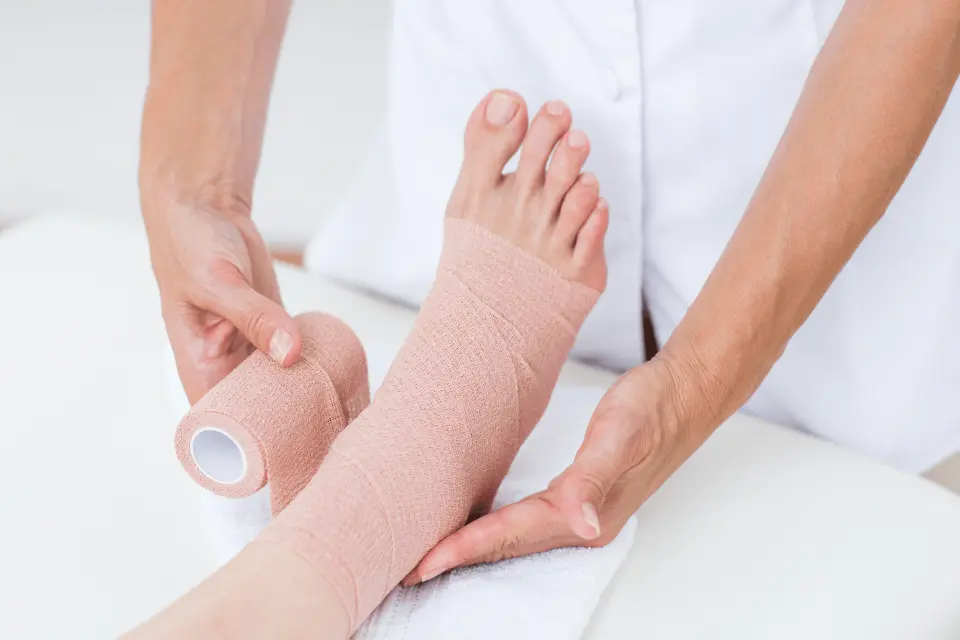
Wrapping an ankle works through two mechanisms: compression limits fluid accumulation in the first 24 to 72 hours after injury, and circumferential pressure provides proprioceptive feedback that helps stabilize an unstable joint.
Elastic bandages are best for acute swelling; cohesive self-adhesive wraps suit active use; kinesiology tape is preferred when you need support without restricting range of motion.
The open basket weave technique is specifically designed for acute injuries with significant swelling, leaving the ankle joint exposed to allow greater fluid drainage.
Always check circulation after wrapping: toes should remain warm, pink, and able to move freely.
Wrapping for a return to activity is different from wrapping an acute injury; the goals, materials, and tension all change as the ankle heals.
If your ankle still feels unstable after swelling subsides, that is a sign the injury may need evaluation. Doctronic.ai connects you with a licensed provider by telehealth to assess your sprain and guide your recovery plan.
An ankle wrap works through two mechanisms.
The first is mechanical compression. When a ligament tears, the inflammatory response floods the surrounding tissue with fluid. Compression creates circumferential pressure that limits soft tissue expansion. Less swelling means less pain, less stiffness, and a faster return to weight-bearing.
The second is proprioceptive feedback. Proprioception is the body's ability to sense joint position. After a sprained ankle, the mechanoreceptors embedded in ligament tissue are damaged alongside the structural fibers, and the ankle loses some ability to detect and correct for unexpected movement. A wrap or brace applies constant skin pressure that partially compensates for this signal loss.
Compression matters most in the first 48 to 72 hours when swelling is active. Proprioceptive support matters more after swelling resolves and loading resumes.
Each material has specific strengths suited to particular situations.
Standard elastic bandages are the most accessible and versatile option: reusable, adjustable, and easy to apply. Their main limitation is migration. Walking repeatedly loosens a standard elastic wrap, requiring rewrapping several times a day. They are best suited for the acute phase when the priority is swelling control and the ankle is largely at rest.
Cohesive (self-adhesive) wraps bond to themselves without clips or adhesive. They stay in place better during activity, resist migration under load, and can be torn to length without scissors. Athletic trainers use them for game-day taping because they maintain position through repeated movement. They are single-use, which makes them more expensive than elastic bandages per application, but they are the better choice when you need compression during activity rather than at rest.
Kinesiology tape is an elastic therapeutic tape applied directly to the skin in specific patterns. Unlike rigid athletic tape or a compression wrap, it does not restrict the range of motion. It lifts the skin microscopically, which may reduce pressure on pain receptors and improve fluid drainage through lymphatic channels. It is best used after the acute swelling phase, when the priority shifts to proprioceptive support and functional movement. It is not a substitute for a compression wrap in the first 24 to 72 hours, and improperly applied tape can cause skin irritation on sensitive skin.
Lace-up and semi-rigid braces are often the appropriate upgrade when a wrap alone is insufficient. A lace-up brace provides mechanical lateral stability that an elastic bandage cannot replicate, restricting the inversion and eversion movements that re-injure a healing ligament. For sprains with any instability, a brace offers better protection for a meaningful return to activity. Ankle strengthening exercises become an important complement once the brace is no longer needed full-time.
The figure-8 is the foundational wrapping method for ankle support. For a full step-by-step walkthrough, see the dedicated guide on wrapping a sprained ankle with an Ace bandage.
The essential sequence: anchor at the ball of the foot with two flat rounds, angle diagonally across the arch toward the inner side, loop under the heel and up the outer ankle, cross diagonally over the top of the foot, loop around the back of the ankle and lower leg, and repeat two to three times. Finish with straight rounds above the ankle bone.
The diagonal crossing over the top of the foot locks the bandage to the ankle contours, preventing it from sliding with movement. A spiral wrap that goes straight up the leg lacks this anchor and migrates quickly.
The open basket weave is used in the first 24 to 48 hours when significant swelling is expected. It is commonly applied in athletic training rooms immediately after injury, before imaging.
Unlike the figure-8, the basket weave leaves the ankle joint itself less compressed than the surrounding tissue. This allows swelling to move away from the joint rather than being trapped against it, which reduces pain and allows better assessment of injury severity.
To apply it, begin with horizontal anchor strips several inches above the ankle. Apply vertical stirrups (from the anchor, under the heel, back up to the anchor on the opposite side) alternating with horizontal horseshoe strips around the back of the heel. The interlocking strips create a supportive basket without direct compression over the most swollen tissue.
This technique requires rigid or semi-rigid athletic tape and is significantly more difficult than a standard figure-8. At home, with only an elastic bandage, a standard figure-8 at controlled tension is appropriate.
The choice should follow the phase of injury. In the first 48 to 72 hours, use an elastic bandage or cohesive wrap. The priority is fluid control, and these provide the circumferential compression that limits swelling. Kinesiology tape provides insufficient compression for acute management.
After 72 hours, as swelling stabilizes and you begin weight-bearing, kinesiology tape becomes appropriate. Restricting range of motion is less useful at this stage; maintaining proprioceptive feedback while allowing the ankle to move is the priority.
For return to sport, a cohesive wrap or a lace-up brace is preferable to kinesiology tape alone for any sprain beyond grade 1. The mechanical support from a wrap or brace exceeds what tape provides under lateral loading.
Get muscle strain treatment online today
A licensed doctor can review your symptoms and send a prescription to your pharmacy, often the same day.
Related medications we prescribe
Learn moreA wrap that is too tight cuts off blood flow and can cause serious harm. Check these signs immediately after applying any wrap:
Toe color: toes should stay the same color. Pale, white, or blue toes indicate arterial compression.
Toe temperature: the foot should feel the same or slightly warmer. A cold foot signals restricted circulation.
Capillary refill: press a toe pad until it blanches, then release. Color should return within 2 seconds.
Sensation: numbness or tingling anywhere in the foot means the wrap is too tight.
Movement: toes should wiggle freely.
Recheck at 10 to 15 minutes and after any activity. If any sign is abnormal, unwrap and rewrap with less tension.
The purpose, tension, and materials for wrapping change as the ankle moves through recovery.
For acute injury (first 72 hours), the goal is swelling control. Apply firm, even compression from the ball of the foot to mid-calf. Keep the foot elevated when not moving, remove it at night, and rewrap it each morning before standing.
For return to activity, the goal shifts to stability and proprioceptive support. A cohesive wrap or lace-up brace is preferable to an elastic bandage that migrates during movement. Some athletes use kinesiology tape alongside a lace-up brace for combined proprioceptive and mechanical support.
For chronic ankle instability, wrapping is a management tool, not a solution. A rehabilitation program targeting peroneal muscle strength, balance, and proprioception addresses the underlying deficit. Wrapping alone without rehabilitation does not reduce the risk of future sprains.
A wrap suits sprains and strains that are mild to moderate, with weight-bearing possible and swelling manageable. Several situations require more than a wrap:
Inability to bear any weight immediately after injury
Pain directly over the fibula tip or the base of the fifth metatarsal, which suggests a fracture
An ankle that buckles when you try to walk, indicating significant ligament disruption
Severe swelling spreading up the lower leg, or extensive bruising
Numbness or tingling from the injury itself
Swelling not improving after 48 to 72 hours of compression and elevation
Grade 3 sprains (complete ligament rupture) require a walking boot or cast, and sometimes surgical evaluation. No compression wrap provides sufficient stability for a completely ruptured ligament. If there is any uncertainty about the fracture, imaging is warranted before relying on conservative wrapping.
Compression wraps are flexible and circumferential, designed to control swelling and provide mild support. Athletic tape is rigid or semi-rigid, applied in strip patterns to mechanically limit specific joint movements. Athletic tape requires more skill to apply and is typically used by athletic trainers for functional support during sport.
Yes, but apply at a lower tension than you would for a mild sprain. The ankle still needs compression to limit further fluid accumulation, but excessive pressure over highly edematous tissue is painful and can restrict circulation. Monitor closely after applying.
During the first 48 to 72 hours, wrap during waking hours and remove at night. After that, taper to periods of extended activity. Most grade 1 sprains no longer need daily wrapping after the first week. Grade 2 sprains often benefit from continued compression and a lace-up brace for several weeks.
Not during the acute phase. Elastic bandages provide greater compression and are more effective at controlling swelling in the first 48 to 72 hours. Kinesiology tape is more appropriate after swelling has stabilized, when the goal is proprioceptive support and functional movement.
Wrapping and bracing reduce re-injury risk in people with a sprain history, particularly during sport. They do not prevent all sprains and are not a substitute for rehabilitation exercises that address the muscle strength and proprioception deficits that make previously injured ankles vulnerable.
Taper off when swelling has resolved, you can bear full weight without pain, and the ankle feels stable during normal daily movement. When returning to sport, continue wearing a lace-up brace or cohesive wrap for the first several weeks of return, even if the ankle feels normal.
Wrapping an ankle correctly matches the technique and material to the phase and goal of recovery. Elastic bandages control swelling in the acute phase. Cohesive wraps stay in place during activity. Kinesiology tape supports proprioception when movement needs to be preserved. Lace-up braces provide mechanical stability that wraps cannot.
The fundamentals apply regardless of material: start at the toes, work upward, maintain even tension, and check circulation after applying and after any activity.
For any ankle injury where swelling is severe, you cannot bear weight, the ankle feels unstable, or symptoms are not improving within a few days, professional evaluation is warranted. Doctronic.ai connects you with a licensed provider by telehealth for a rapid injury assessment without leaving home.
Get pain relief advice
Chat Now