

Vaginal Dryness During Menopause
Meta Description: Understand why vaginal dryness during menopause occurs and explore effective treatments, from moisturizing therapies to low-dose estrogen and laser [...]
Read MoreMost sciatica cases resolve without surgery when treated with proper physical exercises and movement
Targeted stretching provides immediate relief by reducing pressure on the sciatic nerve
Core and posterior chain strengthening prevent recurring episodes
The McKenzie Method and nerve flossing techniques can centralize and reduce radiating pain
Knowing when to stop exercising and seek professional help protects against further injury
Doctronic offers 24/7 access to medical guidance for managing sciatica symptoms
The burning sensation shooting down your leg feels unbearable, and your first instinct is to lie still. That instinct is wrong. Research confirms that approximately 70–90% of sciatica cases improve without surgery, responding well to conservative treatments that prioritize movement over rest. Finding the best sciatica physical exercises makes the difference between weeks of suffering and a faster return to normal life.
The sciatic nerve runs from your lower back through your hips and down each leg. When something compresses or irritates this nerve, pain radiates along its entire path. The good news: specific exercises can reduce that compression, strengthen supporting muscles, and restore mobility. Doctronic helps patients understand their symptoms and determine which exercises match their specific condition before starting any program.
Herniated discs account for an estimated 60–80% of sciatica cases. The soft center of a spinal disc pushes through its outer ring and presses against nerve roots. Spinal stenosis, or narrowing of the spinal canal, creates similar pressure. Piriformis syndrome occurs when the piriformis muscle in your buttocks spasms and irritates the nearby sciatic nerve.
Bone spurs from arthritis can also compress nerve tissue. Pregnancy sometimes triggers sciatica as the growing uterus shifts spinal alignment. Understanding the cause helps determine which exercises will help versus which might worsen symptoms.
Bed rest was once the standard recommendation for back pain. Medical consensus has completely reversed. As experts note, staying active and avoiding prolonged bed rest is crucial for sciatica recovery. Gentle movement, short walks, and basic stretches help reduce inflammation and prevent muscle weakness.
Passive treatments like ice, heat, and massage provide temporary relief. Active approaches build lasting resilience. The goal is not just pain reduction but preventing future episodes through stronger, more flexible supporting structures.
Lie on your back with both knees bent. Cross your right ankle over your left knee. Gently pull your left thigh toward your chest until you feel a stretch deep in your right buttock. Hold for 30 seconds, then switch sides.
This stretch directly addresses piriformis syndrome and helps even when other causes are present. The piriformis muscle often tightens in response to sciatic irritation, creating a secondary pain source.
Sit on the floor with legs extended. Bend your right knee and place your right foot outside your left thigh. Twist your torso to the right, using your left elbow against your right knee for leverage. Keep your spine tall and hold for 20-30 seconds.
Spinal twists may help relieve muscular tension, but should be performed cautiously. Perform these gently and never force the rotation.
Lie flat on your back. Pull one knee toward your chest while keeping the other leg straight or slightly bent. Hold for 30 seconds, then switch. For a deeper stretch, pull both knees to your chest simultaneously and rock side to side gently.
This simple stretch elongates the lower back muscles and reduces compression on the lumbar spine, where most sciatic nerve irritation originates.
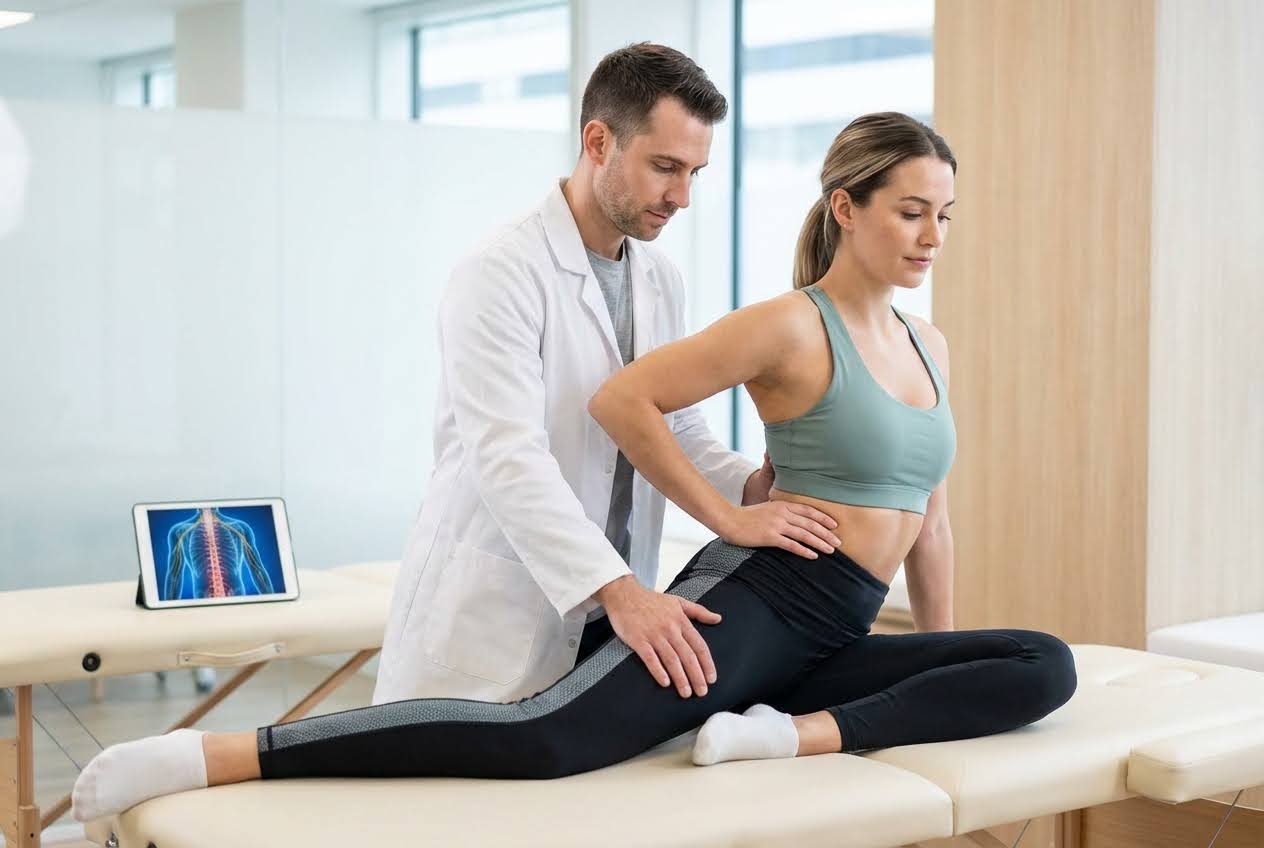 Strengthening the Core and Posterior Chain
Start on hands and knees with a neutral spine. Extend your right arm forward and left leg backward simultaneously, keeping your hips level. Hold for 5-10 seconds, return to the start, and switch sides. Perform 10 repetitions per side.
Bird-dogs strengthen the muscles that stabilize your spine during movement. This exercise teaches your body to maintain proper alignment under load.
For pelvic tilts, lie on your back with your knees bent. Flatten your lower back against the floor by tightening your abdominal muscles. Hold for 5 seconds, release, and repeat 15 times.
Bridges are built on this foundation. From the same starting position, lift your hips toward the ceiling while squeezing your glutes. Your body should form a straight line from shoulders to knees. Hold for 5 seconds and lower slowly. Perform 10-15 repetitions.
Walking, swimming, and stationary cycling improve blood flow to spinal structures without jarring impact. Start with 10-15 minutes daily and gradually increase duration. Water-based exercises are particularly helpful because buoyancy reduces spinal loading while allowing full-range movement.
Physical therapy before injections or surgery can lead to significant cost savings while often producing better outcomes. Active rehabilitation should be the first treatment approach for most patients.
The McKenzie Method uses repeated movements to shift pain from the leg back toward the spine, a process called centralization. Lie face down and prop yourself on your elbows, allowing your lower back to arch gently. Hold for 30 seconds, rest, and repeat.
If this reduces leg symptoms, progress to prone press-ups: place your hands under your shoulders and push your upper body up while keeping your hips on the floor. Centralization indicates the exercise is working correctly.
Nerve flossing mobilizes the sciatic nerve within its surrounding tissues. Sit on a chair edge with good posture. Extend one leg while pointing your toes toward your face. Simultaneously look up toward the ceiling. Then flex your foot downward while tucking your chin to your chest.
This alternating movement gently mobilizes the nerve, helping reduce tension and improve comfort. Perform 10-15 repetitions per leg, stopping if symptoms increase.
Stop any exercise that increases leg pain or causes numbness to spread. Forward-bending exercises can worsen disc herniations in some patients. High-impact activities like running or jumping place excessive stress on compromised spinal structures.
Maintaining proper posture and body mechanics is crucial in managing sciatica. Poor form during exercise can create new problems or worsen existing ones.
Seek immediate medical attention for sudden bladder or bowel control changes, progressive leg weakness, or numbness in the groin area. These symptoms suggest cauda equina syndrome, a medical emergency.
Consult a healthcare provider if pain persists beyond 4-6 weeks of self-care, if symptoms worsen despite exercise, or if pain follows an injury. Doctronic provides 24/7 access to medical guidance that can help determine whether symptoms require urgent evaluation.
Consistency matters more than intensity. Daily stretching for 10-15 minutes prevents muscle tightness from returning. Core strengthening exercises performed 3-4 times weekly build lasting spinal support.
Ergonomic adjustments reduce daily strain. Use lumbar support when sitting. Take standing breaks every 30-45 minutes. Sleep with a pillow between your knees to maintain spinal alignment.
Weight management can help decrease mechanical stress on the spine. Studies suggest that each additional pound of body weight adds roughly two to three pounds of pressure on lumbar structures during movement.
Most people notice some improvement within 2-4 weeks of regular exercise. Complete resolution typically takes 6-12 weeks. If symptoms worsen or show no improvement after 4 weeks, consult a healthcare provider.
Gentle stretching and walking are usually safe during mild flare-ups. Avoid strengthening exercises until acute pain subsides. Ice for 15-20 minutes several times daily can help reduce inflammation during flare-ups.
Light movement, like walking for 5 minutes, should precede stretching. Cold muscles are more prone to injury. Save deeper stretches for after your main exercise routine when tissues are warm.
Avoid heavy deadlifts, sit-ups, leg presses, and any exercise that rounds your lower back under load. High-impact activities and deep forward bends often worsen symptoms.
Stretching can be performed daily. Strengthening exercises work best with rest days between sessions, so 3-4 times weekly is optimal. Aerobic conditioning should gradually build to 30 minutes most days.
The right sciatica physical exercises reduce pain, prevent recurrence, and often eliminate the need for invasive treatments. Start with gentle stretches, progress to strengthening, and maintain consistency for lasting spinal health. For personalized guidance on managing sciatica symptoms, visit Doctronic for free AI-powered medical consultations or affordable telehealth visits with licensed doctors available around the clock.
Meta Description: Understand why vaginal dryness during menopause occurs and explore effective treatments, from moisturizing therapies to low-dose estrogen and laser [...]
Read MoreMeta Description: Discover why perimenopause causes itching and explore effective relief strategies, from hormone therapy to skincare tips, to soothe dry and itchy skin.When [...]
Read MoreMeta Description: Understand why weight gain during perimenopause occurs and learn how to manage it through protein intake, resistance training, and better sleep habits.Why [...]
Read More