
Light Therapy Lamps: How They Help with SAD and Sleep Disruption

Medically reviewed by Veronica Hackethal | MD, MSc, Harvard University | University of Oxford | Columbia Vagelos College of Physicians and Surgeons on May 25th, 2026.
Published on April 17th, 2026. Updated on July 23rd, 2026.
Key takeaways
Light therapy uses bright artificial light to reset the body's internal clock, and it is one of the most effective first-line treatments for seasonal affective disorder.
A 10,000-lux UV-filtered lamp used for 20 to 30 minutes within the first hour of waking produces the strongest clinical benefit for SAD and circadian disruption.
Light therapy also helps with non-seasonal depression, jet lag, shift work sleep disorder, and delayed sleep phase syndrome.
Side effects are usually mild and short-lived, but people with bipolar disorder, certain eye conditions, or photosensitizing medications should consult a clinician before starting.
If you're not sure whether light therapy is right for you, Doctronic.ai connects you to licensed providers who can evaluate your symptoms and guide your treatment.
Questions about light therapy?
Free. Anonymous. Built by doctors.
This article covers general information. Ask Doctronic about your symptoms, medications, side effects, or treatment options.
What Light Therapy Actually Is
Light therapy is a daily practice of sitting near a specialized lamp that emits very bright light, typically 10,000 lux, for a set period. It is not UV tanning. The lamps are designed to emit light that mimics the spectrum and intensity of natural outdoor daylight while filtering out ultraviolet rays to protect the skin and eyes.
The core idea is that the human body regulates sleep, mood, hormones, and dozens of biological functions using light as its primary signal. When that signal is missing or disrupted, things go wrong in predictable ways. Light therapy provides the signal back.
It is one of the best-studied, most accessible treatments for conditions rooted in light deprivation or circadian misalignment.
How It Works in the Body
The mechanism begins in the eyes. Specialized cells in the retina called intrinsically photosensitive retinal ganglion cells detect environmental light and send signals directly to the suprachiasmatic nucleus, a small structure in the hypothalamus that functions as the body's master clock.
When light enters the eyes in the morning, the suprachiasmatic nucleus does several things. It suppresses melatonin production, the hormone that promotes sleep and rises in the absence of light. It triggers a boost in serotonin activity, the neurotransmitter involved in mood regulation, motivation, and energy. And it anchors the circadian rhythm to the current light-dark cycle, helping the body anticipate when to be awake and when to sleep.
In winter, shorter days and less intense daylight mean the eyes receive weaker and delayed light signals. The body drifts. Melatonin lingers later into the morning. Serotonin activity drops. The internal clock slips out of sync with the external world. Light therapy works by delivering a strong morning light signal that corrects this drift, essentially telling the body: the day has started.
Seasonal Affective Disorder and Why Light Is the Treatment
Seasonal affective disorder is a form of recurrent depression that follows a seasonal pattern, most commonly beginning in late fall and resolving in spring. The reduced daylight hours of winter are understood to be its primary trigger.
People with SAD experience the full range of depression symptoms: low mood, fatigue, loss of interest, difficulty concentrating, changes in sleep and appetite. A distinct pattern in winter SAD is hypersomnia and carbohydrate craving, driven by the same melatonin excess and serotonin deficit that light therapy directly addresses.
The clinical research on light therapy for SAD is strong. Studies consistently show response rates comparable to antidepressant medication, and some research suggests light therapy may work faster. For many people with mild to moderate SAD, a good lamp and consistent morning use is the primary treatment. For more severe presentations, it is often used alongside therapy or medication.
The typical protocol is 20 to 30 minutes at 10,000 lux, within the first hour of waking. Earlier is generally better. Sitting at the lamp over breakfast or while reading is a common and effective approach.
Other Conditions Light Therapy Helps
SAD is the most recognized indication, but it is far from the only one. Light therapy has meaningful evidence behind it for several related conditions.
Non-Seasonal Depression
Research has found that light therapy produces antidepressant effects even in people whose depression does not follow a seasonal pattern. A notable trial published in JAMA Psychiatry found that light therapy outperformed placebo for non-seasonal major depressive disorder, particularly when combined with antidepressant medication.
Jet Lag
Jet lag results from the body's clock being out of phase with the local time zone. Strategic morning light exposure at the destination helps accelerate the resynchronization process. Timing matters here: the direction of travel and the number of time zones crossed determine whether morning or evening light is more effective.
Shift Work Sleep Disorder
People who work overnight or rotating shifts often develop chronic circadian misalignment because their schedule conflicts with the natural light-dark cycle. Light therapy during the work period can help shift the body's clock toward the desired schedule, improving alertness and reducing daytime insomnia.
Delayed Sleep Phase Syndrome
This condition involves a biological clock that is chronically shifted late, making it genuinely difficult to fall asleep before 1 or 2 a.m. Morning light therapy at a consistent early time applies a daily signal that gradually shifts the clock earlier, often more effectively and with fewer side effects than sleep medications.
Spring Clock Change Adjustment
The spring daylight saving time shift forces the body's schedule one hour earlier overnight, a mild but real form of circadian disruption. Using a light therapy lamp in the morning for several days before and after the clock change can ease the transition. For more on how the spring clock change affects circadian health, the article on how the daylight saving time change affects sleep and mood covers the mechanisms and adjustment strategies in detail.
Get seasonal affective disorder treatment online today
A licensed doctor can review your symptoms and send a prescription to your pharmacy, often the same day.
- $39 video visit
- Insurance accepted
- 4.8 on Trustpilot
Related medications we prescribe
Learn moreChoosing a Lamp
Not all light therapy lamps are equivalent. The key specifications to look for:
The lamp must emit 10,000 lux at the specified use distance. This is the clinically validated intensity. Lamps rated at 2,500 lux exist but require much longer sessions (60 minutes or more) to achieve equivalent effect.
UV filtration is non-negotiable. The therapeutic effect comes from visible light reaching the retina, not ultraviolet rays. A quality lamp will specify UV-free output. Do not use a tanning lamp or standard sunlamp.
Full-spectrum light that mimics daylight is preferred. Cool white fluorescent or LED panels that cover the visible spectrum produce the most reliable results.
Physical size matters. Larger panels deliver their rated lux more evenly and allow more flexibility in positioning. Small lamps require precise positioning at close range to hit the target intensity.
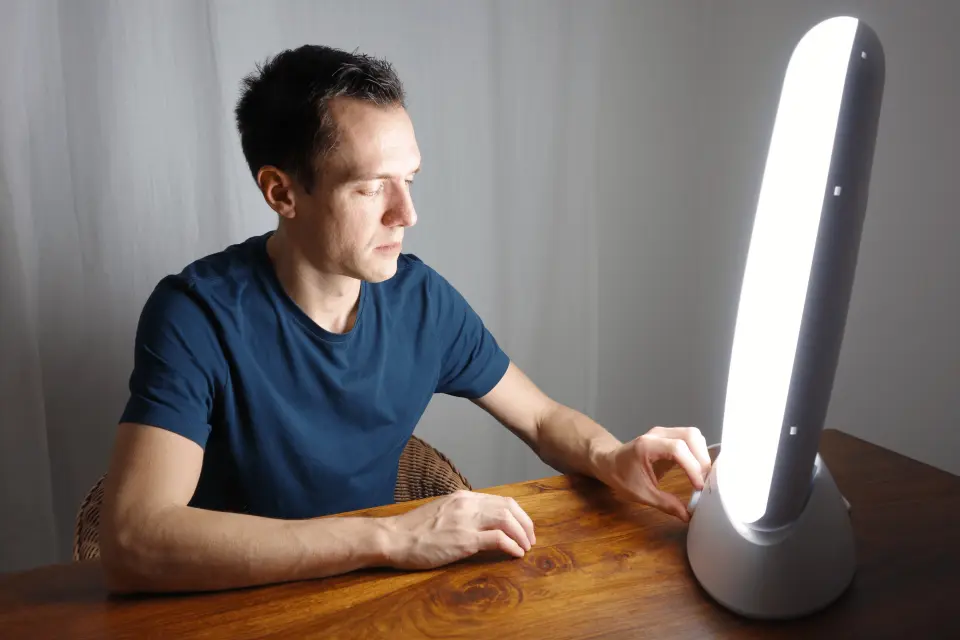
The angle of the lamp relative to your eyes matters more than people expect. The lamp should be positioned to the side or slightly above eye level so that light enters the eyes from the upper field of view. Looking directly at the lamp is not necessary or recommended. The goal is peripheral retinal exposure, not a stare.
How to Use a Light Therapy Lamp
The protocol is simple but consistency matters more than perfection.
Use the lamp every morning during the period when you need it, whether that is the winter months for SAD or year-round for a circadian disorder. Skipping days delays results and extends the adjustment period.
Sit within the distance specified by the manufacturer (typically 40 to 60 centimeters for a 10,000-lux lamp). You do not need to stare at it. Having it in your visual field while you eat, work, or read is sufficient.
Sessions of 20 to 30 minutes are standard at 10,000 lux. If you are using a lower-intensity lamp, adjust the duration accordingly per the manufacturer's guidance.
Avoid evening use unless specifically directed by a clinician for a condition like delayed sleep phase. Evening light signals can delay melatonin onset and push your sleep time later, which is the opposite of the usual goal.
Side Effects and Who Should Be Cautious
Light therapy is well-tolerated by most people. The most common side effects are headache, eye strain, and mild agitation or jitteriness, particularly at the start. These typically resolve within a few days as the body adjusts. Reducing session duration initially and gradually increasing it can help.
For some people, light therapy can cause or worsen anxiety, irritability, or difficulty sleeping if sessions are timed too late in the day or run too long.
There are specific groups who should consult a clinician before starting. People with bipolar disorder face a meaningful risk of light therapy triggering hypomania or mania, particularly without concurrent mood-stabilizing medication. Anyone with a history of bipolar should discuss this with a psychiatrist before beginning.
People with certain eye conditions, including macular degeneration, glaucoma, diabetic retinopathy, and cataracts, should get clearance from an ophthalmologist, as high-intensity light exposure may carry additional risk.
Several medications increase photosensitivity, including some antibiotics, antifungals, and St. John's Wort. If you take any medication with a photosensitivity warning, check with your prescriber or pharmacist before using a light therapy lamp.
Frequently Asked Questions
Most people notice improvement within one to two weeks of consistent daily use. For SAD specifically, some studies show mood changes within the first few days, though the full effect typically builds over two weeks.
No. Standard household bulbs do not reach 10,000 lux at a comfortable distance. You would need to sit uncomfortably close to achieve equivalent intensity, and most standard bulbs do not filter UV light or cover the appropriate spectrum for therapeutic use.
Yes. Sessions much longer than 30 minutes at 10,000 lux can cause jitteriness, headache, or insomnia, especially if done later in the day. More is not better. Start with 20 minutes and increase only if a clinician advises it.
Yes, strategically. For people working overnight, light exposure during the early part of the night shift can help shift the clock later. Timing depends on the specific shift schedule and desired adjustment direction. A sleep specialist can help design the right protocol.
For mild to moderate seasonal depression, light therapy is often sufficient on its own. For more severe SAD or non-seasonal depression, it is typically most effective as part of a combined approach. This is a clinical decision that depends on symptom severity, history, and individual response.
No. Light therapy lamps are available over the counter and do not require a prescription. However, a clinical evaluation is valuable for confirming the diagnosis, choosing the right protocol, and ruling out conditions where light therapy requires caution.
The Bottom Line
Light therapy lamps work by delivering the signal the body's internal clock is designed to receive each morning: bright, full-spectrum light that suppresses melatonin, raises serotonin, and anchors the circadian rhythm to the day. For seasonal affective disorder, that signal is often what's missing. For jet lag, shift work, and clock change disruption, it's the tool that accelerates adjustment.
A 10,000-lux UV-filtered lamp used consistently in the first hour of waking is the evidence-based standard. Most people tolerate it well, and benefits often appear within one to two weeks. If you want guidance on whether light therapy is the right fit for your symptoms, Doctronic.ai connects you with licensed clinicians who can provide a real evaluation.
Related articles
Get sleep health advice
Chat Now