doctronic
Reducing emergency department visits when care starts with an AI clinician
In a health economic model built on real platform care pathways, 86% of chats with emergency-level intent resolved on Doctronic or were directed to office-based care, while 14% were sent on to the emergency department.

Health systems feel avoidable emergency department use twice. Clinically, it crowds the ED and lengthens waits for the patients who truly need it. Financially, for any system bearing medical cost risk, it books low-acuity care in the most expensive setting in medicine. In our modeled commercial population, one ED visit costs roughly 20 times as much as an AI-assisted physician encounter on Doctronic, a consumer-facing AI virtual care platform. We built a health economic model that helps us understand the impact of Doctronic on where care happens, and we analyzed the real-world care pathways behind it to see what happens to emergency-bound demand when care starts with a chat instead.
In the model’s analysis sample, 429 of 8,456 chats (5%) carried emergency-level intent. For each chat, the AI scored the user’s own description of their situation and these were the chats it judged would otherwise have ended in the emergency department. The figure shows where the platform directed them. 70% resolved within the platform, through the AI consultation or an AI-assisted physician encounter. Another 16% were redirected to office-based care, most often a specialist (12%) and otherwise primary care (2%) or urgent care (2%). Only 14% were directed onward to the emergency department. These figures describe where each chat ended and where the user was directed. They are platform dispositions, not verified records of where users actually went afterward.
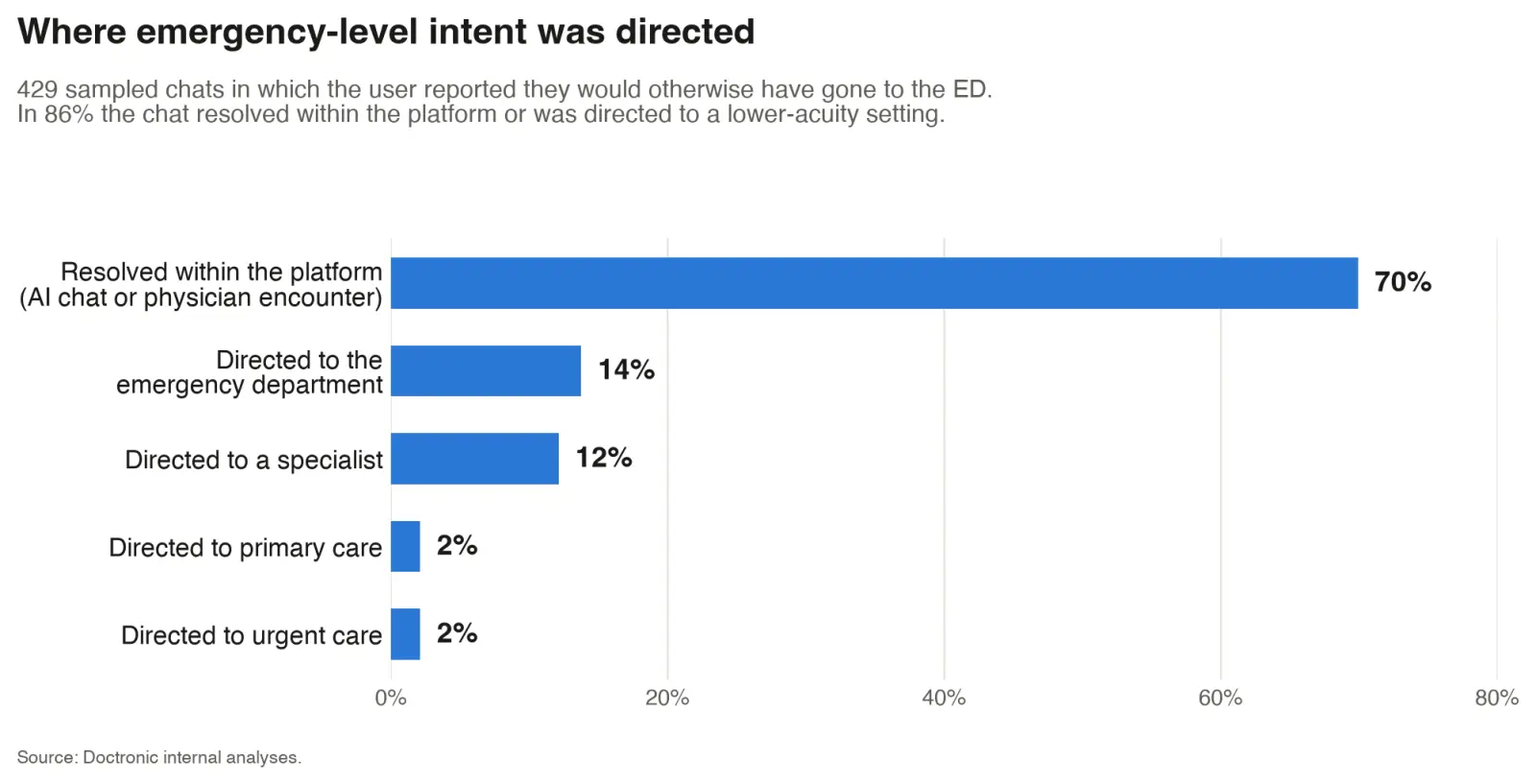
The 14% is as important as the 86%. Triage that cannot recognize a true emergency saves no one money. Across all intent levels, the platform directs about 220 users to the ED for every 10,000 chats, including users who had not planned to go. We see that up-triage as the safety system working, and our model charges every one of those visits at full cost.
Net of those escalations, the model projects 286 ED visits and 37 ambulance runs avoided per 10,000 chats, at any uptake level. For a health system serving 200,000 commercially insured lives with 15% of them using the platform once a year (30,000 chats), that is roughly 860 ED visits and 110 ambulance runs avoided per year, worth about $870,000 in emergency-care spending. Double the uptake to 30% and the projection doubles, to about 1,720 visits and $1.75 million. In capacity terms those are treatment spaces, nursing hours, and boarding slots returned to genuinely emergent patients. The avoided visits amount to about 1% of all ED visits across the covered population at 15% uptake, concentrated precisely in the visits systems most want to move.
One more detail matters to a health system evaluating us. The 16% of emergency-level demand redirected to office-based care does not disappear. It becomes schedulable visits, and inside a partner network those referrals stay in-system.
Limitations and uncertainties
These are projections from a model built on observed platform pathways and national commercial claims, not measured post-deployment outcomes. The direct way to close that gap is a prospective evaluation with a partner system’s own ED data, and we are ready to run one.