doctronic
Potential health system savings with an AI front door to care
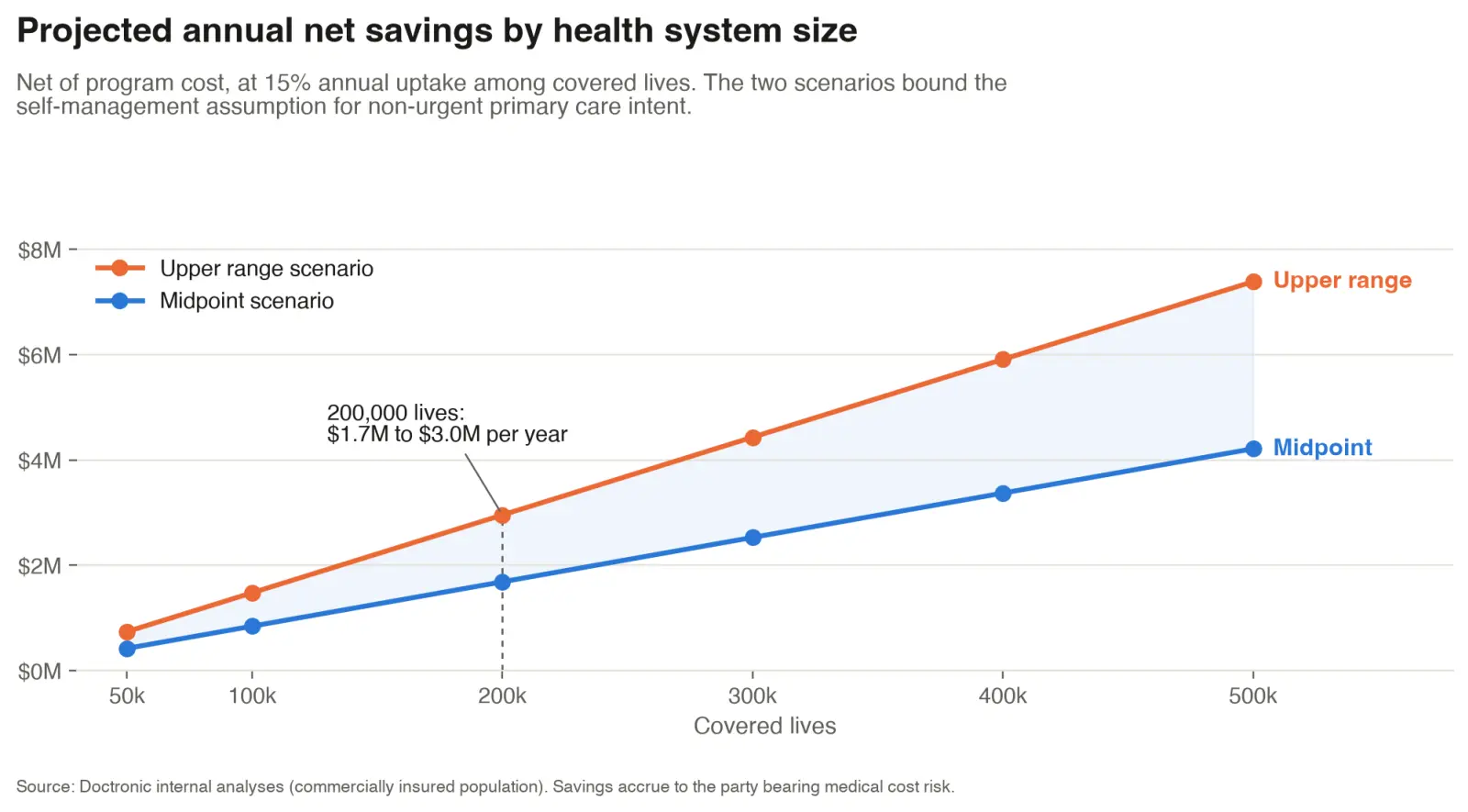
For a 200,000-life system at 15% annual uptake, the model projects $1.7 million to $3.0 million a year in net savings, from avoided unnecessary emergency care and lower-cost sites of care.

For a health system in value-based arrangements, the question about any new front door is not whether patients like it. It is what happens to total cost of care. We built a health economic model that helps us understand the impact of Doctronic, a consumer-facing AI virtual care platform, on that number. In this article we scale its projections to the size of a health system.
The model combines two kinds of evidence. Observed care pathways come from thousands of de-identified platform chats, including what care users said they would otherwise have sought, what the AI recommended, and how AI-assisted physician encounters resolved. Baseline utilization and costs come from a large national commercial claims dataset. The accounting is deliberately conservative. Every escalation the platform generates, including visits users never intended to make, is charged at full baseline cost, and all results are net of the program’s own cost.
For a system serving 200,000 commercially insured lives with 15% annual uptake, the model projects 30,000 chats and about 3,150 AI-assisted physician encounters per year, at a program cost near $123,000. Projected net savings are $1.7 million to $3.0 million per year, where the two scenarios bound how much inferred non-urgent primary care intent is reclassified to self-management. Under probabilistic analysis of the midpoint scenario, the 95% uncertainty interval runs from $0.9 million to $2.7 million, and net savings stayed positive in all 1,000 simulation draws. The scenario range and the interval answer different questions. The scenarios bound one structural assumption about self-management, while the interval reflects statistical uncertainty in the inputs within the midpoint scenario, which is why its lower bound sits below the scenario range.
The savings split into two streams. In the midpoint scenario, 48 cents of every gross dollar comes from avoided unnecessary emergency care, meaning ED visits and ambulance runs that observed user intent says would have happened without the platform. The other 52 cents comes from site-of-care substitution, where demand resolves in a chat or a low-cost AI-assisted physician encounter instead of an office visit. Alongside the dollars, the midpoint projection moves roughly 5,400 office visits and 860 ED visits per year out of higher-cost settings.
In scenarios for a 500,000-life system at the same uptake, projected net savings reach $4.2 million to $7.4 million per year. Uptake is the lever a system actually controls, and at 30% uptake the 200,000-life example rises to $3.4 million to $5.9 million.
It is worth being plain about scale. Spread across the membership, the projections work out to about $0.70 to $1.23 per member per month, a fraction of a percent of total medical spend. The right way to read these numbers is a meaningful return on a small program cost, alongside capacity and access effects that never show up in a claims feed.
Limitations and uncertainties
These are model projections from observed pathways and national claims, not measured post-deployment savings. The dollars accrue to whoever bears medical cost risk, so a system paid fee-for-service realizes the benefit as freed capacity rather than margin. Both are testable. The model runs on any population mix, and we are ready to parameterize it to a specific system’s covered lives and evaluate it prospectively.