doctronic
Doctronic performs level with the top published medical AI on an independent safety benchmark
On the public NoHarm benchmark, Doctronic configurations scored in the same range as the top published system, with a severe-mistake rate as low as 4.5%.

When a health system evaluates an AI clinical platform, the hardest question is also the simplest. How good is the medicine? Independent benchmarks are where that conversation should start. One of the most demanding public tests is NoHarm, part of the MAST suite published by ARISE, an independent group of clinicians and researchers. It is built from 100 real primary care to specialist eConsult cases, filtered from 16,399 candidates across 10 specialties, in which specialist physicians rated roughly 4,249 possible clinical actions for appropriateness and harm. A system is scored on the must-do actions it catches and the harmful actions it avoids, weighted by severity, alongside a severe-mistake rate that captures how often a plan contains an error specialists classified as severe.
We ran Doctronic’s clinical AI on the benchmark’s 330 public inputs (30 base cases, each tested in 11 phrasings), scored by the benchmark’s own automated judge, which our team validated by reproducing a published reference score to within 0.001. Doctronic model configurations scored between 0.887 and 0.901, in the same range as the top published system, AMBOSS LiSA, at 0.891. The confidence intervals overlap, and published leaderboard scores come from single runs where differences of a few hundredths are not reliably distinguishable, so we read this as comparable performance among the leading systems. The clearest difference shows up on safety. Severe-mistake rates for the Doctronic configurations ranged from 4.5% to 8.2%, and the 4.5% rate was the lowest of any system measured in this comparison, against 5.8% for the published leader and 11% to 16% for other widely used clinical AI tools, as published on the benchmark’s public leaderboard (open-30, unprompted, accessed September 2026).
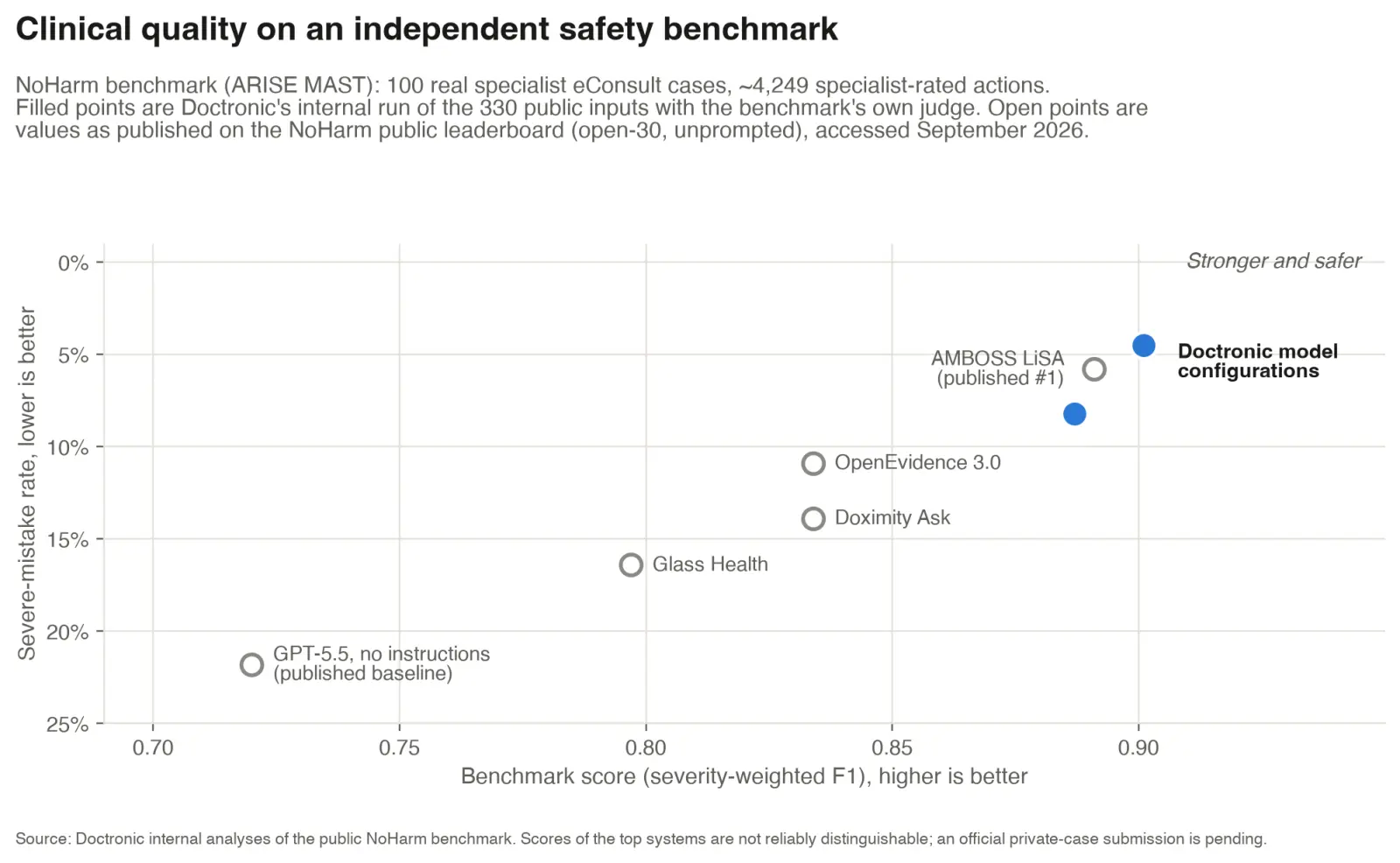
The baseline point in the figure matters most for a health system doing diligence. A raw frontier model with no clinical instructions scored 0.720 and made severe errors in 21.8% of cases, roughly 5 times as often as the strongest Doctronic configuration on the same cases. The distance between those points is the product. Clinical framing, curated guideline retrieval, and physician oversight engineered around the model are what move safety, and the severe-mistake rate is the number we would encourage every health system to ask any vendor for.
Limitations and uncertainties
This is an internal run, and an official submission on the benchmark’s 70 held-out private cases is pending. Only that settles a leaderboard position. The benchmark tests single-turn, English, outpatient cases that primary care physicians had already flagged as hard enough to escalate. It does not measure multi-turn dialogue, emergency care, or bedside manner, which we evaluate separately. Benchmarks complement monitoring of deployed care rather than replace it.
If your clinical team wants to go deeper, we will walk them through the full methodology, case-level results, and what we found about the benchmark’s own limits.